
[Paper Review] Real-time Detection of AI-Generated Speech for DeepFake Voice Conversion
The paper creates the DEEP-VOICE dataset of real and AI-generated speech, analyzes statistical audio features, and shows XGBoost achieves 99.3% accuracy with real-time 0.004 ms inference for 1-second audio intervals in detecting RVC-based voice conversion.
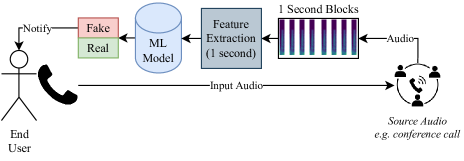
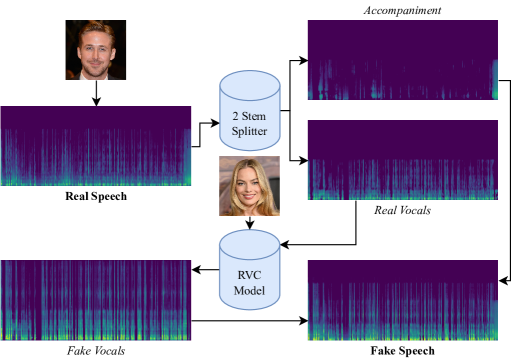
There are growing implications surrounding generative AI in the speech domain that enable voice cloning and real-time voice conversion from one individual to another. This technology poses a significant ethical threat and could lead to breaches of privacy and misrepresentation, thus there is an urgent need for real-time detection of AI-generated speech for DeepFake Voice Conversion. To address the above emerging issues, the DEEP-VOICE dataset is generated in this study, comprised of real human speech from eight well-known figures and their speech converted to one another using Retrieval-based Voice Conversion. Presenting as a binary classification problem of whether the speech is real or AI-generated, statistical analysis of temporal audio features through t-testing reveals that there are significantly different distributions. Hyperparameter optimisation is implemented for machine learning models to identify the source of speech. Following the training of 208 individual machine learning models over 10-fold cross validation, it is found that the Extreme Gradient Boosting model can achieve an average classification accuracy of 99.3% and can classify speech in real-time, at around 0.004 milliseconds given one second of speech. All data generated for this study is released publicly for future research on AI speech detection.
Motivation & Objective
- Motivate the need to detect AI-generated speech to prevent privacy breaches and misrepresentation in real-time communications.
- Develop an original dataset (DEEP-VOICE) comprising real and AI-generated speech from eight public figures using Retrieval-based Voice Conversion (RVC).
- Analyze statistical significance of audio features for distinguishing real vs AI-generated speech.
- Evaluate multiple machine learning models with hyperparameter optimization to enable real-time detection.
Proposed method
- Generate a DEEP-VOICE dataset with 62 minutes 22 seconds of real speech from eight individuals and AI-generated speech via Retrieval-based Voice Conversion.
- Extract 26 audio features per 1-second segment including chromagrams, MFCCs, spectral features, ZCR, and RMS.
- Balance data 1:1 by undersampling fake (AI-generated) samples to match real samples.
- Train and evaluate a suite of ML models (XGBoost, Random Forest, QDA, LDA, Ridge, Gaussian Naive Bayes, Bernoulli NB, KNN, SVM, SGD, Gaussian Process) with 10-fold cross-validation and seed 42.
- Hyperparameter optimize XGBoost (330 rounds found best), Random Forest (310 trees), KNN (1 neighbor optimal), and report inference times (0.004–0.057 ms per 1-second).
- Assess performance with metrics including accuracy, precision, recall, F1, MCC, ROC AUC.
Experimental results
Research questions
- RQ1Can real-time detection differentiate real human speech from AI-generated speech produced by Retrieval-based Voice Conversion?
- RQ2Which audio features most distinguish real vs AI-generated speech, and how do different ML models perform under real-time constraints?
- RQ3How do hyperparameters affect accuracy and inference time for real-time detection of DeepFake voice conversions?
- RQ4Is it feasible to deploy a real-time warning system during calls or conferencing to flag AI-generated speech?
Key findings
- XGBoost with 330 boosting rounds achieves 99.3% accuracy on 10-fold cross-validation (precision 0.995, recall 0.991, F1 0.993, MCC 0.986, ROC AUC 0.993).
- Inference time for 1-second audio with XGBoost is 0.004 ms on average.
- Random Forest with 310 trees achieves 98.89% accuracy (precision 0.995, recall 0.983, F1 0.989, MCC 0.978, ROC AUC 0.989) and 0.057 ms per 1-second.
- KNN (1 neighbor) attains 81.48% accuracy with 0.143 ms per 1-second, while QDA offers 94.8% accuracy with 0.002 ms inference.
- Overall, XGBoost and Random Forest show strong generalization across folds and enable real-time detection of RVC-based voice conversion.
Read this paper
Open the full text in the Nubint reader and ask about any passage as you read.
Read this paper on NubintThis review was generated by AI from the original paper. Please check the paper before citing it.