
[Paper Review] Real-time End-to-End Federated Learning: An Automotive Case Study
This paper proposes an asynchronous, real-time end-to-end Federated Learning framework for autonomous driving, using a sliding window and version-based aggregation to enable efficient, privacy-preserving model training on heterogeneous edge devices. It achieves 70% faster training and 60% lower bandwidth use than centralized learning, with prediction accuracy matching or exceeding synchronous Federated Learning and centralized methods.
With the development and the increasing interests in ML/DL fields, companies are eager to apply Machine Learning/Deep Learning approaches to increase service quality and customer experience. Federated Learning was implemented as an effective model training method for distributing and accelerating time-consuming model training while protecting user data privacy. However, common Federated Learning approaches, on the other hand, use a synchronous protocol to conduct model aggregation, which is inflexible and unable to adapt to rapidly changing environments and heterogeneous hardware settings in real-world scenarios. In this paper, we present an approach to real-time end-to-end Federated Learning combined with a novel asynchronous model aggregation protocol. Our method is validated in an industrial use case in the automotive domain, focusing on steering wheel angle prediction for autonomous driving. Our findings show that asynchronous Federated Learning can significantly improve the prediction performance of local edge models while maintaining the same level of accuracy as centralized machine learning. Furthermore, by using a sliding training window, the approach can minimize communication overhead, accelerate model training speed and consume real-time streaming data, proving high efficiency when deploying ML/DL components to heterogeneous real-world embedded systems.
Motivation & Objective
- To address the inflexibility of synchronous Federated Learning in real-world, heterogeneous edge environments, especially in automotive systems with variable device capabilities and network conditions.
- To enable real-time, end-to-end training of machine learning models on streaming data from edge devices without centralizing raw data, preserving privacy.
- To improve training efficiency and scalability by replacing synchronous aggregation with an asynchronous protocol that adapts to device heterogeneity and dynamic workloads.
- To validate the approach in a real-world automotive use case—steering wheel angle prediction—demonstrating performance parity with centralized learning and superiority over synchronous FL.
- To reduce communication overhead and training time in distributed edge learning by employing a sliding window mechanism for streaming data processing.
Proposed method
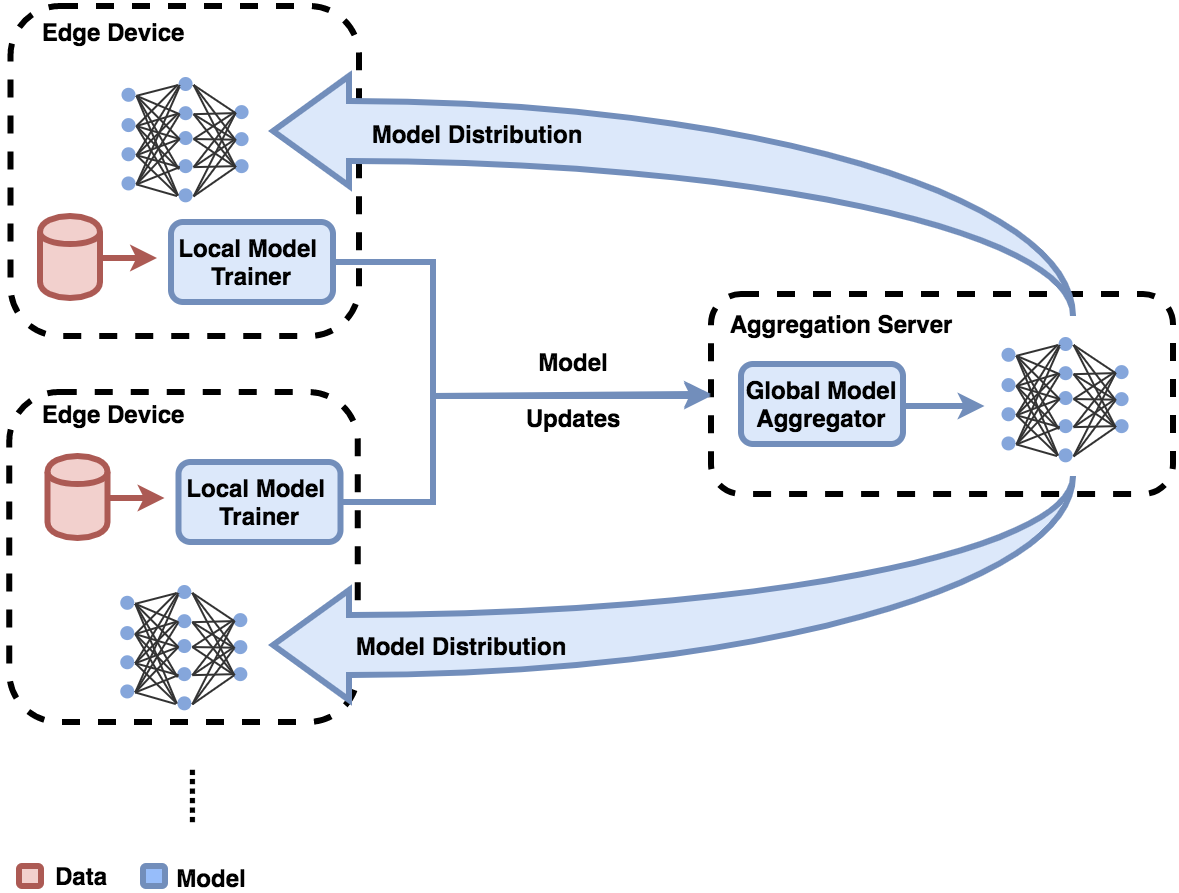
- The method employs a version-based asynchronous model aggregation protocol, allowing the server to accept updates from edge devices as they arrive, without waiting for all devices.
- A sliding window mechanism is used to process real-time streaming data, minimizing storage needs and enabling continuous model training.
- A two-stream 3D-CNN model is trained end-to-end to predict steering wheel angles directly from video input, leveraging temporal and spatial features.
- The system uses a hybrid training setup: edge vehicles with GPUs (V100 and T4) train locally, while the server aggregates models asynchronously based on versioned updates.
- The aggregation protocol is bounded by lower and upper frequency thresholds (a_l and a_u) to control update frequency and reduce communication overhead.
- Model updates are transmitted as compressed weight vectors, reducing bandwidth costs compared to full model transfers.
Experimental results
Research questions
- RQ1Can asynchronous Federated Learning with real-time streaming data achieve comparable or better prediction accuracy than centralized learning in autonomous driving?
- RQ2How does the proposed asynchronous aggregation protocol perform in terms of training speed and communication efficiency compared to synchronous Federated Learning and centralized training?
- RQ3To what extent does the sliding window mechanism reduce storage and communication overhead in edge-based model training?
- RQ4How does the system handle device heterogeneity and variable network conditions in real-world automotive deployments?
- RQ5What is the impact of the version-based aggregation protocol on convergence speed and model performance in a distributed, real-time setting?
Key findings
- Asynchronous Federated Learning reduced total training time by approximately 70% compared to centralized learning, achieving convergence 70% faster than baseline models.
- The method reduced bandwidth consumption by approximately 60% compared to centralized learning, with only 0.78 GB transferred across four vehicles.
- The asynchronous approach achieved a regression error of 0.2–0.4 lower than synchronous Federated Learning, indicating superior prediction performance.
- Model accuracy matched or exceeded that of centralized learning and synchronous Federated Learning, demonstrating parity in performance despite distributed training.
- The sliding window mechanism enabled efficient processing of real-time streaming data without requiring large-scale data storage on individual edge devices.
- The system outperformed both synchronous Federated Learning and local independent training in terms of training efficiency and convergence speed.

Read this paper
Open the full text in the Nubint reader and ask about any passage as you read.
Read this paper on NubintThis review was generated by AI from the original paper. Please check the paper before citing it.