
[Paper Review] Real-time Photorealistic Dynamic Scene Representation and Rendering with 4D Gaussian Splatting
The paper introduces a 4D Gaussian Splatting (4DGS) representation for dynamic scenes, achieving end-to-end trainable, real-time, photorealistic rendering of high-resolution dynamic views by modeling spatiotemporal 4D Gaussians and time-evolving appearance with 4D spherindrical harmonics.
Reconstructing dynamic 3D scenes from 2D images and generating diverse views over time is challenging due to scene complexity and temporal dynamics. Despite advancements in neural implicit models, limitations persist: (i) Inadequate Scene Structure: Existing methods struggle to reveal the spatial and temporal structure of dynamic scenes from directly learning the complex 6D plenoptic function. (ii) Scaling Deformation Modeling: Explicitly modeling scene element deformation becomes impractical for complex dynamics. To address these issues, we consider the spacetime as an entirety and propose to approximate the underlying spatio-temporal 4D volume of a dynamic scene by optimizing a collection of 4D primitives, with explicit geometry and appearance modeling. Learning to optimize the 4D primitives enables us to synthesize novel views at any desired time with our tailored rendering routine. Our model is conceptually simple, consisting of a 4D Gaussian parameterized by anisotropic ellipses that can rotate arbitrarily in space and time, as well as view-dependent and time-evolved appearance represented by the coefficient of 4D spherindrical harmonics. This approach offers simplicity, flexibility for variable-length video and end-to-end training, and efficient real-time rendering, making it suitable for capturing complex dynamic scene motions. Experiments across various benchmarks, including monocular and multi-view scenarios, demonstrate our 4DGS model's superior visual quality and efficiency.
Motivation & Objective
- Motivate real-time, photorealistic rendering of dynamic scenes from 2D images by capturing spatio-temporal structure in a unified 4D volume.
- Propose a 4D Gaussian primitive with explicit geometry and appearance for dynamic scenes, enabling end-to-end training and real-time rendering.
- Introduce a time-evolving appearance model via 4D spherindrical harmonics to capture view-dependent color changes over time.
- Demonstrate superior visual quality and efficiency on diverse real and synthetic dynamic datasets compared to prior methods.
Proposed method
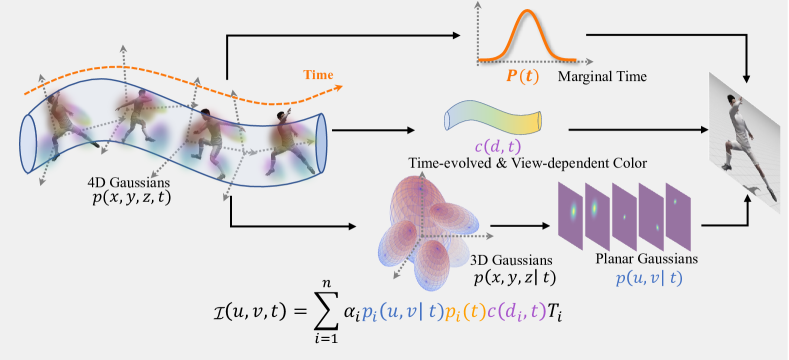
- Represent dynamic scenes as a collection of 4D Gaussians with mean, spatial-temporal covariance, and time-evolving color.
- Parameterize the 4D covariance as Sigma = R S S^T R^T with 4D rotation R (via left and right isotropic rotations) and diagonal scaling S for space and time.
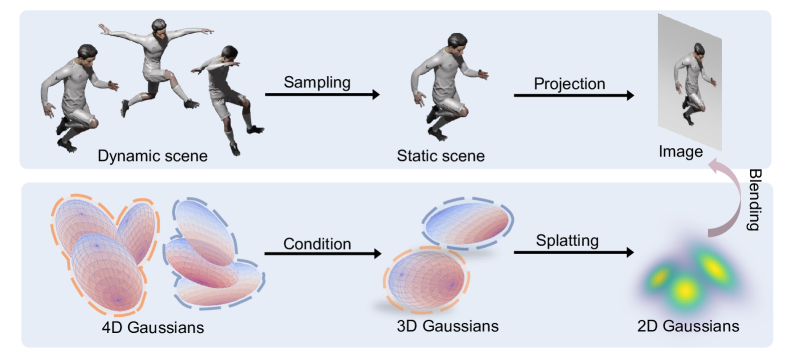
- Derive a conditional 3D Gaussian p(xyz|t) and marginal p(t) to render a 2D splat per Gaussian when projecting to the image plane, integrating over time.
- Model time and space jointly by treating (x,y,z) and t as components of a cohesive 4D Gaussian, enabling end-to-end optimization and radiance-splat rendering.
- Represent view-dependent color with 4D spherindrical harmonics (4DSH) to capture time-evolving appearance dependent on viewpoint and time.
- Train end-to-end with a rendering loss, using time-sampled batches to reduce temporal flicker and employing densification and density control in spacetime.
Experimental results
Research questions
- RQ1Can a unified 4D Gaussian primitive capture the spatiotemporal structure of dynamic scenes for photorealistic, real-time view synthesis?
- RQ2Does a 4D rotation and 4D SH-based appearance model improve dynamic scene rendering quality over 3D-based or time-segregated representations?
- RQ3Is end-to-end training with a 4D Gaussian rasterization pipeline capable of real-time rendering across monocular and multi-view dynamic datasets?
Key findings
- 4D Gaussian primitives with 4D rotations effectively model dynamic scenes and enable real-time, high-fidelity rendering.
- The 4D Spherindrical Harmonics (4DSH) capture time-evolving, view-dependent appearance leading to improved visual quality.
- On Plenoptic Video and D-NeRF datasets, 4DGS achieves superior PSNR, SSIM/DPSSIM-like metrics and LPIPS with real-time FPS compared to prior methods.
- Ablation shows that jointly modeling space-time with 4D rotations and time-coupled appearance is superior to temporally independent extensions.
- The approach supports end-to-end training over entire videos, rather than frame-by-frame optimization, enabling scalable dynamic scene synthesis.
Read this paper
Open the full text in the Nubint reader and ask about any passage as you read.
Read this paper on NubintThis review was generated by AI from the original paper. Please check the paper before citing it.