
[Paper Review] Real-time Trust Prediction in Conditionally Automated Driving Using Physiological Measures
This study proposes a real-time trust prediction system for conditionally automated vehicles using physiological measures and machine learning. By analyzing galvanic skin response (GSR), heart rate variability (HRV), and eye-tracking data during simulated takeover scenarios, the XGBoost model achieved an 89.1% F1-score in dynamically predicting driver trust, outperforming other models and offering a foundation for in-vehicle trust calibration systems.
Trust calibration presents a main challenge during the interaction between drivers and automated vehicles (AVs). In order to calibrate trust, it is important to measure drivers' trust in real time. One possible method is through modeling its dynamic changes using machine learning models and physiological measures. In this paper, we proposed a technique based on machine learning models to predict drivers' dynamic trust in conditional AVs using physiological measurements in real time. We conducted the study in a driving simulator where participants were requested to take over control from automated driving in three conditions that included a control condition, a false alarm condition, a miss condition with eight takeover requests (TORs) in different scenarios. Drivers' physiological measures were recorded during the experiment, including galvanic skin response (GSR), heart rate (HR) indices, and eye-tracking metrics. Using five machine learning models, we found that eXtreme Gradient Boosting (XGBoost) performed the best and was able to predict drivers' trust in real time with an f1-score of 89.1%. Our findings provide good implications on how to design an in-vehicle trust monitoring system to calibrate drivers' trust to facilitate interaction between the driver and the AV in real time.
Motivation & Objective
- To develop a real-time method for predicting dynamic trust in conditionally automated vehicles using physiological signals.
- To evaluate the effectiveness of machine learning models in predicting trust based on physiological and behavioral measures during takeover scenarios.
- To identify the most predictive physiological features for trust estimation in automated driving contexts.
- To inform the design of in-vehicle trust calibration systems that enhance driver-AV interaction and safety.
Proposed method
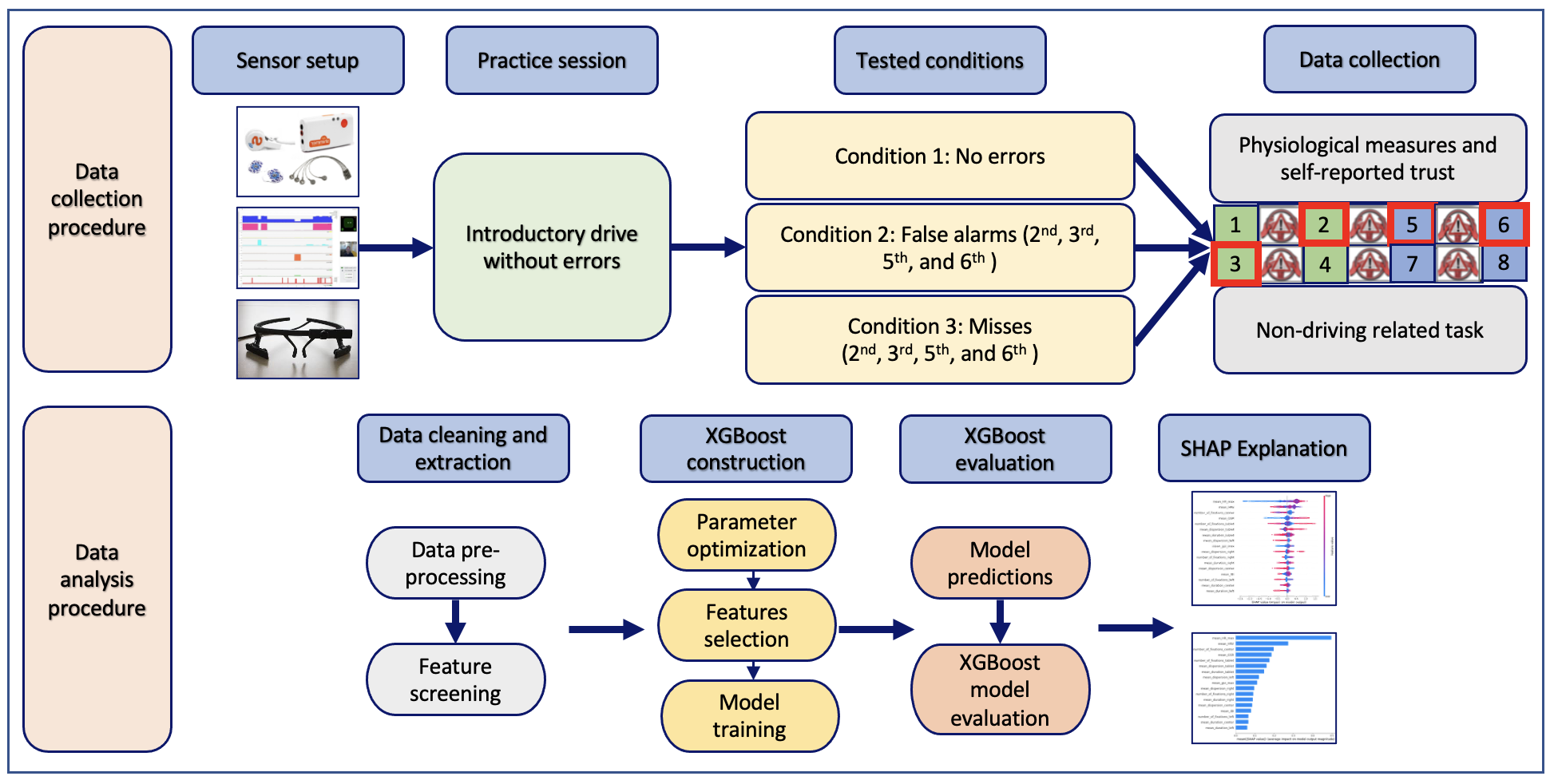
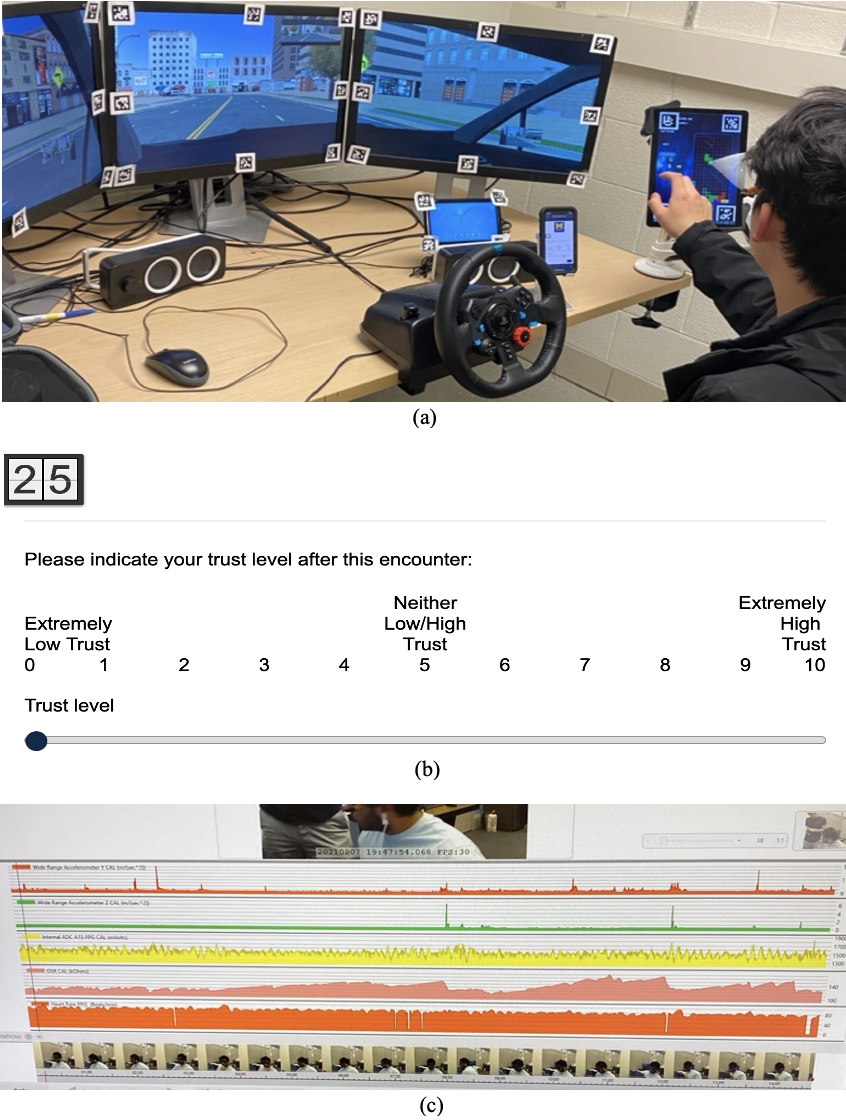
- Conducted a driving simulator study with 59 participants across three conditions: control, false alarm, and miss scenarios involving eight takeover requests (TORs).
- Collected physiological data including galvanic skin response (GSR), heart rate (HR) indices, and eye-tracking metrics such as fixation count and duration on the central display and tablet.
- Preprocessed and extracted features from physiological and eye-tracking data, including mean_GSR, mean_HRV, number_of_fixations_center, and mean_duration_tablet.
- Trained five machine learning models—XGBoost, Random Forest, Logistic Regression, SVM, and Naive Bayes—on labeled trust states derived from behavioral and physiological patterns.
- Used a time-windowed approach to enable real-time prediction of trust levels during dynamic driving interactions.
- Selected XGBoost as the optimal model based on F1-score and feature importance analysis.
Experimental results
Research questions
- RQ1Can physiological measures reliably predict dynamic trust in conditionally automated driving in real time?
- RQ2How do different system malfunctions—false alarms and misses—affect trust dynamics and physiological responses?
- RQ3Which machine learning model performs best in predicting trust using real-time physiological data?
- RQ4Which specific physiological and eye-tracking features are most predictive of driver trust?
Key findings
- The XGBoost model achieved the highest performance with an F1-score of 89.1% in real-time trust prediction, outperforming other models.
- The model achieved an accuracy of 81.6% in classifying trust states across control, false alarm, and miss conditions.
- The most predictive features were mean_HR_max, mean_HRV, number_of_fixations_center, mean_GSR, number_of_fixations_tablet, mean_dispersion_tablet, and mean_duration_tablet.
- Higher mean_HRV was associated with increased alertness and better cognitive readiness, particularly in low-trust conditions such as misses.
- Higher mean_GSR was linked to higher trust, possibly due to increased arousal during engaging control conditions, contradicting some prior findings.
- Eye-tracking features such as fixation count and duration on the central display and tablet were significant predictors, indicating attentional engagement with system interfaces.
Better researchstarts right now
From reading papers to final review, dramatically reduce your research time.
No credit card · Free plan available
This review was created by AI and reviewed by human editors.