
[Paper Review] Real-Time User-Guided Image Colorization with Learned Deep Priors
This paper proposes a real-time, deep learning-based method for user-guided image colorization using a convolutional neural network (CNN) that maps grayscale images and sparse user hints to full color outputs. Trained on a million synthetic user inputs, the model leverages learned deep priors for realistic, diverse colorizations with minimal user input, achieving high-quality results in under a minute while supporting global histogram transfer for artistic control.
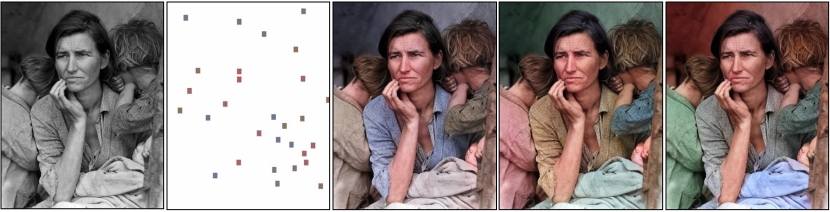
We propose a deep learning approach for user-guided image colorization. The system directly maps a grayscale image, along with sparse, local user "hints" to an output colorization with a Convolutional Neural Network (CNN). Rather than using hand-defined rules, the network propagates user edits by fusing low-level cues along with high-level semantic information, learned from large-scale data. We train on a million images, with simulated user inputs. To guide the user towards efficient input selection, the system recommends likely colors based on the input image and current user inputs. The colorization is performed in a single feed-forward pass, enabling real-time use. Even with randomly simulated user inputs, we show that the proposed system helps novice users quickly create realistic colorizations, and offers large improvements in colorization quality with just a minute of use. In addition, we demonstrate that the framework can incorporate other user "hints" to the desired colorization, showing an application to color histogram transfer. Our code and models are available at https://richzhang.github.io/ideepcolor.
Motivation & Objective
- To develop a real-time, deep learning system for interactive image colorization that reduces reliance on extensive user input.
- To learn user-edit propagation from large-scale data instead of hand-crafted priors or optimization frameworks.
- To guide users toward effective input by suggesting likely colors based on image context and current hints.
- To enable flexible colorization by incorporating additional hints, such as global color histograms, for artistic control.
- To demonstrate that minimal user interaction (under a minute) can produce high-quality, realistic colorizations.
Proposed method
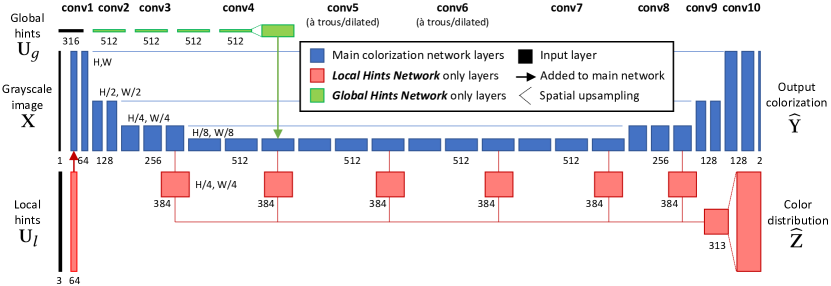
- A deep CNN is trained to directly predict a full color image from a grayscale input and sparse user-provided color hints.
- Training data is synthesized by randomly sampling user hints on real color images, preserving ground-truth color distributions.
- The network learns to propagate user edits by fusing low-level image cues with high-level semantic information from large-scale data.
- A data-driven color palette is integrated into the interface to recommend plausible colors at each user input location.
- The system supports global histogram transfer by conditioning the network on reference image color statistics, enabling artistic colorization.
- The model performs inference in a single feed-forward pass, enabling real-time performance on standard hardware.
Experimental results
Research questions
- RQ1Can a deep neural network learn to propagate sparse user color hints effectively without hand-designed priors?
- RQ2Can learned deep priors from large-scale data improve colorization quality and realism compared to traditional optimization-based methods?
- RQ3How effective is the system with minimal user input, and can it guide users toward optimal hints?
- RQ4Can the framework be extended to incorporate global color statistics for artistic or stylized colorization?
- RQ5How does the system handle ambiguous color regions or complex segmentation boundaries?
Key findings
- The model achieves a PSNR of 28.57 dB when combined with global histogram transfer, significantly outperforming baseline methods.
- With only a minute of user interaction, the system enables novice users to produce realistic and diverse colorizations.
- The system generalizes well to legacy grayscale photographs, producing plausible colorizations without fine-tuning.
- The network successfully transfers global color histograms from reference images to target grayscale images, producing diverse and realistic results.
- The system can handle ambiguous regions by creating smooth, context-aware transitions between different user-provided colors.
- The interface's real-time performance enables interactive exploration of multiple plausible colorizations in seconds.
Read this paper
Open the full text in the Nubint reader and ask about any passage as you read.
Read this paper on NubintThis review was generated by AI from the original paper. Please check the paper before citing it.