
[Paper Review] RealmDreamer: Text-Driven 3D Scene Generation with Inpainting and Depth Diffusion
RealmDreamer generates forward-facing 3D scenes from text by initializing a 3D Gaussian Splatting model with 2D diffusion priors, inpainting, and depth diffusion, producing high-fidelity geometry and parallax without multi-view data.
We introduce RealmDreamer, a technique for generating forward-facing 3D scenes from text descriptions. Our method optimizes a 3D Gaussian Splatting representation to match complex text prompts using pretrained diffusion models. Our key insight is to leverage 2D inpainting diffusion models conditioned on an initial scene estimate to provide low variance supervision for unknown regions during 3D distillation. In conjunction, we imbue high-fidelity geometry with geometric distillation from a depth diffusion model, conditioned on samples from the inpainting model. We find that the initialization of the optimization is crucial, and provide a principled methodology for doing so. Notably, our technique doesn't require video or multi-view data and can synthesize various high-quality 3D scenes in different styles with complex layouts. Further, the generality of our method allows 3D synthesis from a single image. As measured by a comprehensive user study, our method outperforms all existing approaches, preferred by 88-95%. Project Page: https://realmdreamer.github.io/
Motivation & Objective
- Demonstrate text-to-3D scene synthesis at scene scale using 3D Gaussian splatting.
- Leverage 2D diffusion priors for robust initialization and multi-view consistency.
- Incorporate inpainting and depth diffusion priors to fill disoccluded regions and improve geometry.
- Provide a finetuning stage with sharpening and opacity regularization to enhance detail.
Proposed method
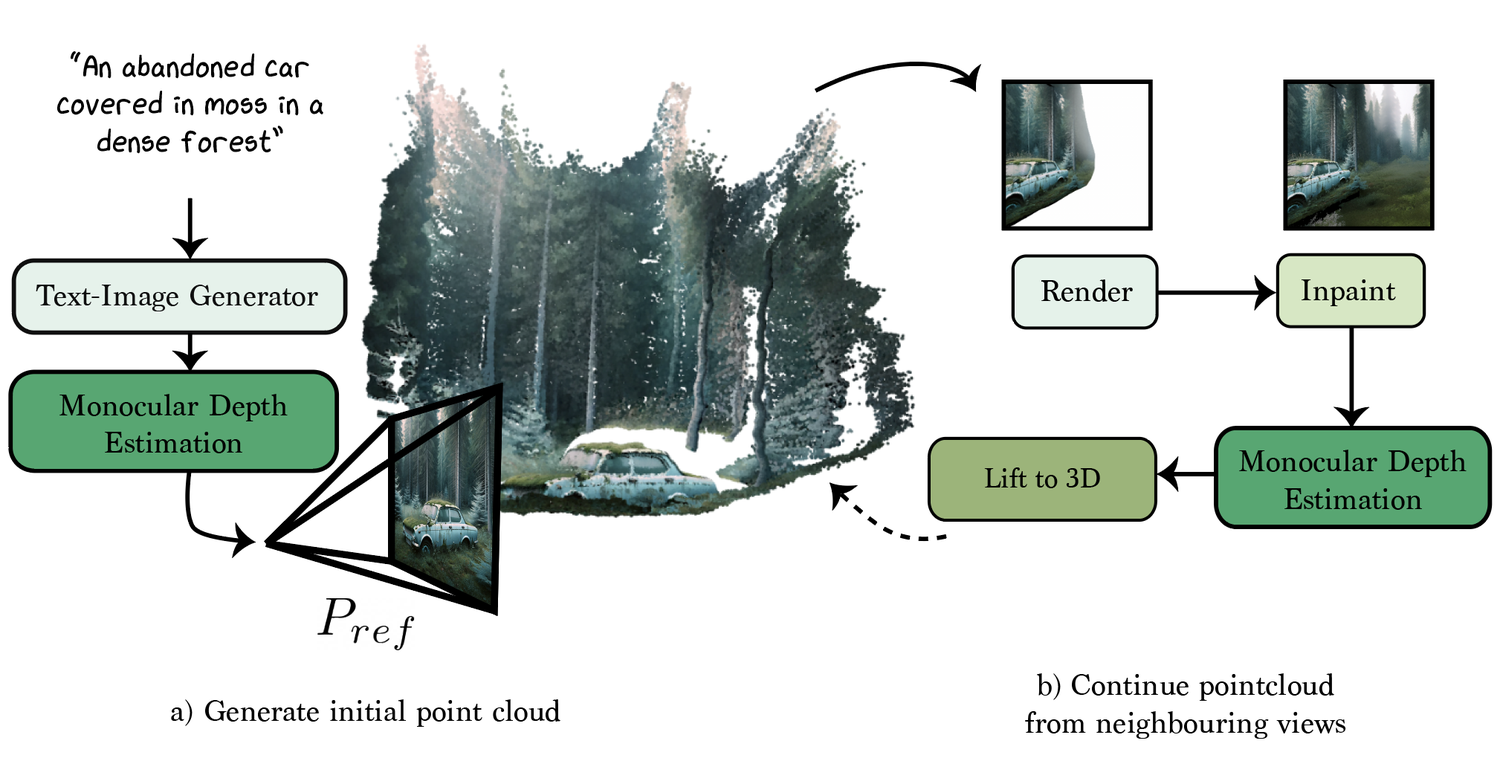
- Initialize a scene-level 3D Gaussian Splatting representation from a text prompt using 2D diffusion priors and monocular depth; compute an occlusion volume and combine with the point cloud.
- Treat scene completion as an inpainting problem using a 2D inpainting diffusion model with conditioning on text, image, and occlusion masks; optimize with a combined latent and image-space loss plus perceptual and anchor terms.
- Distill depth information from an image-conditional depth diffusion model by using clean inpainted samples as conditioning, and optimize a depth loss based on Pearson correlation.
- Perform a finetuning stage with a personalized text-to-image diffusion model to sharpen details, plus an opacity regularization to encourage binary opacity, and a sharpening filter on samples to improve final render quality.
- Implementations rely on PyTorch3D, NeRFStudio, Stable Diffusion 2.0, Marigold depth estimation, and DepthAnything scaling for absolute depth.
Experimental results
Research questions
- RQ1How can 3D scene-level generation be achieved from text prompts without video or multi-view data?
- RQ2Can 2D diffusion priors (inpainting and depth) be distilled into a 3D Gaussian Splatting representation to produce coherent geometry across views?
- RQ3What is the impact of a robust initialization and subsequent inpainting/depth distillation on scene fidelity and parallax realism?
- RQ4Does a finetuning and sharpening stage improve detail while preserving alignment to the text prompt?
- RQ5Can single-image to 3D generation be extended effectively using the proposed pipeline?
Key findings
- RealmDreamer achieves state-of-the-art qualitative results for text-based 3D scene generation with parallax and high-fidelity geometry.
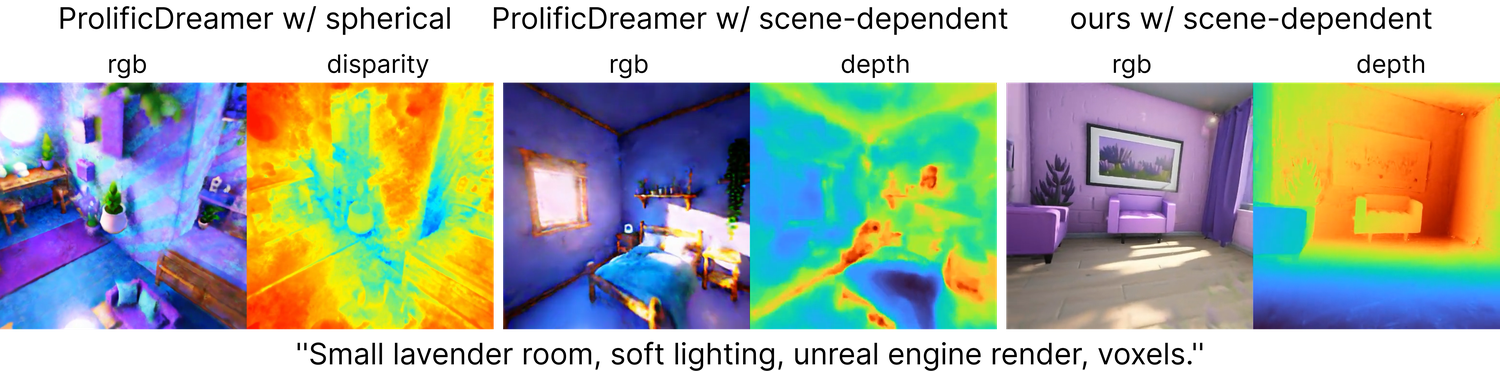
- Compared to baselines, it produces more coherent geometry and crisper renders, with fewer artifacts such as cloudiness or oversaturation.
- A CLIP-based evaluation shows higher alignment to the prompt for RealmDreamer than Text2Room, DreamFusion, and ProlificDreamer on a per-scene basis.
- Ablation studies confirm the importance of inpainting diffusion, depth priors, robust initialization, and sharpening for final quality.
- The method can also generate 3D scenes from a single image when paired with a captioned prompt.
Read this paper
Open the full text in the Nubint reader and ask about any passage as you read.
Read this paper on NubintThis review was generated by AI from the original paper. Please check the paper before citing it.