
[Paper Review] Reasoning before Comparison: LLM-Enhanced Semantic Similarity Metrics for Domain Specialized Text Analysis
The paper uses GPT-4 to generate clinically meaningful labels for radiology reports and measures semantic similarity with embeddings, outperforming traditional lexical metrics (ROUGE/BLEU) against ground truth.
In this study, we leverage LLM to enhance the semantic analysis and develop similarity metrics for texts, addressing the limitations of traditional unsupervised NLP metrics like ROUGE and BLEU. We develop a framework where LLMs such as GPT-4 are employed for zero-shot text identification and label generation for radiology reports, where the labels are then used as measurements for text similarity. By testing the proposed framework on the MIMIC data, we find that GPT-4 generated labels can significantly improve the semantic similarity assessment, with scores more closely aligned with clinical ground truth than traditional NLP metrics. Our work demonstrates the possibility of conducting semantic analysis of the text data using semi-quantitative reasoning results by the LLMs for highly specialized domains. While the framework is implemented for radiology report similarity analysis, its concept can be extended to other specialized domains as well.
Motivation & Objective
- Motivate and address limitations of lexical similarity metrics (ROUGE/BLEU) in medical text analysis.
- Propose a framework where GPT-4 generates task-based labels to semantically compare radiology reports.
- Incorporate human-in-the-loop concepts to improve label interpretability and clinical relevance.
- Evaluate semantic-label-based similarity against ground-truth CheXpert/NegBio annotations on MIMIC-CXR.
Proposed method
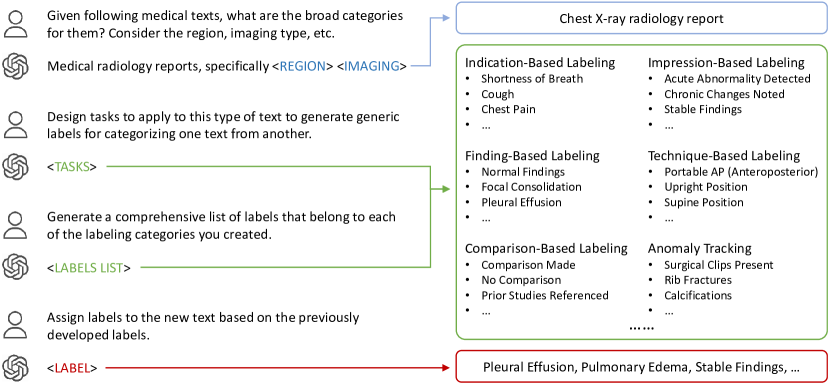
- Use GPT-4 for zero-shot text identification of radiology reports.
- Have GPT-4 generate tasks and generic labels from reports for semantic categorization.
- Create labels with human-in-the-loop review to ensure clinical relevance.
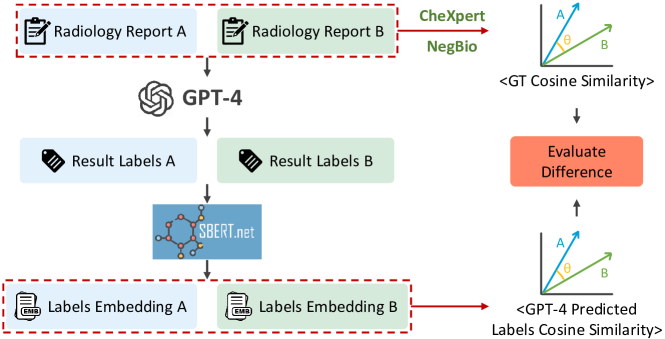
- Embed the GPT-4-generated labels with all-mpnet-base-v2 to compute semantic similarities via cosine similarity.
- Compare GPT-4 label-based similarities to CheXpert/NegBio ground truth and to traditional ROUGE/BLEU metrics across 62,500 report-pair comparisons.
Experimental results
Research questions
- RQ1Can GPT-4 generate clinically meaningful labels that semantically align radiology reports with ground truth findings?
- RQ2Do GPT-4 generated labels', semantic similarities correlate more closely with ground truth than traditional lexical metrics?
- RQ3What is the relative performance of semantic-label similarity versus ROUGE/BLEU in domain-specific medical text analysis?
Key findings
- GPT-4 generated similarities (GPT_sim) align more closely with ground truth than ROUGE and BLEU metrics.
- GPT_sim mean similarity scores toward CheXpert/NegBio: 0.1768 and 0.1793 respectively.
- ROUGE-1_F1, ROUGE-2_F1, ROUGE-L_F1 scores range from 0.3654 to 0.5827 across the GT comparisons.
- BLEU scores are around 0.6 but show larger deviation from ground truth than GPT_sim.
- Ground-truth-based evaluation used 62,500 report-pair comparisons derived from MIMIC-CXR and CheXpert/NegBio labels.
- The methodology demonstrates superior semantic capture of medical texts compared to traditional lexical metrics.
Read this paper
Open the full text in the Nubint reader and ask about any passage as you read.
Read this paper on NubintThis review was generated by AI from the original paper. Please check the paper before citing it.