
[Paper Review] REBELS-IFU: Dust Build-up in Massive Galaxies at Redshift 7
This paper analyzes dust, gas, and metal content in 12 REBELS galaxies at z~6.5–7.7 using JWST/NIRSpec metallicities and ALMA dust and gas measurements to constrain dust-to-gas, dust-to-metal, and dust-to-stellar mass relations in the early Universe.
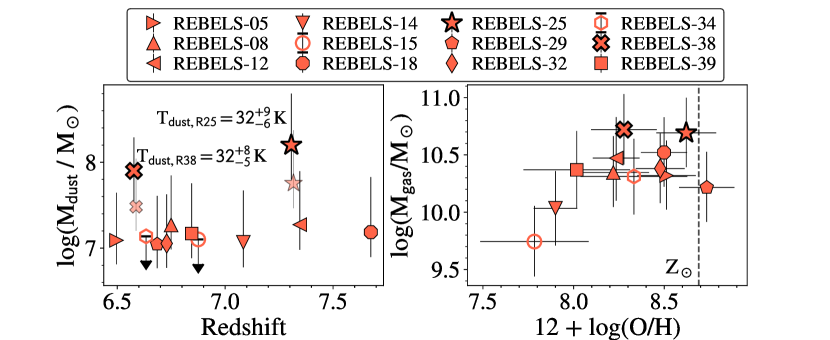
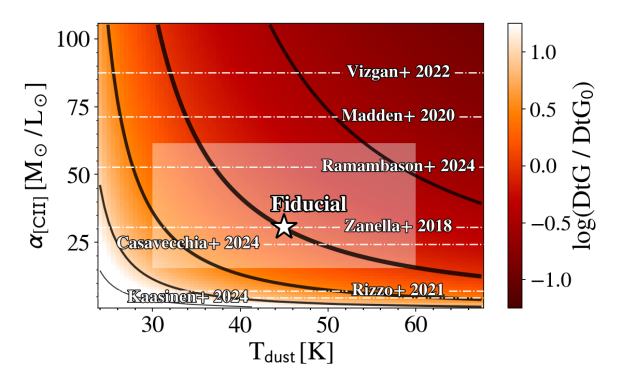
In recent years, observations with the JWST have started to map out the rapid metal enrichment of the early Universe, while (sub)millimeter observations have simultaneously begun to reveal the ubiquity of dust beyond $z\gtrsim6$. However, the pathways that led to the assembly of early dust reservoirs remain poorly quantified, and require pushing our understanding of key scaling relations between dust, gas and metals into the early Universe. We investigate the dust build-up in twelve $6.5 \lesssim z \lesssim 7.7$ galaxies drawn from the REBELS survey that benefit from (i) JWST/NIRSpec strong-line metallicity measurements, (ii) ALMA [CII]-based redshifts and gas masses, and (iii) dust masses from single- or multi-band ALMA continuum observations. Combining these measurements, we investigate the dust-to-gas (DtG), dust-to-metal (DtM), and dust-to-stellar mass (DtS) ratios of our sample as a function of metallicity. While our analysis is limited by systematic uncertainties related to the [CII]-to-H$_2$ conversion factor and dust temperature, we explore a wide range of possible values, and carefully assess their impact on our results. Under a fiducial set of assumptions, we find an average $\log(\mathrm{DtG}) = -3.02 \pm 0.23$, only slightly below that of local metal-rich galaxies. On the other hand, at fixed metallicity our average $\log(\mathrm{DtS}) = -2.15 \pm 0.42$ is significantly larger than that of low-redshift galaxies. Finally, through a comparison to various theoretical models of high-redshift dust production, we find that assembling the dust reservoirs in massive galaxies at $z\approx7$ likely requires the combination of rapid supernova enrichment and efficient ISM dust growth.
Motivation & Objective
- Quantify dust, gas, and metal contents of massive galaxies at z>6 using joint JWST/NIRSpec and ALMA data.
- Examine scaling relations between dust-to-gas, dust-to-metal, and dust-to-stellar mass as a function of metallicity.
- Assess the roles of SN enrichment and ISM dust growth in producing early dust reservoirs.
- Evaluate systematic uncertainties, including the [C II]-to-H2 conversion and dust temperature, across plausible parameter ranges.
Proposed method
- Combine ALMA [C II]-based gas masses with dust masses from continuum observations to derive DtG, DtM, and DtS ratios.
- Use Zanella et al. (2018) [C II]-to-H2 calibration to infer molecular gas masses from [C II] luminosities.
- Adopt metallicities from JWST/NIRSpec strong-line diagnostics (R23, O32, R3 where applicable) and cross-check with alternative calibrations.
- Compute dust-to-gas, dust-to-metal, and dust-to-stellar mass ratios under a fiducial set of assumptions; explore a wide range of dust temperatures and other uncertain parameters.
- Assume molecular gas as the dominant gas component in the early galaxies (negligible HI) and examine implications for dust growth models.
Experimental results
Research questions
- RQ1What are the observed DtG, DtM, and DtS ratios in z~6.5–7.7 galaxies, and how do they scale with gas-phase metallicity?
- RQ2Can rapid SN enrichment and ISM dust growth together explain the inferred dust reservoirs in massive early galaxies?
- RQ3How do assumptions about [C II]-to-H2 conversion, dust temperature, and dust properties affect the inferred dust scaling relations?
- RQ4Do the observed dust and metal contents favor certain theoretical models of high-redshift dust production over others?
Key findings
- Average DtG is log(DtG) ≈ -3.02 with ≈0.23 dex scatter, slightly below local metal-rich galaxies.
- Average DtS at fixed metallicity is log(DtS) ≈ -2.15 with ≈0.42 dex scatter, higher than typical low-redshift galaxies.
- DtM and DtS relationships suggest substantial dust mass relative to metal content in these z~7 systems, implying efficient dust processing.
- Results remain sensitive to [C II]-to-H2 conversion and assumed dust temperatures; a broad parameter exploration is conducted to quantify impacts.
- Comparisons with theoretical models indicate a combination of rapid SN enrichment and efficient ISM dust growth is needed to build the observed dust reservoirs by z~7.
Read this paper
Open the full text in the Nubint reader and ask about any passage as you read.
Read this paper on NubintThis review was generated by AI from the original paper. Please check the paper before citing it.