
[Paper Review] Recent Advances in Deep Learning Based Dialogue Systems: A Systematic Survey
A comprehensive survey of deep learning-based dialogue systems, analyzing models by type and system category, and covering evaluation methods and datasets with insights into future trends.
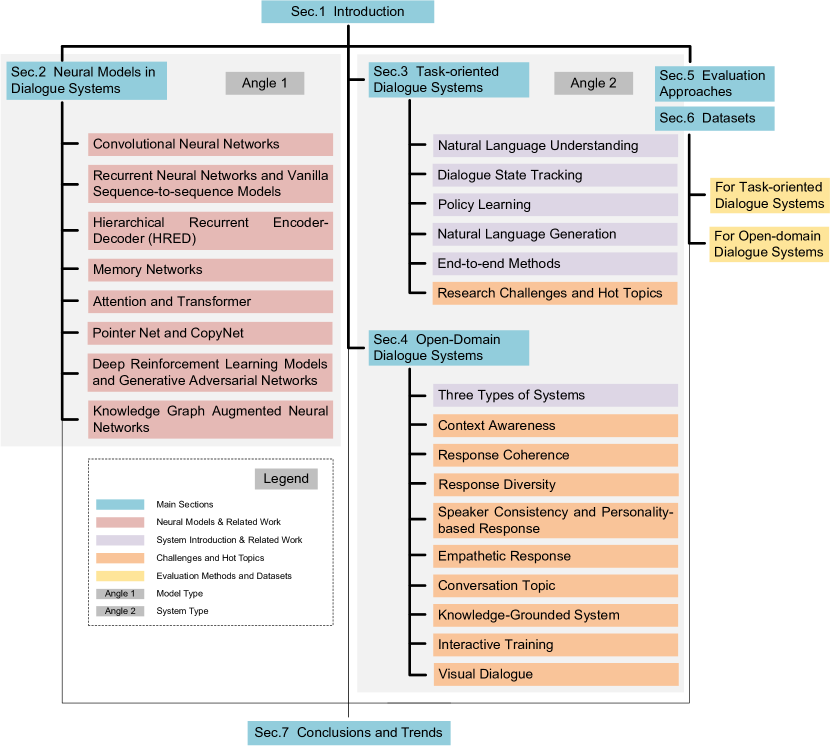
Dialogue systems are a popular natural language processing (NLP) task as it is promising in real-life applications. It is also a complicated task since many NLP tasks deserving study are involved. As a result, a multitude of novel works on this task are carried out, and most of them are deep learning based due to the outstanding performance. In this survey, we mainly focus on the deep learning based dialogue systems. We comprehensively review state-of-the-art research outcomes in dialogue systems and analyze them from two angles: model type and system type. Specifically, from the angle of model type, we discuss the principles, characteristics, and applications of different models that are widely used in dialogue systems. This will help researchers acquaint these models and see how they are applied in state-of-the-art frameworks, which is rather helpful when designing a new dialogue system. From the angle of system type, we discuss task-oriented and open-domain dialogue systems as two streams of research, providing insight into the hot topics related. Furthermore, we comprehensively review the evaluation methods and datasets for dialogue systems to pave the way for future research. Finally, some possible research trends are identified based on the recent research outcomes. To the best of our knowledge, this survey is the most comprehensive and up-to-date one at present for deep learning based dialogue systems, extensively covering the popular techniques. We speculate that this work is a good starting point for academics who are new to the dialogue systems or those who want to quickly grasp up-to-date techniques in this area.
Motivation & Objective
- Review state-of-the-art deep learning approaches in dialogue systems.
- Analyze dialogue models from model-type and system-type perspectives.
- Survey evaluation methods and datasets used in dialogue system research.
- Identify emerging research trends and potential directions in the field.
Proposed method
- Surveyed neural architectures (CNNs, RNNs, seq2seq, HRED, memory networks, attention, Transformer, GANs, KG-augmented nets).
- Discussed traditional vs end-to-end task-oriented dialogue systems and open-domain dialogue systems.
- Reviewed evaluation metrics and datasets for dialogue systems.
- Integrated related dialogue tasks and cross-domain connections to contextualize current methods.
- Identified hot topics and potential future directions such as domain adaptation, efficiency, controllable generation, and multimodal/dialogue-grounded setups.
Experimental results
Research questions
- RQ1What are the dominant deep learning models currently used in task-oriented and open-domain dialogue systems?
- RQ2How are task-oriented and open-domain dialogue systems architected and optimized, including end-to-end versus modular pipelines?
- RQ3What evaluation methods and datasets are employed to assess dialogue systems, and what are their limitations?
- RQ4What trends and future directions are suggested by recent literature in deep learning-based dialogue systems?
Key findings
- The survey comprehensively covers popular neural architectures and their applications in dialogue systems.
- It analyzes both task-oriented and open-domain dialogue system paradigms and their evolution toward end-to-end designs.
- Memory networks, hierarchical models, and knowledge-grounded approaches are highlighted as key techniques for incorporating external information.
- Evaluation methods and dataset ecosystems for dialogue systems are summarized to guide future benchmarking.
- The authors identify emerging trends such as domain adaptation, efficiency improvements, controllable generation, and multimodal dialogue research.
Read this paper
Open the full text in the Nubint reader and ask about any passage as you read.
Read this paper on NubintThis review was generated by AI from the original paper. Please check the paper before citing it.