
[Paper Review] Recent Advances in Joint Wireless Energy and Information Transfer
This paper reviews recent advances in simultaneous wireless information and power transfer (SWIPT) and wireless powered communication networks (WPCN), focusing on RF-based energy transfer for low-power devices. It proposes joint signal design and resource allocation to maximize spectral efficiency and energy harvesting, demonstrating that massive MIMO and full-duplex operation significantly improve network throughput and fairness while mitigating the doubly near-far problem.
In this paper, we provide an overview of the recent advances in microwave-enabled wireless energy transfer (WET) technologies and their applications in wireless communications. Specifically, we divide our discussions into three parts. First, we introduce the state-of-the-art WET technologies and the signal processing techniques to maximize the energy transfer efficiency. Then, we discuss an interesting paradigm named simultaneous wireless information and power transfer (SWIPT), where energy and information are jointly transmitted using the same radio waveform. At last, we review the recent progress in wireless powered communication networks (WPCN), where wireless devices communicate using the power harvested by means of WET. Extensions and future directions are also discussed in each of these areas.
Motivation & Objective
- To analyze recent advancements in RF-enabled wireless energy transfer (WET) for powering low-energy wireless devices.
- To investigate the design and performance gains of simultaneous wireless information and power transfer (SWIPT) in spectral-efficient communication systems.
- To explore the challenges and opportunities in wireless powered communication networks (WPCN), particularly in resource allocation and fairness.
- To examine the impact of massive MIMO and full-duplex operation on WPCN performance and energy efficiency.
- To identify key open problems in channel estimation, system architecture, and practical deployment of WPCN.
Proposed method
- Models a MIMO downlink system with energy beamforming to maximize harvested energy using a rectifying circuit at the receiver.
- Applies energy beamforming and multi-user detection (MUD) to balance energy and information transfer in SWIPT and WPCN systems.
- Uses stochastic geometry to derive outage probability and capacity scaling laws in multi-cell WPCNs with power beacons (PBs).
- Optimizes time allocation between downlink energy transfer and uplink data transmission to maximize sum or minimum user throughput.
- Proposes user cooperation and full-duplex operation to mitigate the doubly near-far problem in WPCN.
- Integrates channel estimation into system design, jointly optimizing training, energy transfer, and data transmission durations.
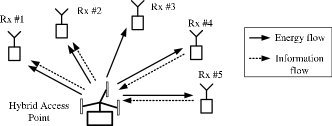
Experimental results
Research questions
- RQ1How can energy beamforming and MIMO techniques improve the efficiency of RF-based wireless energy transfer in WPCN?
- RQ2What are the performance limits of SWIPT systems in terms of spectral efficiency and fairness when energy and information are transmitted simultaneously?
- RQ3How does the deployment of power beacons (PBs) and their density affect outage probability and network capacity in multi-cell WPCNs?
- RQ4In what ways can massive MIMO and full-duplex operation enhance the performance and scalability of WPCN?
- RQ5What are the key challenges in joint channel estimation for WPCN, and how can they be addressed to improve both energy and information transfer?
Key findings
- Energy beamforming significantly improves energy transfer efficiency in MIMO-based WET, enabling long-range and scalable power delivery.
- SWIPT achieves higher spectrum efficiency than orthogonal transmission by using the same waveform for energy and information.
- The doubly near-far problem in WPCN—where distant users suffer from low harvested energy and high transmit power—can be mitigated by maximizing the minimum user throughput.
- Massive MIMO simplifies beamforming and multi-user detection in WPCN, enabling efficient multi-user access and improved spectral efficiency.
- Full-duplex HAPs can simultaneously transmit energy and receive uplink data, but require advanced self-interference cancellation techniques.
- Stochastic geometry models show that increasing PB density and using directional beamforming reduce transmission outage probability in multi-cell WPCNs.
![Figure 2: Structure of an RF energy receiver using a rectifying circuit [ 2 ] .](https://ar5iv.labs.arxiv.org/html/1407.0474/assets/x2.png)
Better researchstarts right now
From reading papers to final review, dramatically reduce your research time.
No credit card · Free plan available
This review was created by AI and reviewed by human editors.