
[Paper Review] Recent Advances in Named Entity Recognition: A Comprehensive Survey and Comparative Study
This survey reviews recent NER approaches including graph-based, transformer-based models, LLMs, and low-resource methods, and provides a cross-dataset comparison of popular frameworks.
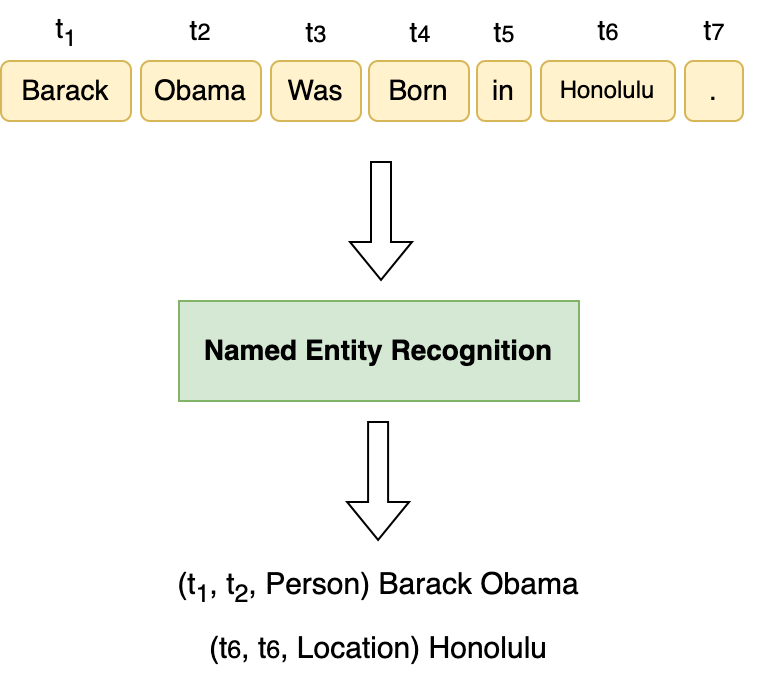
Named Entity Recognition seeks to extract substrings within a text that name real-world objects and to determine their type (for example, whether they refer to persons or organizations). In this survey, we first present an overview of recent popular approaches, including advancements in Transformer-based methods and Large Language Models (LLMs) that have not had much coverage in other surveys. In addition, we discuss reinforcement learning and graph-based approaches, highlighting their role in enhancing NER performance. Second, we focus on methods designed for datasets with scarce annotations. Third, we evaluate the performance of the main NER implementations on a variety of datasets with differing characteristics (as regards their domain, their size, and their number of classes). We thus provide a deep comparison of algorithms that have never been considered together. Our experiments shed some light on how the characteristics of datasets affect the behavior of the methods we compare.
Motivation & Objective
- Define the NER task and its applications across domains.
- Survey and categorize contemporary NER methods, with emphasis on transformers and LLMs.
- Highlight methods designed for low-resource/low-annotation settings.
- Provide an experimental comparison of popular NER frameworks across diverse datasets.
Proposed method
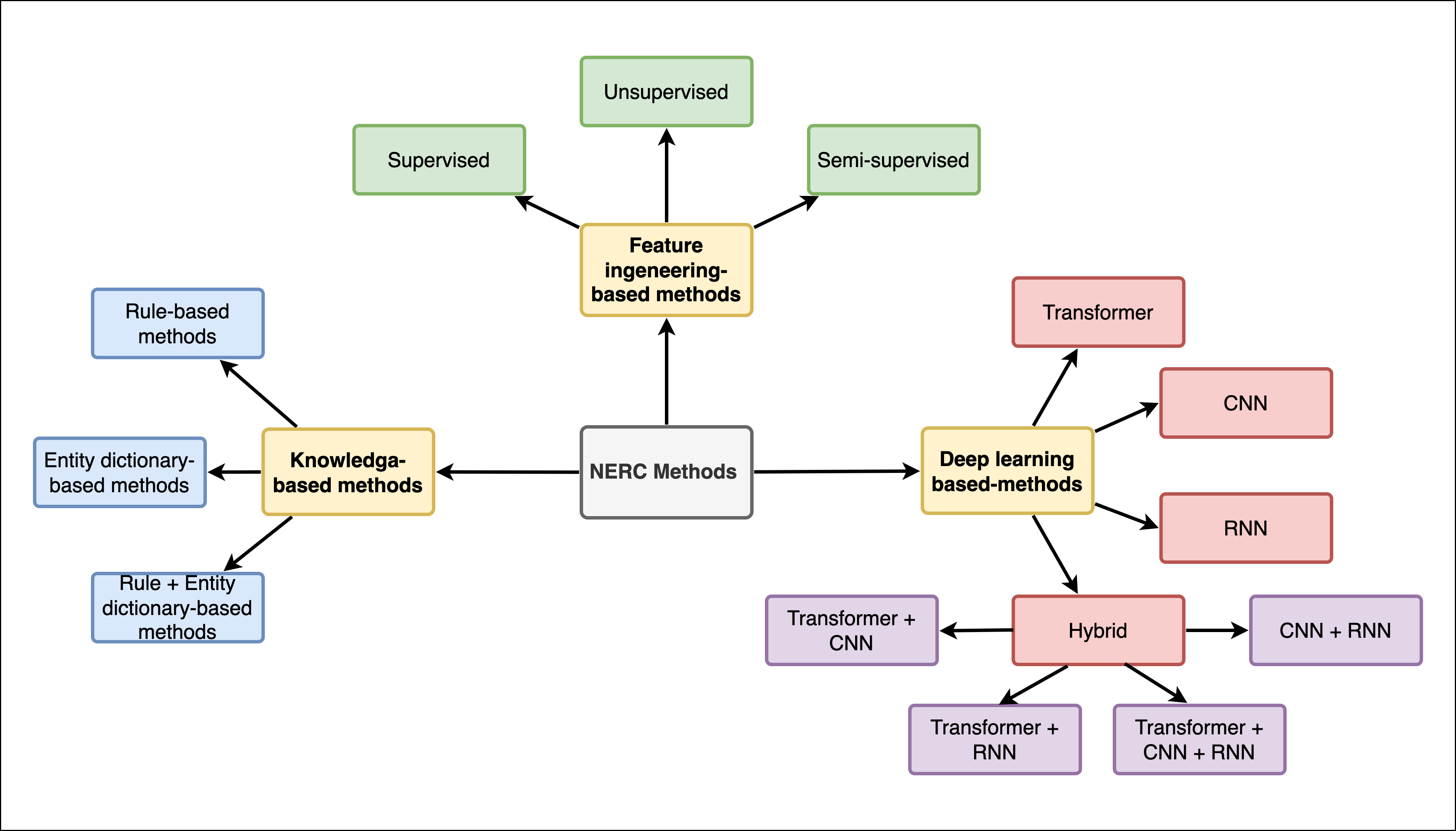
- Classify methods into knowledge-based, feature-engineering, supervised, deep learning (CNN/RNN/Hybrid), transformer-based encoders, and large language model (LLM) approaches.
- Describe data representations, including word and character embeddings, and context encoding strategies (CNNs, RNNs, BiLSTMs, and transformers).
- Discuss tag decoding architectures (CRF, MLP, pointer networks) and their impact on sequence labeling.
- Summarize transformer-based models (BERT, DistilBERT, RoBERTa) and their adaptations for NER, including multilingual and domain-specific fine-tuning.
- Explain LLM-based NER approaches (text-generation framing, few-shot prompts) and present a table of studies with observed outcomes.
Experimental results
Research questions
- RQ1What are the dominant methodological trends in NER (knowledge-based, supervised, deep learning, transformers, LLMs) and how have they evolved?
- RQ2How do dataset characteristics (domain, size, class count) affect the relative performance of NER methods?
- RQ3What are the challenges and efficacies of NER in low-resource or scarce-annotation contexts?
- RQ4How do transformer encoders and LLMs compare to traditional architectures for NER tasks across languages and domains?
Key findings
- The survey emphasizes the rising prominence of transformer-based encoders and LLMs in NER.
- It highlights methods tailored for low-annotation settings and discusses their performance implications.
- Experimental comparisons across datasets reveal how dataset properties influence method effectiveness.
- LLM-based NER approaches show promise in few-shot and low-resource scenarios, sometimes matching supervised baselines.
- A variety of tools and pre-trained model resources for NER are reviewed alongside evaluation schemes and corpora.
Better researchstarts right now
From reading papers to final review, dramatically reduce your research time.
No credit card · Free plan available
This review was created by AI and reviewed by human editors.