
[Paper Review] Recent Advances in Speech Language Models: A Survey
This survey presents the first comprehensive overview of Speech Language Models (SpeechLMs), which generate speech directly from audio without text-based intermediaries, overcoming limitations of the ASR+LLM+TTS pipeline such as information loss and error accumulation. The paper details SpeechLM architectures, training recipes, evaluation metrics, and identifies key challenges and future directions in end-to-end training, real-time inference, safety, and low-resource language support.
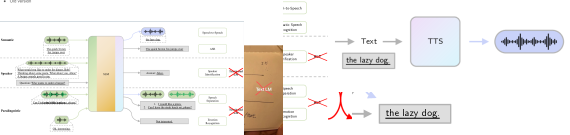
Large Language Models (LLMs) have recently garnered significant attention, primarily for their capabilities in text-based interactions. However, natural human interaction often relies on speech, necessitating a shift towards voice-based models. A straightforward approach to achieve this involves a pipeline of ``Automatic Speech Recognition (ASR) + LLM + Text-to-Speech (TTS)", where input speech is transcribed to text, processed by an LLM, and then converted back to speech. Despite being straightforward, this method suffers from inherent limitations, such as information loss during modality conversion, significant latency due to the complex pipeline, and error accumulation across the three stages. To address these issues, Speech Language Models (SpeechLMs) -- end-to-end models that generate speech without converting from text -- have emerged as a promising alternative. This survey paper provides the first comprehensive overview of recent methodologies for constructing SpeechLMs, detailing the key components of their architecture and the various training recipes integral to their development. Additionally, we systematically survey the various capabilities of SpeechLMs, categorize their evaluation metrics, and discuss the challenges and future research directions in this rapidly evolving field. The GitHub repository is available at https://github.com/dreamtheater123/Awesome-SpeechLM-Survey
Motivation & Objective
- To address the limitations of the ASR+LLM+TTS pipeline, which suffers from information loss and error accumulation during modality conversion.
- To provide a systematic overview of SpeechLM architectures, components, and training recipes for end-to-end speech generation.
- To classify and analyze evaluation metrics for SpeechLMs across multiple dimensions of performance.
- To identify key challenges in real-time generation, safety risks, and low-resource language support.
- To outline future research directions for advancing SpeechLM technology, including end-to-end training and improved safety measures.
Proposed method
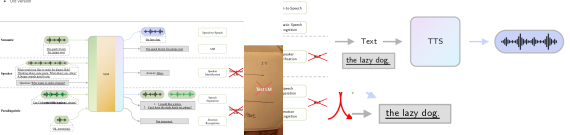
- Proposes a novel taxonomy for classifying SpeechLMs based on underlying components and training recipes.
- Reviews key architectural components: speech tokenizers, autoregressive language models, and vocoders for speech synthesis.
- Analyzes training recipes involving pretraining on large-scale speech data and fine-tuning for downstream tasks.
- Introduces a multi-dimensional evaluation framework, including automatic and human evaluation metrics for quality, coherence, and expressiveness.
- Explores end-to-end training strategies to enable gradient flow from vocoder output back to tokenizer input, improving coherence.
- Proposes streamable vocoders and waveform-based generation to reduce latency for real-time applications.
Experimental results
Research questions
- RQ1How do SpeechLMs overcome the information loss and error accumulation inherent in the ASR+LLM+TTS pipeline?
- RQ2What are the key architectural components and training recipes that enable effective end-to-end speech generation in SpeechLMs?
- RQ3How can SpeechLMs be evaluated across multiple dimensions such as speech quality, semantic accuracy, and emotional expressiveness?
- RQ4What are the major challenges in achieving real-time, low-latency speech generation with SpeechLMs?
- RQ5How can SpeechLMs be made safer and more robust, especially regarding toxicity and privacy risks in speech generation?
Key findings
- SpeechLMs preserve paralinguistic information such as pitch, timbre, and tonality, which is lost in text-based LLMs, enabling more expressive and natural speech generation.
- End-to-end training of SpeechLMs can reduce error propagation and improve coherence by enabling gradient flow from vocoder output to tokenizer input.
- Current vocoders introduce significant latency because they must wait for the full sequence of tokens, highlighting the need for streamable or autoregressive vocoders.
- SpeechLMs show strong potential for low-resource languages by leveraging available speech data, even when textual data is scarce.
- Safety risks in SpeechLMs include generation of toxic or explicit content and privacy leaks through speaker identity inference, which are unique challenges compared to text-only models.
- Evaluation of SpeechLMs requires a multi-faceted approach combining automatic metrics (e.g., MOS, STOI) and human evaluation to assess quality, coherence, and emotional nuance.
Read this paper
Open the full text in the Nubint reader and ask about any passage as you read.
Read this paper on NubintThis review was generated by AI from the original paper. Please check the paper before citing it.