
[Paper Review] Recent advances in text embedding: A Comprehensive Review of Top-Performing Methods on the MTEB Benchmark
This survey analyzes top-performing universal text embeddings on MTEB, detailing data, loss, and LLM-based approaches from 2023–2024, and outlines trends and gaps.
Text embedding methods have become increasingly popular in both industrial and academic fields due to their critical role in a variety of natural language processing tasks. The significance of universal text embeddings has been further highlighted with the rise of Large Language Models (LLMs) applications such as Retrieval-Augmented Systems (RAGs). While previous models have attempted to be general-purpose, they often struggle to generalize across tasks and domains. However, recent advancements in training data quantity, quality and diversity; synthetic data generation from LLMs as well as using LLMs as backbones encourage great improvements in pursuing universal text embeddings. In this paper, we provide an overview of the recent advances in universal text embedding models with a focus on the top performing text embeddings on Massive Text Embedding Benchmark (MTEB). Through detailed comparison and analysis, we highlight the key contributions and limitations in this area, and propose potentially inspiring future research directions.
Motivation & Objective
- Motivate the study by reviewing universal text embeddings prioritized by MTEB benchmarks and their relevance to retrieval, classification, clustering, and other tasks.
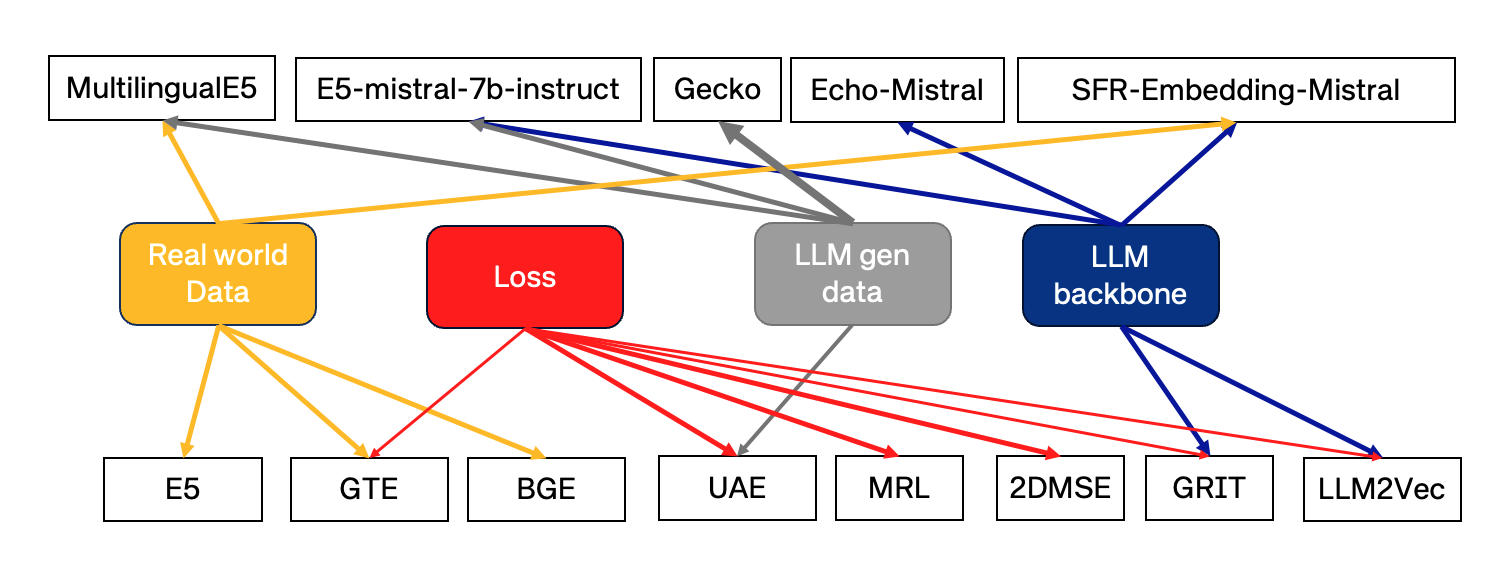
- Organize the literature into data-focused, loss-focused, and LLM-focused families to clarify developmental directions in universal embeddings.
- Summarize the main architectures (e.g., GTE, BGE, E5, UAE, Multilingual-E5) and how data quality, diversity, and training signals affect performance.
- Highlight how MTEB's multi-task, multilingual evaluation setting drives model design for cross-task generalization.
Proposed method
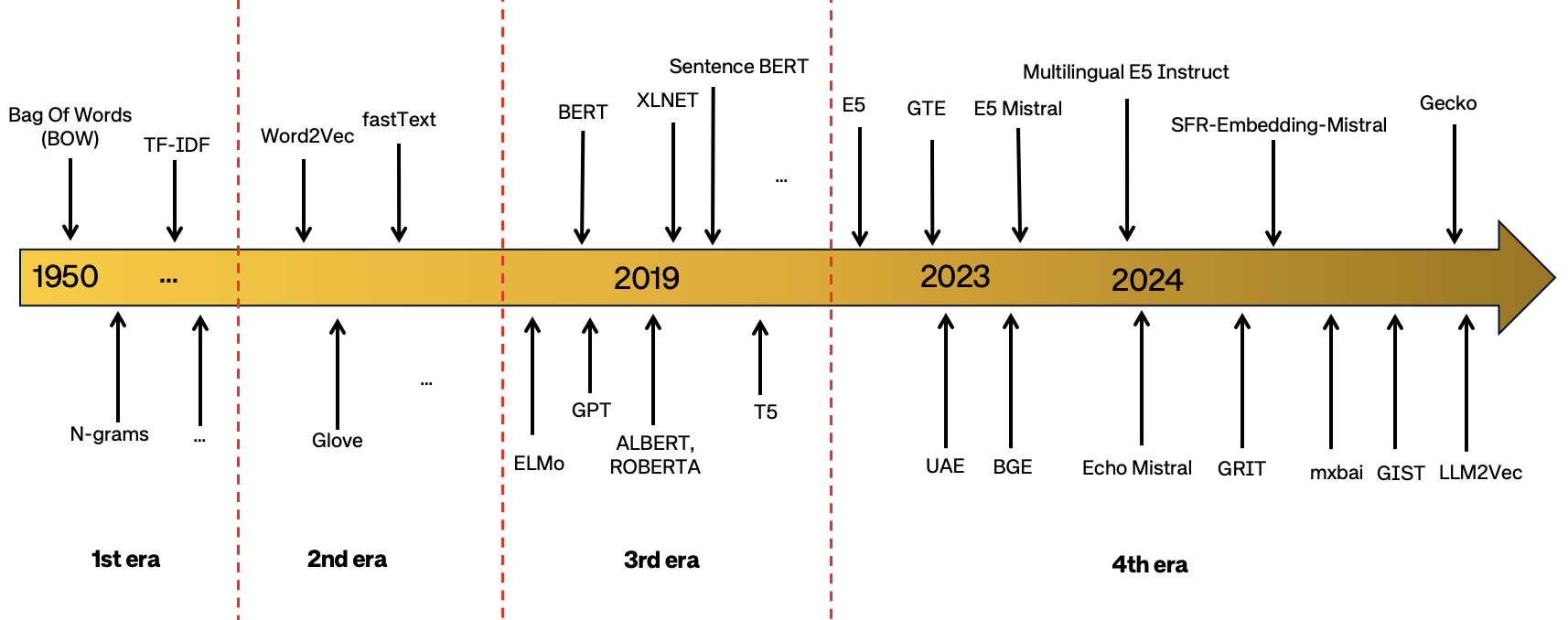
- Discuss data-focused strategies that boost universal embeddings via large-scale, diverse pre-training and high-quality fine-tuning data (e.g., CCPairs, CC-based sources, multi-dataset mixtures).
- Describe loss-function innovations that improve contrastive learning and address gradient issues (e.g., improved InfoNCE variants, angle optimization in UAE).
- Explain the role of hard negatives, in-batch negatives, and knowledge distillation in pre-training and fine-tuning stages.
- Outline how LLMs are used as data annotators or as backbones to enhance universality and multilinguality (e.g., synthetic data, instruction-tuning, cross-encoder distillation).
- Summarize the backbone models and training regimes (BERT-family, RoBERTa, Long-range transformers, and decoder-only LLMs) used across methods.
Experimental results
Research questions
- RQ1What defines a universal text embedding in the context of MTEB, and how do data, loss, and model choices impact cross-task generalization?
- RQ2How do top-performing methods leverage data quality, diversity, and synthetic data to improve performance across 58 datasets and 112 languages?
- RQ3What are the limitations and trade-offs of current data-, loss-, and LLM-focused approaches for universal embeddings?
- RQ4To what extent do LLMs serve as effective backbones or annotators for improving universal embeddings across tasks and languages?
- RQ5What future directions can further enhance universality and efficiency of text embeddings?
Key findings
- Top models on MTEB rely on large, diverse pre-training and high-quality fine-tuning data to achieve broad task coverage.
- Loss innovations and handling of gradient issues (e.g., angle optimization) contribute to improved optimization and embedding quality.
- In-batch and hard negative sampling, plus distillation from cross-encoders, boost retrieval and exemplar-quality embeddings.
- LLMs are increasingly used as both data annotators and backbone models to enhance multilingual and multi-task performance.
- Multilingual-E5 and related models demonstrate the value of multilingual data mixtures and instruction data for cross-language universality.
- The surveyed methods show significant improvements in universal text embeddings, but challenges remain in generalization across unseen tasks and domains.
Read this paper
Open the full text in the Nubint reader and ask about any passage as you read.
Read this paper on NubintThis review was generated by AI from the original paper. Please check the paper before citing it.