
[Paper Review] Recipe recommendation using ingredient networks
This paper proposes a recipe recommendation system that leverages ingredient networks—complement networks for co-occurring ingredients and substitute networks for user-suggested ingredient swaps—to predict recipe ratings. By combining structural features from these networks with nutrition data, the model achieves a prediction accuracy of 0.792, with 84% of the predictive power derived from ingredient networks alone.
The recording and sharing of cooking recipes, a human activity dating back thousands of years, naturally became an early and prominent social use of the web. The resulting online recipe collections are repositories of ingredient combinations and cooking methods whose large-scale and variety yield interesting insights about both the fundamentals of cooking and user preferences. At the level of an individual ingredient we measure whether it tends to be essential or can be dropped or added, and whether its quantity can be modified. We also construct two types of networks to capture the relationships between ingredients. The complement network captures which ingredients tend to co-occur frequently, and is composed of two large communities: one savory, the other sweet. The substitute network, derived from user-generated suggestions for modifications, can be decomposed into many communities of functionally equivalent ingredients, and captures users' preference for healthier variants of a recipe. Our experiments reveal that recipe ratings can be well predicted with features derived from combinations of ingredient networks and nutrition information.
Motivation & Objective
- To model user preferences in recipe selection by analyzing ingredient relationships in large-scale online recipe collections.
- To identify patterns of ingredient co-occurrence (complement network) and user-suggested substitutions (substitute network) from user-generated content.
- To develop a predictive model for recipe ratings using structural features from ingredient networks and nutrition information.
- To assess the relative contribution of ingredient networks versus nutritional data in predicting recipe popularity.
- To enable intelligent recipe recommendations by identifying modifiable ingredients and healthy substitutions based on user behavior.
Proposed method
- Extracted ingredient lists and user reviews from Allrecipes.com, a large-scale recipe-sharing website.
- Constructed a complement network based on frequent co-occurrence of ingredients across recipes, revealing two dominant communities: savory and sweet.
- Built a substitute network from user-generated modification suggestions (e.g., 'use ground turkey instead of beef'), identifying functionally equivalent ingredient communities.
- Applied Singular Value Decomposition (SVD) to reduce dimensionality of network features, selecting k=50 for optimal performance via cross-validation.
- Combined SVD-reduced features from complement, substitute, and nutrition networks into a single feature vector for recipe rating prediction.
- Trained a regression model on recipe ratings using the combined feature set, evaluating performance via correlation and relative importance analysis.
Experimental results
Research questions
- RQ1How do ingredient co-occurrence patterns in online recipes reflect regional or flavor-based preferences?
- RQ2To what extent can user-suggested ingredient substitutions reveal functional equivalences and health-conscious preferences?
- RQ3Can structural features from ingredient networks predict recipe ratings more effectively than traditional nutritional features?
- RQ4Which network type—complement, substitute, or nutrition—contributes most significantly to rating prediction accuracy?
- RQ5How do reduced-dimension representations of ingredient networks improve generalization and prediction performance?
Key findings
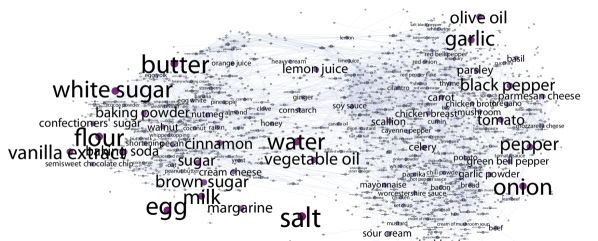
- The complement network, which captures frequent ingredient co-occurrences, formed two dominant communities: one savory and one sweet, reflecting flavor-based groupings.
- The substitute network revealed multiple communities of functionally equivalent ingredients, such as sweeteners and oils, reflecting user preferences for healthier or available alternatives.
- Recipe ratings were predicted with an accuracy of 0.792 using features from combined ingredient networks and nutrition data.
- Ingredient networks alone contributed 84% of the prediction power, outperforming nutrition data, indicating that co-occurrence and substitution patterns encode significant preference signals.
- The complement network alone yielded better prediction performance than either the substitute or nutrition networks individually, especially at low feature dimensions.
- The top five SVD components of the substitute network highlighted influential communities—such as sweeteners and oil substitutes—whose features were highly informative for rating prediction.
Read this paper
Open the full text in the Nubint reader and ask about any passage as you read.
Read this paper on NubintThis review was generated by AI from the original paper. Please check the paper before citing it.