
[论文解读] Recommendation as Instruction Following: A Large Language Model Empowered Recommendation Approach
本文提出 InstructRec,一种将推荐视为通过对LLM进行微调的3B Flan-T5-XL模型来执行指令的推荐系统,使用大量以用户为中心的自然语言指令来提升个性化和泛化。
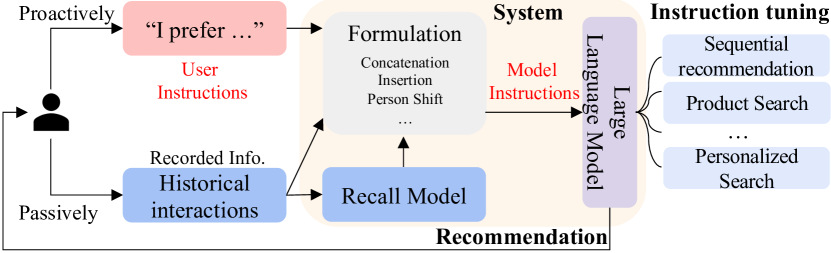
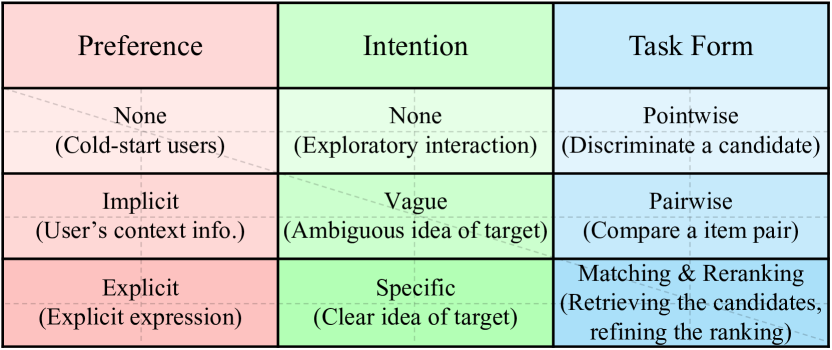
In the past decades, recommender systems have attracted much attention in both research and industry communities, and a large number of studies have been devoted to developing effective recommendation models. Basically speaking, these models mainly learn the underlying user preference from historical behavior data, and then estimate the user-item matching relationships for recommendations. Inspired by the recent progress on large language models (LLMs), we take a different approach to developing the recommendation models, considering recommendation as instruction following by LLMs. The key idea is that the preferences or needs of a user can be expressed in natural language descriptions (called instructions), so that LLMs can understand and further execute the instruction for fulfilling the recommendation task. Instead of using public APIs of LLMs, we instruction tune an open-source LLM (3B Flan-T5-XL), in order to better adapt LLMs to recommender systems. For this purpose, we first design a general instruction format for describing the preference, intention, task form and context of a user in natural language. Then we manually design 39 instruction templates and automatically generate a large amount of user-personalized instruction data (252K instructions) with varying types of preferences and intentions. To demonstrate the effectiveness of our approach, we instantiate the instruction templates into several widely-studied recommendation (or search) tasks, and conduct extensive experiments on these tasks with real-world datasets. Experiment results show that the proposed approach can outperform several competitive baselines, including the powerful GPT-3.5, on these evaluation tasks. Our approach sheds light on developing more user-friendly recommender systems, in which users can freely communicate with the system and obtain more accurate recommendations via natural language instructions.
研究动机与目标
- 引入将推荐视为由LLMs执行指令的概念。
- 设计一个灵活的指令格式,捕捉用户偏好、意图、任务形式和情境。
- 生成大规模高质量的指令数据集,用于对LLM在推荐任务上的调优。
- 在真实数据集和任务上证明 InstructRec 的有效性与泛化能力。
提出的方法
- 为推荐定义一个统一的指令格式,包括偏好、意图、任务形式和情景。
- 手动设计39个粗粒度指令模板,利用GPT-3.5作为教师-LLM自动生成252K个细粒度的用户指令。
- 用指令数据对3B Flan-T5-XL模型进行微调,使其能够执行跟随指令的推荐。
- 使用训练好的LLM作为重排序器,从候选集合中给出最终的项目排序。
- 提供提高指令多样性的策略(如交换输入输出、CoT推理),并确保与用户需求的一致性。
实验结果
研究问题
- RQ1推荐任务能否被有效地构造成LLMs执行指令来完成?
- RQ2指令格式、数据生成和微调如何影响推荐质量与泛化?
- RQ3InstructRec 是否优于基线并对未见域/未见指令具有泛化能力?
- RQ4指令多样性对模型性能的影响如何?
主要发现
- InstructRec 在评估任务上可以超过包括 GPT-3.5 在内的若干有竞争力的基线。
- 该方法提升了LLM 适应多样化用户需求的能力,并在未见指令与领域上展现出更好的泛化性。
- 一个规模庞大、质量高的252K指令数据集支持对推荐系统进行有效的指令调优。
- 指令格式有效地捕捉用户偏好、意图、任务形式和情境,以引导推荐。
- 提升指令多样性并结合类似CoT的推理可以进一步提升性能。
更好的研究,从现在开始
从论文设计到论文写作,大幅缩短您的研究时间。
无需绑定信用卡
本解读由 AI 生成,并经人工编辑审核。