
[Paper Review] Reconfigurable Intelligent Surfaces for Future Wireless Networks: A Channel Modeling Perspective
This paper proposes a novel physical channel modeling framework for reconfigurable intelligent surfaces (RIS) in 6G wireless networks, introducing the open-source SimRIS Channel Simulator v2.0 to evaluate RIS-empowered millimeter-wave systems. It demonstrates that RISs can significantly enhance signal quality and achievable rates in both indoor and outdoor environments through optimal sizing, positioning, and phase control, validating their potential as a key 6G technology when properly engineered and deployed.
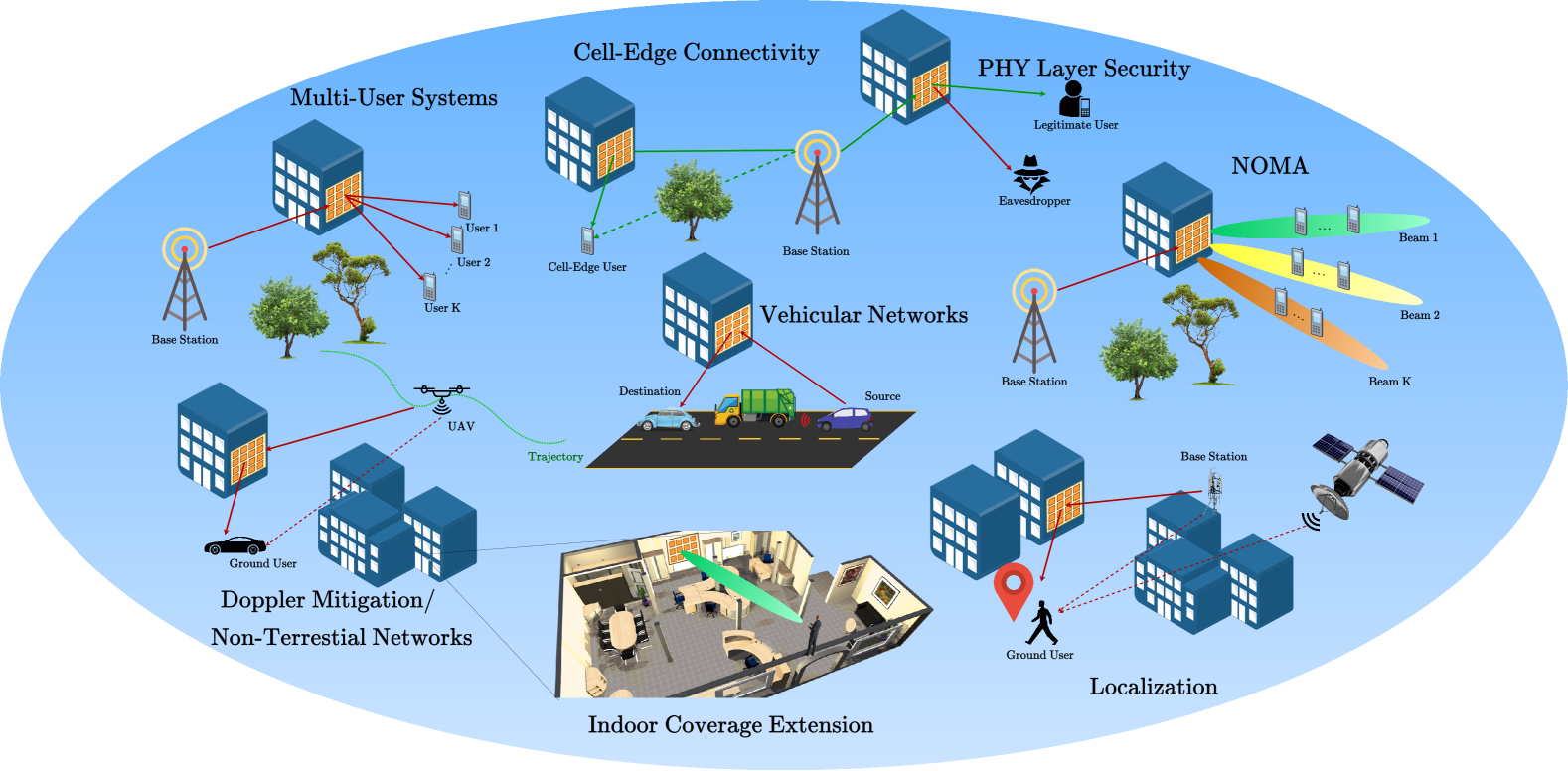
While the researchers have set their sights on future wireless networks of 2030, communications through reconfigurable intelligent surfaces (RISs) appears as one of the potential enabling technologies for 6G wireless networking. This article aims to shed light on the potential use-cases of RISs in future wireless systems by means of a novel channel modeling methodology as well as a new software tool for RIS-empowered millimeter-wave communication systems. It is shown by the open-source, user-friendly, and widely applicable SimRIS Channel Simulator, whose 2.0 version is proposed and goes online by this article, that RISs will work under certain use-cases and communication environments. Potential future research directions are also discussed to bridge the gap between the theory and practice of RIS-empowered systems towards their standardization for 6G wireless networks.
Motivation & Objective
- To address the lack of practical, physics-based RIS channel models for different frequency bands and propagation environments.
- To bridge the gap between theoretical RIS performance and real-world deployment by providing a realistic simulation framework.
- To identify viable use-cases where RISs can significantly improve communication quality-of-service in future wireless networks.
- To support standardization efforts for RIS-empowered systems by offering a widely accessible, open-source simulation tool.
- To guide future research by outlining key open problems in RIS deployment, including hardware limitations, energy efficiency, and system coordination.
Proposed method
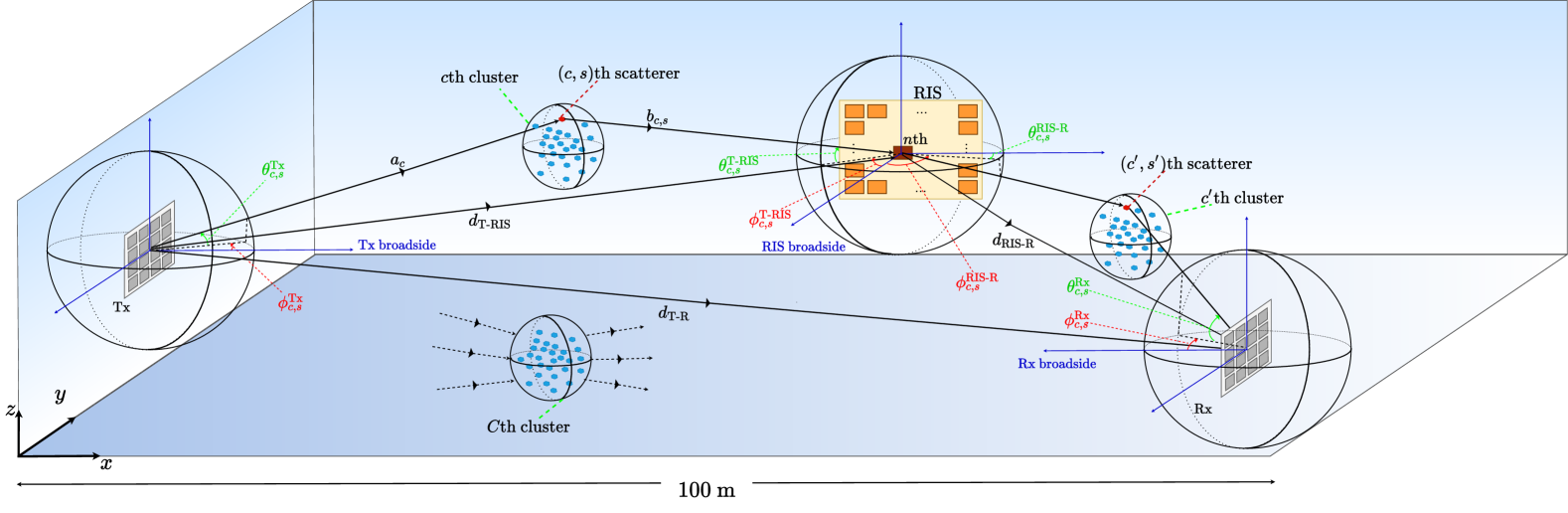
- Develops a 3D physical channel modeling methodology that incorporates RIS-specific electromagnetic properties and wave propagation effects.
- Extends the SimRIS Channel Simulator to support MIMO-aided transceivers and mmWave communication scenarios.
- Integrates realistic RIS parameters such as phase shift resolution, element size, and surface geometry into the simulation framework.
- Employs a ray-tracing-based approach to model signal reflections and scattering at the RIS, capturing multipath and spatial channel characteristics.
- Validates the model using extensive computer simulations across diverse indoor and outdoor environments.
- Provides open-source access to SimRIS v2.0 to enable reproducibility and community-driven evaluation of RIS-empowered systems.
Experimental results
Research questions
- RQ1In what specific environments and configurations can RISs significantly improve signal quality and achievable rate in mmWave systems?
- RQ2How do physical RIS parameters—such as size, phase resolution, and positioning—affect the performance of RIS-empowered communication links?
- RQ3What are the practical limitations of RISs in real-world deployments, including hardware impairments and feedback errors?
- RQ4Which communication scenarios offer the highest potential for RIS deployment in 6G networks?
- RQ5How can the performance of RIS-empowered systems be benchmarked against theoretical limits under realistic conditions?
Key findings
- RISs can significantly boost received signal quality and achievable data rates in both indoor and outdoor environments when properly configured in terms of size, position, and phase shifts.
- The SimRIS v2.0 simulator enables accurate and reproducible evaluation of RIS-empowered systems across diverse propagation environments and frequency bands.
- Optimal RIS deployment leads to strong composite Tx-RIS-Rx channels, especially in non-line-of-sight and shadowed scenarios.
- The simulator results confirm that RISs are viable for enhancing coverage and spectral efficiency in mmWave and sub-THz bands.
- Physical channel modeling reveals that RIS performance is highly sensitive to phase resolution, surface size, and alignment with direct and reflected paths.
- The study identifies critical open issues such as hardware impairments, energy consumption, and feedback overhead that must be addressed before real-world deployment.
Read this paper
Open the full text in the Nubint reader and ask about any passage as you read.
Read this paper on NubintThis review was generated by AI from the original paper. Please check the paper before citing it.