
[Paper Review] Reconstructing Training Data from Multiclass Neural Networks
This paper demonstrates that training data can be reconstructed from multiclass neural networks using gradient-based optimization, leveraging the implicit bias of gradient descent to recover samples near the decision margin. It shows that weight decay enhances reconstruction quality and enables successful reconstruction from models trained on up to 5,000 samples across 100 classes—significantly scaling beyond prior work limited to binary classifiers and small datasets.
Reconstructing samples from the training set of trained neural networks is a major privacy concern. Haim et al. (2022) recently showed that it is possible to reconstruct training samples from neural network binary classifiers, based on theoretical results about the implicit bias of gradient methods. In this work, we present several improvements and new insights over this previous work. As our main improvement, we show that training-data reconstruction is possible in the multi-class setting and that the reconstruction quality is even higher than in the case of binary classification. Moreover, we show that using weight-decay during training increases the vulnerability to sample reconstruction. Finally, while in the previous work the training set was of size at most $1000$ from $10$ classes, we show preliminary evidence of the ability to reconstruct from a model trained on $5000$ samples from $100$ classes.
Motivation & Objective
- To extend data reconstruction from binary to multiclass neural networks, overcoming a key limitation of prior work.
- To investigate whether standard training practices like weight decay increase vulnerability to reconstruction attacks.
- To scale reconstruction to larger datasets, such as 5,000 samples from 100 classes, beyond the 1,000-sample limit of prior studies.
- To analyze the relationship between model generalization and reconstruction feasibility, especially when training error is non-zero.
- To explore the role of margin proximity in enabling reconstruction, particularly under weight-decay regularization.
Proposed method
- Formulates a multiclass extension of the implicit bias theory from Lyu & Li (2019), showing that gradient flow converges to a KKT point of a maximum-margin problem.
- Designs a reconstruction loss function that optimizes input images to satisfy the KKT conditions derived from the implicit bias, using gradient descent on the input space.
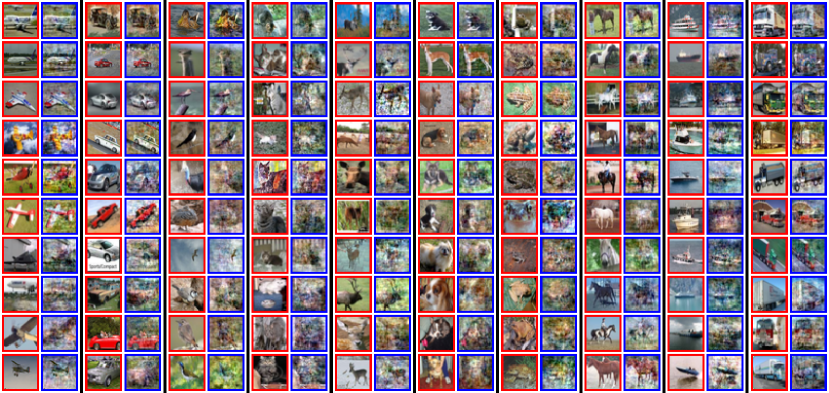
- Applies the reconstruction method to multiclass MLPs trained on CIFAR-10 and CIFAR-100 datasets, with and without weight decay.
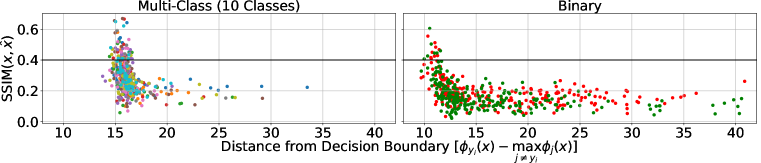
- Uses structural similarity (SSIM) to quantitatively evaluate reconstruction quality, comparing it to the distance from the decision margin.
- Employs a two-stage optimization: first, optimize input to minimize the loss derived from KKT conditions; second, refine using L2 regularization and iterative refinement.
- Analyzes the distribution of training samples relative to the margin in weight-decayed models, showing increased concentration on the margin.
Experimental results
Research questions
- RQ1Can training data be reconstructed from multiclass neural networks, extending prior work limited to binary classifiers?
- RQ2Does the use of weight decay during training increase the vulnerability of models to data reconstruction attacks?
- RQ3To what extent can reconstruction be scaled to larger datasets, such as 5,000 samples from 100 classes?
- RQ4How does the generalization performance (e.g., test error) correlate with reconstruction success when training error is non-zero?
- RQ5What is the relationship between sample proximity to the decision margin and reconstruction quality in weight-decayed models?
Key findings
- Reconstruction is successfully achieved in multiclass settings, with high-quality reconstructions observed even for models trained on 5000 samples from 100 classes.
- Weight decay significantly increases reconstruction quality and enables successful reconstruction from models trained with standard (non-small) weight initialization.
- For certain weight-decay values, a higher proportion of training samples lie exactly on the margin, making them more vulnerable to reconstruction.
- Reconstruction is possible even for models with non-zero training error, suggesting the theoretical assumptions of Lyu & Li (2019) are not strictly necessary.
- In models with weight decay, the number of successfully reconstructed samples (SSIM > 0.4) increases substantially compared to models without weight decay.
- The scatter plot of SSIM vs. margin distance shows a strong correlation: samples closer to the margin are reconstructed more accurately, especially under weight decay.
Read this paper
Open the full text in the Nubint reader and ask about any passage as you read.
Read this paper on NubintThis review was generated by AI from the original paper. Please check the paper before citing it.