
[Paper Review] Red Teaming Language Model Detectors with Language Models
This paper proposes two red teaming strategies to test the robustness of large language model (LLM) detectors: (1) word substitution using a protected LLM to replace tokens in generated text, and (2) automatic generation of instructional prompts to alter writing style. Both methods effectively evade all tested detectors—classifier-based, watermarking, and likelihood-based—while maintaining high fluency and plausibility, revealing critical vulnerabilities in current LLM detection systems.
The prevalence and strong capability of large language models (LLMs) present significant safety and ethical risks if exploited by malicious users. To prevent the potentially deceptive usage of LLMs, recent works have proposed algorithms to detect LLM-generated text and protect LLMs. In this paper, we investigate the robustness and reliability of these LLM detectors under adversarial attacks. We study two types of attack strategies: 1) replacing certain words in an LLM's output with their synonyms given the context; 2) automatically searching for an instructional prompt to alter the writing style of the generation. In both strategies, we leverage an auxiliary LLM to generate the word replacements or the instructional prompt. Different from previous works, we consider a challenging setting where the auxiliary LLM can also be protected by a detector. Experiments reveal that our attacks effectively compromise the performance of all detectors in the study with plausible generations, underscoring the urgent need to improve the robustness of LLM-generated text detection systems.
Motivation & Objective
- To evaluate the robustness of existing LLM text detectors under adversarial attacks.
- To investigate whether detectors remain reliable when the attacker uses a language model that is itself protected by a detector.
- To develop and test novel attack strategies that maintain text quality while evading detection.
- To expose the limitations of current detection methods and guide future development of more robust detectors.
Proposed method
- Leverage an auxiliary LLM to generate word substitutions in LLM-generated text, using either query-free or query-based evolutionary search to optimize evasion.
- Use a query-based evolutionary search to iteratively improve word substitutions by querying the detector’s output to maximize evasion success.
- Design and automatically search for instructional prompts that reconfigure the LLM’s generation style to evade classifier-based detectors.
- Apply the attacks to three detector types: classifier-based, watermarking, and likelihood-based (e.g., DetectGPT), under realistic conditions where the attacker LLM is also protected.
- Conduct human evaluation to assess fluency and plausibility of attacked texts, ensuring they remain natural and effective in real-world scenarios.
- Use a combination of automatic metrics and human annotation to validate attack effectiveness and text quality.
Experimental results
Research questions
- RQ1Can LLM-generated text be modified via word substitution to evade detection by classifier-based, watermarking, and likelihood-based detectors?
- RQ2How effective is an attacker LLM—protected by a detector—when used to generate evasion attacks?
- RQ3Does the use of instructional prompts to alter generation style significantly reduce detector performance while preserving text quality?
- RQ4How does the quality of adversarially modified text compare to original text in terms of fluency and plausibility?
- RQ5Can detector robustness be improved by combining watermarking with likelihood-based analysis to detect substitution attacks?
Key findings
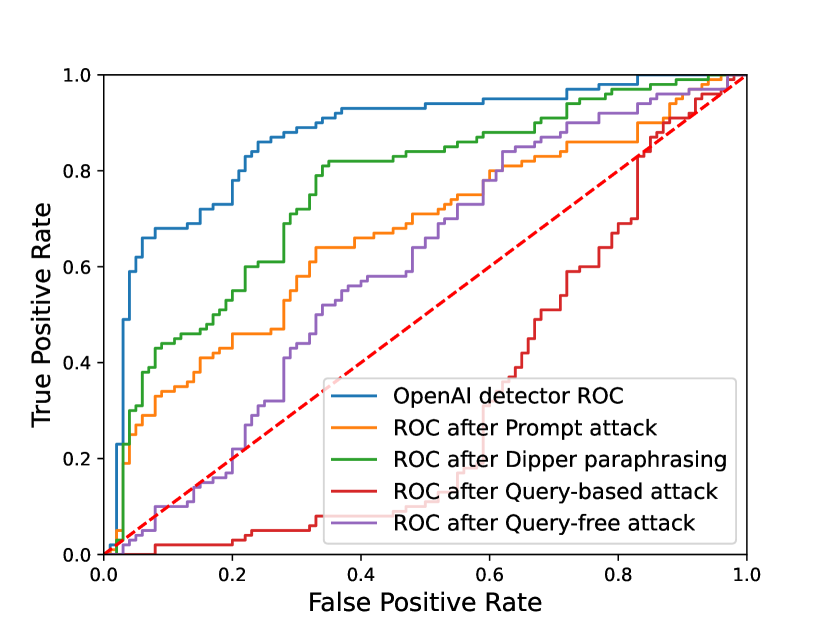
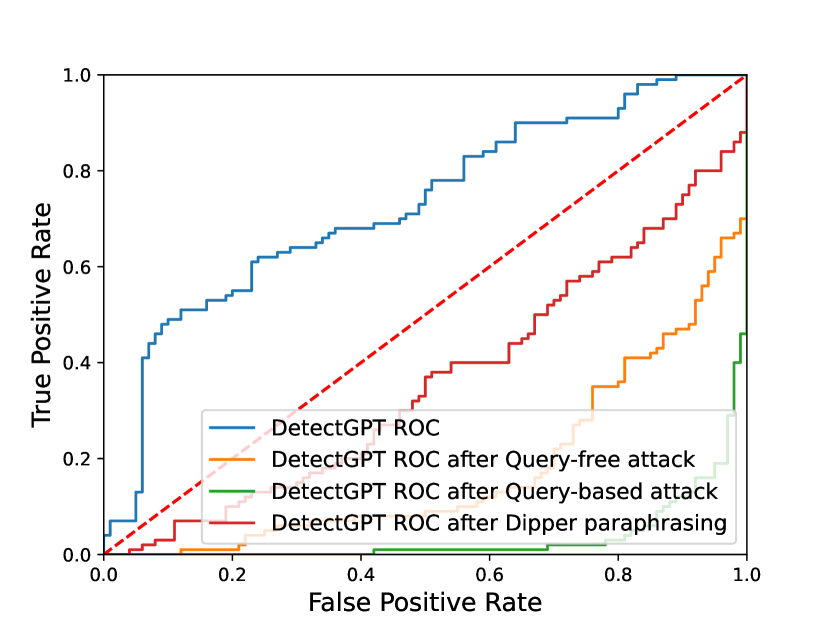
- All tested detectors—classifier-based, watermarking, and likelihood-based—exhibited significant performance degradation under the proposed attacks.
- The query-based substitution method achieved stronger evasion than query-free substitution, though with a slight trade-off in text fluency.
- The instructional prompt attack method produced highly plausible and fluent text, often outperforming word substitution in fluency while maintaining strong evasion capability.
- Human evaluation confirmed that attacked texts maintained high fluency and plausibility, with only minor degradation, making them viable for real-world abuse.
- Watermarking detectors showed greater robustness than classifier-based and likelihood-based detectors, but still failed under targeted attacks.
- The results demonstrate that current LLM detectors are not sufficiently robust and highlight the urgent need for more resilient detection systems.
Read this paper
Open the full text in the Nubint reader and ask about any passage as you read.
Read this paper on NubintThis review was generated by AI from the original paper. Please check the paper before citing it.