
[Paper Review] Redefining "Hallucination" in LLMs: Towards a psychology-informed framework for mitigating misinformation
The paper argues that the common term 'hallucination' for LLM errors is misleading and proposes a psychology-based taxonomy (source amnesia, recency, availability, suggestibility, cognitive dissonance, confabulation) with metacognition-inspired mitigation strategies.
In recent years, large language models (LLMs) have become incredibly popular, with ChatGPT for example being used by over a billion users. While these models exhibit remarkable language understanding and logical prowess, a notable challenge surfaces in the form of "hallucinations." This phenomenon results in LLMs outputting misinformation in a confident manner, which can lead to devastating consequences with such a large user base. However, we question the appropriateness of the term "hallucination" in LLMs, proposing a psychological taxonomy based on cognitive biases and other psychological phenomena. Our approach offers a more fine-grained understanding of this phenomenon, allowing for targeted solutions. By leveraging insights from how humans internally resolve similar challenges, we aim to develop strategies to mitigate LLM hallucinations. This interdisciplinary approach seeks to move beyond conventional terminology, providing a nuanced understanding and actionable pathways for improvement in LLM reliability.
Motivation & Objective
- Critically assess the term 'hallucination' in LLMs and its adequacy for describing model outputs.
- Propose a psychology-based taxonomy mapping LLM errors to cognitive biases and memory phenomena.
- Suggest concrete mitigation strategies inspired by human metacognition and source monitoring.
- Advocate for targeted mitigation pathways that leverage psychological constructs to improve LLM reliability.
Proposed method
- Review and synthesize existing definitions and taxonomies of LLM hallucinations.
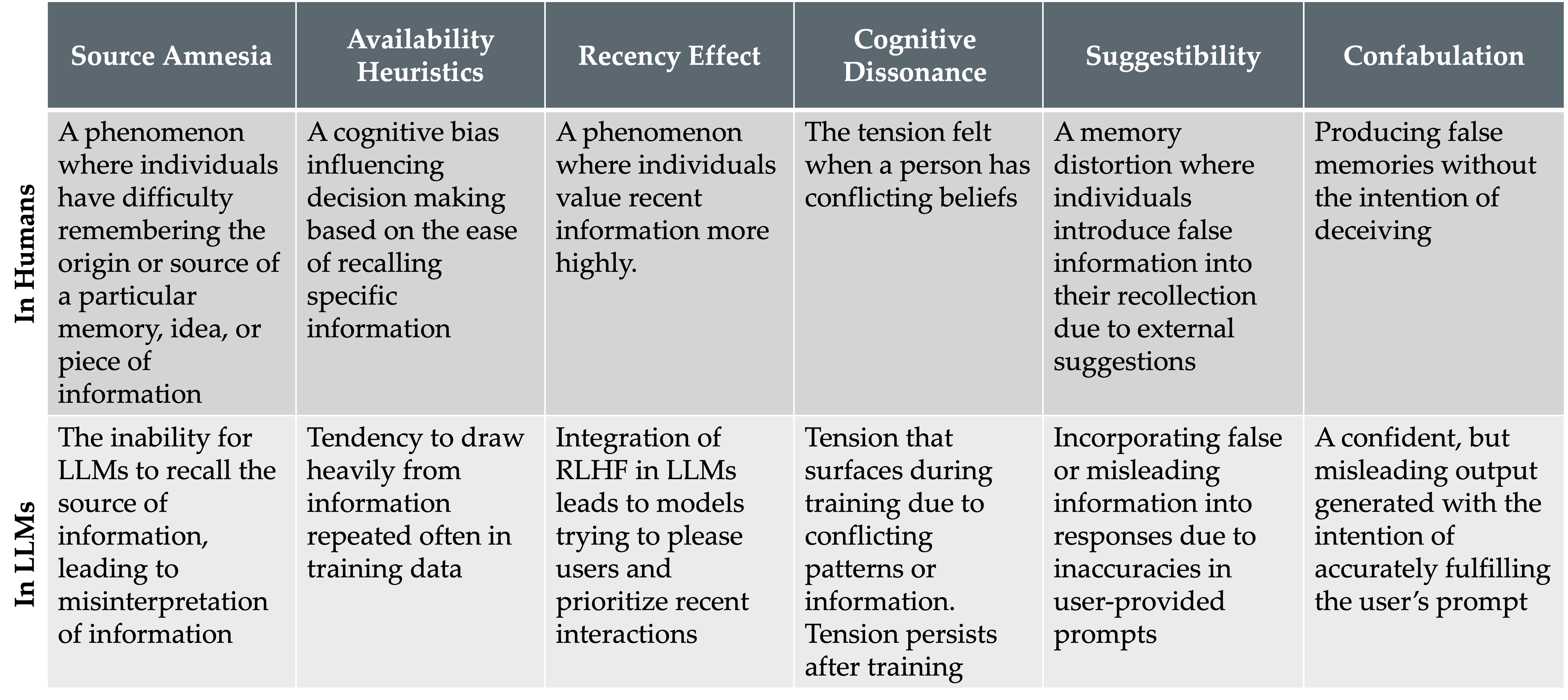
- Map identified phenomena to psychological concepts: source amnesia, recency effect, availability heuristics, suggestibility, cognitive dissonance, confabulation.
- Argue for and describe a psychology-informed taxonomy as an alternative to task-specific hallucination labels.
- Discuss potential metacognitive-inspired strategies (enhanced source attribution, source monitoring, reflective processing, artificial metacognition).
- Cite related works on self-reflection and self-inquiry as parallels to proposed mitigations.
Experimental results
Research questions
- RQ1How well does the term 'hallucination' capture the phenomena observed in LLM outputs?
- RQ2Can a psychology-based taxonomy more precisely categorize LLM errors than existing intrinsic/extrinsic or task-specific labels?
- RQ3What mitigation strategies inspired by human metacognition could reduce LLM misinformation?
- RQ4Which psychological constructs best align with different error types in LLMs to inform targeted fixes?
Key findings
- A psychology-informed taxonomy aligns LLM error types with known cognitive biases and memory phenomena.
- Source amnesia, recency effect, availability heuristics, suggestibility, cognitive dissonance, and confabulation map to distinct but overlapping LLM failure modes.
- Metacognition-inspired strategies (source attribution, monitoring, reflective processing) are proposed as practical avenues to mitigate misinformation in LLMs.
- Self-reflection and self-inquiry approaches from related works demonstrate potential for reducing hallucination-like outputs.
- The paper argues for moving beyond 'hallucination' terminology to enable more precise, targeted mitigation.
Read this paper
Open the full text in the Nubint reader and ask about any passage as you read.
Read this paper on NubintThis review was generated by AI from the original paper. Please check the paper before citing it.