
[Paper Review] Reduce, Reuse, Recycle: Compositional Generation with Energy-Based Diffusion Models and MCMC
The paper shows how diffusion models can be composed with MCMC sampling and energy-based parameterizations to enable accurate compositional generation across images and text-to-image tasks, outperforming standard reverse-diffusion sampling in several settings.
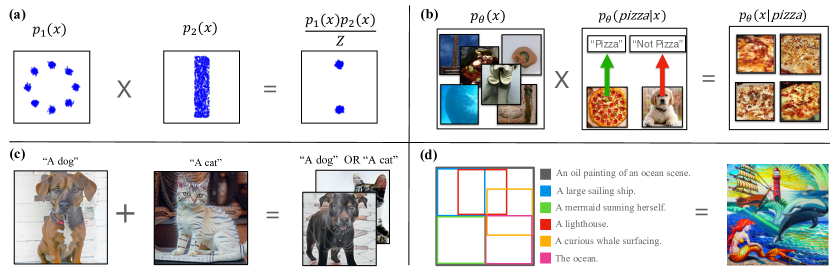
Since their introduction, diffusion models have quickly become the prevailing approach to generative modeling in many domains. They can be interpreted as learning the gradients of a time-varying sequence of log-probability density functions. This interpretation has motivated classifier-based and classifier-free guidance as methods for post-hoc control of diffusion models. In this work, we build upon these ideas using the score-based interpretation of diffusion models, and explore alternative ways to condition, modify, and reuse diffusion models for tasks involving compositional generation and guidance. In particular, we investigate why certain types of composition fail using current techniques and present a number of solutions. We conclude that the sampler (not the model) is responsible for this failure and propose new samplers, inspired by MCMC, which enable successful compositional generation. Further, we propose an energy-based parameterization of diffusion models which enables the use of new compositional operators and more sophisticated, Metropolis-corrected samplers. Intriguingly we find these samplers lead to notable improvements in compositional generation across a wide set of problems such as classifier-guided ImageNet modeling and compositional text-to-image generation.
Motivation & Objective
- Motivate why simple diffusion-model compositions fail and identify sampler limitations as the root cause.
- Propose MCMC-based sampling and energy-based parameterizations to enable correct compositional generation without retraining.
- Demonstrate improved compositional generation across 2D, CLEVR-like shapes, ImageNet classifier guidance, and text-to-image synthesis.
- Showcase how energy-based diffusion enables more flexible, refined compositional operators such as product, mixture, and negation.
Proposed method
- Frame diffusion models in a score-based/denoising-score-matching perspective and discuss conditional guidance via Bayes’ rule and guidance scales.
- Introduce and analyze compositional operators: product, mixture, and negation, and show why naive score-based combination can fail.
- Propose annealed MCMC samplers (ULA, HMC variants) to sample from composed distributions, including Metropolis-corrected variants (MALA, MALA-like, HMC).
- Adopt an energy-based parameterization f_theta(x,t) with epsilon_theta(x,t) = -∇x f_theta(x,t) to obtain an explicit unnormalized log-density, enabling Metropolis adjustments and richer composition.
- Demonstrate how energy-based parameterization enables sampling with MCMC that faithfully samples from composed distributions.
- Apply the approach to 2D densities, CLEVR-like cube placements, ImageNet classifier-guided generation, and text-to-image composition, including tapestry-style multi-scale content.
Experimental results
Research questions
- RQ1Can diffusion-model compositions be sample-correctly realized without retraining using standard reverse diffusion?
- RQ2Does MCMC-based sampling (ULA, HMC, with or without Metropolis corrections) yield samples faithful to composed distributions, and how does energy-based parameterization affect this?
- RQ3What are the practical gains in sample quality and fidelity when applying compositional operators (product, mixture, negation) across varied domains (2D, 3D-like shapes, ImageNet, text-to-image)?
- RQ4How do energy-based diffusion models enable more sophisticated samplers and compositions compared to score-based parameterizations?
Key findings
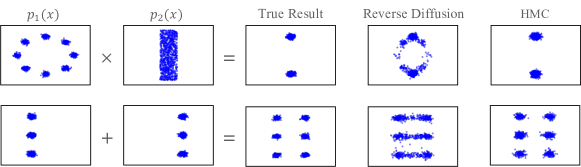
- Naive reverse-diffusion sampling fails to faithfully realize composed distributions (product/mixture) in diffusion-model ensembles.
- Annealed MCMC sampling (ULA, HMC) improves samples from composed models, with Metropolis adjustments providing further gains.
- Energy-based parameterization enabling explicit log-density allows effective Metropolis-corrected samplers (MALA, HMC) and yields notable improvements in compositional tasks.
- Across 2D densities, CLEVR-like cube conditioning, ImageNet classifier-guided generation, and text-to-image composition, MCMC-based sampling with energy-based parameterization achieves higher fidelity and better quantitative metrics (e.g., RAISE/LL/MMD-based assessments; improved Inception Score and FID in classifier-guided ImageNet).
- The approach enables text-to-image composition and image tapestry generation, with results suggesting that sampling method (not just model) drives compositional success.
Read this paper
Open the full text in the Nubint reader and ask about any passage as you read.
Read this paper on NubintThis review was generated by AI from the original paper. Please check the paper before citing it.