
[Paper Review] Reducing approximate Longest Common Subsequence to approximate Edit Distance
This paper presents a novel reduction from approximate Longest Common Subsequence (LCS) to approximate Edit Distance (ED), enabling the first efficient $(1/2 + \epsilon)$-approximation algorithm for binary LCS—breaking the longstanding $1/2$-approximation barrier. The method leverages fine-grained analysis of character counts and substring matching strategies, using a black-box approximate ED algorithm to guide LCS approximation via dynamic partitioning and greedy matching on balanced string segments.
Given a pair of strings, the problems of computing their Longest Common Subsequence and Edit Distance have been extensively studied for decades. For exact algorithms, LCS and Edit Distance (with character insertions and deletions) are equivalent; the state of the art running time is (almost) quadratic and this is tight under plausible fine-grained complexity assumptions. But for approximation algorithms the picture is different: there is a long line of works with improved approximation factors for Edit Distance, but for LCS (with binary strings) only a trivial $1/2$-approximation was known. In this work we give a reduction from approximate LCS to approximate Edit Distance, yielding the first efficient $(1/2+ε)$-approximation algorithm for LCS for some constant $ε>0$.
Motivation & Objective
- To overcome the long-standing $1/2$-approximation barrier for binary LCS, which had resisted improvement despite progress in edit distance approximation.
- To establish a fine-grained reduction from approximate LCS to approximate edit distance, showing that better LCS approximation is no harder than better ED approximation.
- To design a deterministic, efficient algorithm for binary LCS that achieves a $(1/2 + \epsilon)$-approximation factor using only a constant-factor approximate ED oracle.
- To demonstrate that near-linear time approximate ED algorithms can be leveraged to achieve $O(n^{1+\delta})$-time $(1/2 + \epsilon)$-approximation for LCS.
Proposed method
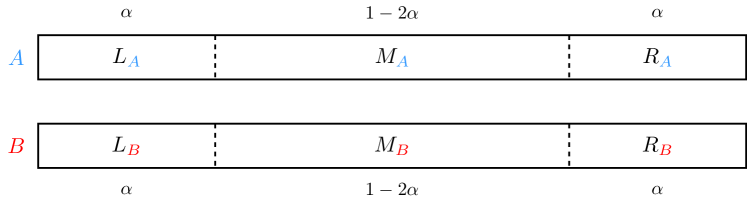
- Partition input strings $A$ and $B$ into left, middle, and right segments of equal length $\alpha$, enabling localized analysis of character distributions.
- Use a black-box approximate edit distance algorithm to estimate $\widetilde{\text{ED}}(A,B)$, which informs the choice of matching strategy based on $0$ and $1$ counts in substrings.
- Apply a greedy matching procedure $\textsc{Match}(X,Y,b)$ that finds the longest common subsequence of $X$ and $Y$ consisting only of bit $b$, based on minima of $b$-counts.
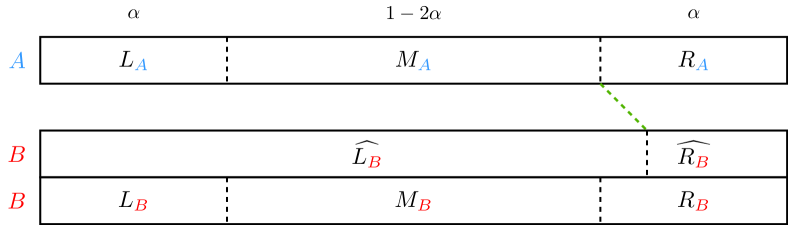
- Define cases based on the distribution of $0$s and $1$s in the right and left parts of $B$, using thresholds $\alpha/2 \pm \beta$ to guide algorithmic branching.
- Combine results from multiple $\textsc{Match}$ calls on overlapping or adjacent substrings (e.g., $L_A \cup M_A$ and $L_B \cup M_B$) to construct a common subsequence of length $\geq \alpha + 2\beta$.
- Use a fallback strategy when $\textsc{Match}$ results are small, switching to a best-match or ED-estimated path to ensure $\Omega(\alpha)$-length output.
Experimental results
Research questions
- RQ1Can a $(1/2 + \epsilon)$-approximation for binary LCS be achieved using only a constant-factor approximate edit distance oracle?
- RQ2Is there a fine-grained reduction from approximate LCS to approximate edit distance that preserves sub-quadratic running time?
- RQ3Can the $1/2$-approximation barrier for binary LCS be broken using techniques from approximate edit distance algorithms?
- RQ4What structural properties of string substrings (e.g., $0$ and $1$ counts) can be exploited to design better LCS approximation algorithms?
- RQ5Can near-linear time approximate edit distance algorithms be used to achieve $O(n^{1+\delta})$-time $(1/2 + \epsilon)$-approximation for LCS?
Key findings
- The paper establishes a reduction from approximate LCS to approximate edit distance: if a $c$-approximate ED algorithm exists, then a $(1/2 + \epsilon(c))$-approximation for LCS exists.
- The algorithm achieves a $(1/2 + \epsilon)$-approximation for binary LCS in time $T(n) + O(n)$, where $T(n)$ is the time of the approximate ED oracle.
- By plugging in the $\widetilde{O}(n^{2-2/7})$-time constant-factor ED approximation algorithm from [CDG+18], the paper yields a $(1/2 + \epsilon)$-approximation for LCS in $\widetilde{O}(n^{2-2/7})$ time.
- Using near-linear time approximate ED algorithms (e.g., [KS19, BR19]), the paper obtains an $O(n^{1+\delta})$-time $(1/2 + \epsilon)$-approximation for LCS for any $\delta > 0$.
- The algorithm guarantees a common subsequence of length at least $\alpha + 2\beta$ in favorable cases, where $\alpha$ is half the string length and $\beta$ is a small constant.
- The reduction is robust to sublinear additive errors in the ED oracle, making it compatible with recent near-linear time ED approximation algorithms.
Read this paper
Open the full text in the Nubint reader and ask about any passage as you read.
Read this paper on NubintThis review was generated by AI from the original paper. Please check the paper before citing it.