
[Paper Review] Reducing Popularity Bias in Recommender Systems through AUC-Optimal Negative Sampling
This paper proposes AUC-optimal negative sampling to reduce popularity bias in recommender systems without sacrificing recommendation accuracy. By optimizing negative sampling to maximize partial AUC, the method corrects both model-dependent and model-independent biases, achieving improved fairness and performance in real-world datasets.
Popularity bias is a persistent issue associated with recommendation systems, posing challenges to both fairness and efficiency. Existing literature widely acknowledges that reducing popularity bias often requires sacrificing recommendation accuracy. In this paper, we challenge this commonly held belief. Our analysis under general bias-variance decomposition framework shows that reducing bias can actually lead to improved model performance under certain conditions. To achieve this win-win situation, we propose to intervene in model training through negative sampling thereby modifying model predictions. Specifically, we provide an optimal negative sampling rule that maximizes partial AUC to preserve the accuracy of any given model, while correcting sample information and prior information to reduce popularity bias in a flexible and principled way. Our experimental results on real-world datasets demonstrate the superiority of our approach in improving recommendation performance and reducing popularity bias.
Motivation & Objective
- To challenge the widely held belief that reducing popularity bias necessarily harms recommendation accuracy.
- To address the interplay between model-dependent and model-independent biases that amplify popularity bias in collaborative filtering.
- To develop a flexible, lightweight method that maintains model accuracy while correcting bias through principled negative sampling.
- To provide a unified framework for reducing both overestimation of popular items and underestimation of cold items.
Proposed method
- The method intervenes in model training via negative sampling to maximize partial AUC, preserving the accuracy of any given recommendation model.
- It introduces an optimal negative sampling rule that corrects sample information to mitigate model-dependent bias (e.g., from collaborative filtering feedback loops).
- It corrects prior information to address model-independent bias (e.g., selection bias from skewed item popularity distributions).
- The approach uses a bias-variance decomposition framework to show that bias reduction and performance improvement can coexist under certain conditions.
- The sampling rule is derived to optimize the trade-off between true positive rate and false positive rate within a controllable range (controlled by γ).
- The method is implemented as a pre-processing step before contrastive loss computation, making it compatible with any existing recommendation model.
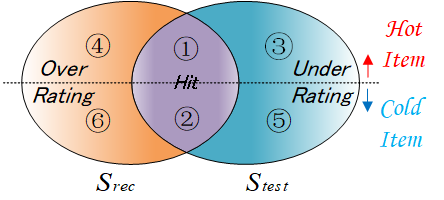
Experimental results
Research questions
- RQ1Can reducing popularity bias be achieved without sacrificing recommendation accuracy, contrary to the common trade-off assumption?
- RQ2How is popularity bias related to false positive and false negative rates in model predictions?
- RQ3What is the optimal negative sampling strategy that maximizes partial AUC while correcting both model-dependent and model-independent biases?
- RQ4Can a unified, lightweight method reduce both overestimation of popular items and underestimation of cold items?
- RQ5How does the choice of γ (controlling acceptable false positive rate) affect top-k ranking performance?
Key findings
- The proposed method achieves a win-win outcome: reducing popularity bias while improving or maintaining recommendation accuracy.
- The best top-5 ranking performance (Pre@5 = 0.4324) was achieved at γ = 6e-3, indicating optimal balance between false positive rate and true positive rate.
- The best top-10 ranking performance (Pre@10 = 0.3594) was achieved at γ = 100e-3, reflecting greater tolerance for false positives as k increases.
- The method effectively reduces both overestimation of popular items and underestimation of cold items through targeted correction of sample and prior information.
- Empirical results on real-world datasets confirm the superiority of the approach in reducing popularity bias and improving fairness without model complexity increase.
- The method maintains high performance even when γ is increased, demonstrating robustness to varying false positive rate tolerances.
Read this paper
Open the full text in the Nubint reader and ask about any passage as you read.
Read this paper on NubintThis review was generated by AI from the original paper. Please check the paper before citing it.