
[Paper Review] Ref-NeuS: Ambiguity-Reduced Neural Implicit Surface Learning for Multi-View Reconstruction with Reflection
Ref-NeuS proposes a novel neural implicit surface learning framework for multi-view 3D reconstruction of reflective objects, reducing ambiguity through a reflection-aware photometric loss that models rendered color as a Gaussian distribution with variance guided by an anomaly-detected reflection score. It further improves geometry by using reflection direction-dependent radiance, achieving state-of-the-art performance on reflective surfaces with 0.46 reconstruction accuracy (MAE: 0.91) on the Shiny Blender dataset.
Neural implicit surface learning has shown significant progress in multi-view 3D reconstruction, where an object is represented by multilayer perceptrons that provide continuous implicit surface representation and view-dependent radiance. However, current methods often fail to accurately reconstruct reflective surfaces, leading to severe ambiguity. To overcome this issue, we propose Ref-NeuS, which aims to reduce ambiguity by attenuating the effect of reflective surfaces. Specifically, we utilize an anomaly detector to estimate an explicit reflection score with the guidance of multi-view context to localize reflective surfaces. Afterward, we design a reflection-aware photometric loss that adaptively reduces ambiguity by modeling rendered color as a Gaussian distribution, with the reflection score representing the variance. We show that together with a reflection direction-dependent radiance, our model achieves high-quality surface reconstruction on reflective surfaces and outperforms the state-of-the-arts by a large margin. Besides, our model is also comparable on general surfaces.
Motivation & Objective
- Address the critical challenge of ambiguous geometry reconstruction in reflective surfaces during multi-view 3D reconstruction.
- Overcome the failure of existing neural implicit methods in handling reflective surfaces due to multi-view consistency breakdown.
- Develop a method that reduces ambiguity without relying on complex physical decomposition of surface appearance.
- Improve surface normal accuracy and rendering realism on reflective objects through better radiance modeling and loss weighting.
- Achieve state-of-the-art reconstruction quality on both reflective and general surfaces using a unified, end-to-end framework.
Proposed method
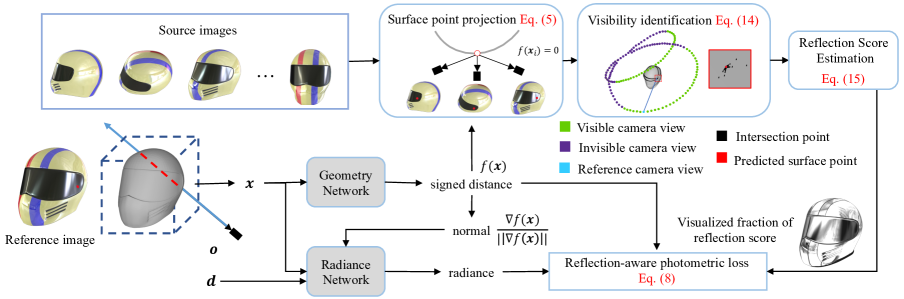
- Introduce a reflection score estimation module using an anomaly detector that leverages multi-view context from visible images to localize reflective regions.
- Design a reflection-aware photometric loss that models rendered color as a Gaussian distribution, with the reflection score as the variance to attenuate the influence of reflective pixels.
- Use visibility identification to ensure unbiased reflection score estimation by only considering colors from visible source views for each surface point.
- Replace standard view-dependent radiance with reflection direction-dependent radiance to improve radiance field quality and geometry accuracy.
- Train the model end-to-end using a differentiable Gaussian loss, enabling joint optimization of geometry, normals, and appearance.
- Leverage multi-view consistency with adaptive weighting to preserve geometric structure while reducing sensitivity to reflections.

Experimental results
Research questions
- RQ1How can neural implicit surface learning be made robust to reflective surfaces, where multi-view consistency is inherently compromised?
- RQ2Can reflection-induced ambiguity be effectively reduced without relying on physically decomposed surface components?
- RQ3What role does multi-view context play in accurately estimating reflection scores for use in loss weighting?
- RQ4How does reflection direction-dependent radiance improve geometry and surface normal estimation compared to standard view-dependent radiance?
- RQ5To what extent does combining reflection-aware loss with direction-dependent radiance enhance reconstruction quality on reflective objects?
Key findings
- Ref-NeuS achieves a reconstruction accuracy of 0.46 (lower is better) and a mean angular error (MAE) of 0.91 on the Shiny Blender dataset, significantly outperforming baseline methods like NeuS (1.69, 1.77) and Ref-NeRF.
- The ablation study confirms that combining visibility-aware reflection score estimation with reflection direction-dependent radiance yields the best performance, reducing MAE by 45% compared to baseline NeuS.
- The reflection-aware photometric loss with variance modeled by reflection scores reduces the impact of reflective pixels, leading to more accurate surface geometry and normals.
- Improved surface normals from the model lead to higher PSNR in novel view synthesis, demonstrating better rendering realism compared to Ref-NeRF, despite using fewer rays.
- The method maintains strong performance on non-reflective surfaces, showing generalization capability beyond reflective objects.
- The full model (with both reflection-aware loss and direction-dependent radiance) achieves the best results, proving the complementarity of both components.
Read this paper
Open the full text in the Nubint reader and ask about any passage as you read.
Read this paper on NubintThis review was generated by AI from the original paper. Please check the paper before citing it.