
[Paper Review] REFLECT: Summarizing Robot Experiences for Failure Explanation and Correction
REFLECT uses a hierarchical, multisensory robot summary to query LLMs for failure explanations and correction plans, evaluated on RoboFail with both simulation and real-world data.
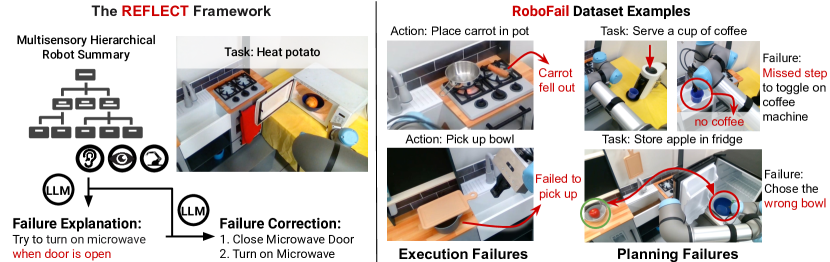
The ability to detect and analyze failed executions automatically is crucial for an explainable and robust robotic system. Recently, Large Language Models (LLMs) have demonstrated strong reasoning abilities on textual inputs. To leverage the power of LLMs for robot failure explanation, we introduce REFLECT, a framework which queries LLM for failure reasoning based on a hierarchical summary of robot past experiences generated from multisensory observations. The failure explanation can further guide a language-based planner to correct the failure and complete the task. To systematically evaluate the framework, we create the RoboFail dataset with a variety of tasks and failure scenarios. We demonstrate that the LLM-based framework is able to generate informative failure explanations that assist successful correction planning.
Motivation & Objective
- Motivate robust, explainable robotics by automatically reflecting on past failures.
- Develop a multisensory, hierarchical summary of robot experiences for failure reasoning.
- Harness Large Language Models to produce natural-language failure explanations and corrective plans.
- Create and utilize RoboFail, a dataset of robot failure demonstrations for evaluation.
Proposed method
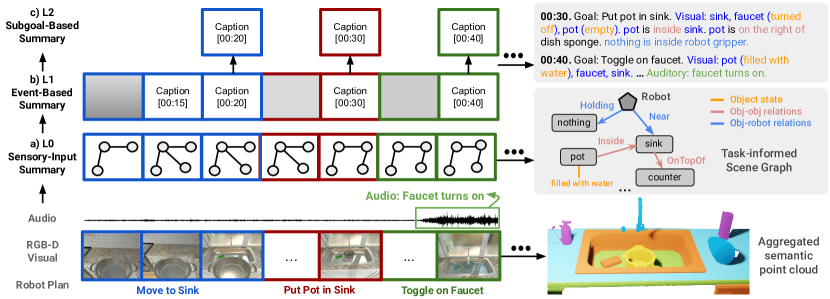
- Construct a three-level hierarchical robot summary (sensory-input, event-based, subgoal-based) from multisensory observations (RGB-D, audio, states).
- Translate sensory data into a task-informed scene graph and audio captions for informative summaries.
- Progressively query an LLM to first detect subgoal success, then generate failure explanations using relevant history from the summaries.
- Ask the LLM to produce a correction plan; map generated actions to executable environment actions using embedding-based matching.
Experimental results
Research questions
- RQ1Can a hierarchical, multisensory summary enable accurate failure localization and explanation via LLMs?
- RQ2Do progressive failure explanations improve localization and explanation quality over non-progressive querying?
- RQ3Can LLM-generated correction plans effectively fix failures in simulated and real-world robot tasks?
- RQ4What is the impact of including audio modality on explanation and localization performance?
- RQ5How does REFLECT compare to caption-based or no-explanation baselines in failure handling?
Key findings
- REFLECT achieves the highest scores for explanation, localization, and correction planning in simulation compared to baselines.
- In simulation, REFLECT reaches about 88.4% explanation, 96.0% localization, and 79.1% correction planning success for execution failures; 84.2%, 80.7%, and 80.7% for planning failures.
- In real-world experiments, REFLECT outperforms baselines with 68.8% explanation and 93.8% localization for execution failures, and 78.6% explanation and 78.6% localization for planning failures.
- Ablations show that progressive failure explanation improves performance over non-progressive baselines; audio helps explain failures inaccessible to vision alone.
- BLIP2 captions perform poorly for failure explanation, while zero-shot, task-relevant summaries capture necessary object-state and spatial-relational information.
Read this paper
Open the full text in the Nubint reader and ask about any passage as you read.
Read this paper on NubintThis review was generated by AI from the original paper. Please check the paper before citing it.