
[Paper Review] Region-centric Image-Language Pretraining for Open-Vocabulary Detection
This paper proposes DITO, a detection-oriented image-text pretraining method that replaces standard classification-based pretraining with a detector architecture to learn region-level, open-vocabulary object representations from noisy image-text pairs using only contrastive loss. By training detector heads directly on large-scale image-text data and introducing Shifted-Window Learning for improved feature robustness, DITO achieves 40.4 mask APr on LVIS and 40.8 novel AP on COCO—surpassing state-of-the-art methods without pseudo-labeling.
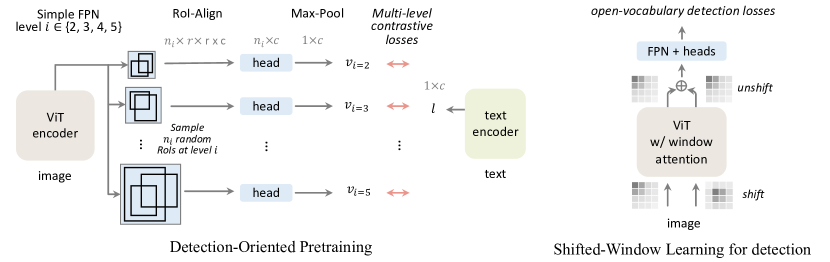
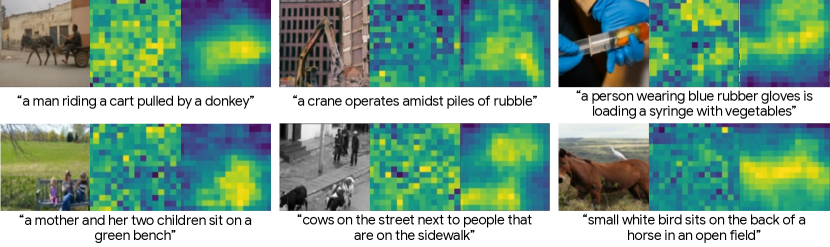
We present a new open-vocabulary detection approach based on region-centric image-language pretraining to bridge the gap between image-level pretraining and open-vocabulary object detection. At the pretraining phase, we incorporate the detector architecture on top of the classification backbone, which better serves the region-level recognition needs of detection by enabling the detector heads to learn from large-scale image-text pairs. Using only standard contrastive loss and no pseudo-labeling, our approach is a simple yet effective extension of the contrastive learning method to learn emergent object-semantic cues. In addition, we propose a shifted-window learning approach upon window attention to make the backbone representation more robust, translation-invariant, and less biased by the window pattern. On the popular LVIS open-vocabulary detection benchmark, our approach sets a new state of the art of 37.6 mask APr using the common ViT-L backbone and public LAION dataset, and 40.5 mask APr using the DataComp-1B dataset, significantly outperforming the best existing approach by +3.7 mask APr at system level. On the COCO benchmark, we achieve very competitive 39.6 novel AP without pseudo labeling or weak supervision. In addition, we evaluate our approach on the transfer detection setup, where it demonstrates notable improvement over the baseline. Visualization reveals emerging object locality from the pretraining recipes compared to the baseline.
Motivation & Objective
- To close the gap between image-level pretraining and open-vocabulary object detection by learning region-level representations during pretraining.
- To enable detector heads to learn from large-scale, noisy image-text pairs without requiring pseudo-labeling or additional supervision.
- To improve vision transformer robustness and reduce window-attention bias in detection through a novel shifted-window learning strategy.
- To achieve state-of-the-art performance on open-vocabulary detection benchmarks without relying on weak supervision or joint training.
- To demonstrate that detector architecture during pretraining enables emergent object locality and better generalization to novel categories.
Proposed method
- Replace standard image classification head with a detection head during pretraining to enable region-level supervision from image-text pairs.
- Use random region sampling and RoI pooling across multiple feature pyramid levels to provide multi-scale image-text supervision.
- Apply max pooling over RoI embeddings to aggregate region-level features, improving alignment with text queries.
- Introduce Shifted-Window Learning (SWL) by applying non-overlapping window attention with stride less than window size to reduce pattern bias and improve translation invariance.
- Train using only contrastive loss on image-text pairs, without additional objectives or pseudo-labeling.
- Fine-tune the full detector on downstream detection datasets using standard detection head training.
Experimental results
Research questions
- RQ1Can training detector heads directly during image-text pretraining improve open-vocabulary detection performance without additional supervision?
- RQ2Does replacing classification-based pretraining with detection-based pretraining lead to better localization and generalization to novel categories?
- RQ3Can Shifted-Window Learning mitigate the bias introduced by standard window attention in vision transformers for detection?
- RQ4How does detection-oriented pretraining compare to existing methods in terms of zero-shot and few-shot generalization on LVIS and COCO?
- RQ5To what extent do the pretraining features learn localized, object-aware representations without explicit bounding box supervision?
Key findings
- DITO achieves 40.4 mask APr on the LVIS open-vocabulary detection benchmark using a ViT-L backbone, surpassing the previous best method by +6.5 APr at the system level.
- In the setting with external box annotations, DITO achieves 45.8 box APr, a significant +12.5 point improvement over the prior state of the art.
- On the COCO benchmark, DITO achieves 40.8 novel AP without using pseudo-labeling or weak supervision, demonstrating strong generalization to novel categories.
- The ablation study shows that using shifted-window learning in both the frozen backbone and fine-tuned detector yields the largest gain of +4.1 APr.
- The optimal window size for SWL is 4×4, outperforming full global attention (1×1 grid) by +4.6 APr.
- Visualization confirms that DITO features learn more localized semantic representations compared to baseline features, especially for unseen or novel objects.
Read this paper
Open the full text in the Nubint reader and ask about any passage as you read.
Read this paper on NubintThis review was generated by AI from the original paper. Please check the paper before citing it.