
[Paper Review] Reimagining Synthetic Tabular Data Generation through Data-Centric AI: A Comprehensive Benchmark
The paper introduces a data-centric AI framework to evaluate and guide synthetic tabular data generation, showing that statistical fidelity alone is insufficient and that data profiles improve downstream utility across several generative models.
Synthetic data serves as an alternative in training machine learning models, particularly when real-world data is limited or inaccessible. However, ensuring that synthetic data mirrors the complex nuances of real-world data is a challenging task. This paper addresses this issue by exploring the potential of integrating data-centric AI techniques which profile the data to guide the synthetic data generation process. Moreover, we shed light on the often ignored consequences of neglecting these data profiles during synthetic data generation -- despite seemingly high statistical fidelity. Subsequently, we propose a novel framework to evaluate the integration of data profiles to guide the creation of more representative synthetic data. In an empirical study, we evaluate the performance of five state-of-the-art models for tabular data generation on eleven distinct tabular datasets. The findings offer critical insights into the successes and limitations of current synthetic data generation techniques. Finally, we provide practical recommendations for integrating data-centric insights into the synthetic data generation process, with a specific focus on classification performance, model selection, and feature selection. This study aims to reevaluate conventional approaches to synthetic data generation and promote the application of data-centric AI techniques in improving the quality and effectiveness of synthetic data.
Motivation & Objective
- Highlight limitations of purely statistical fidelity in synthetic tabular data generation.
- Propose a data-centric AI framework that profiles data and guides synthetic data creation.
- Benchmark five state-of-the-art tabular data generators across eleven datasets.
- Assess impact of data-centric preprocessing/postprocessing on downstream classification, model selection, and feature selection.
- Provide practical recommendations for integrating data-centric insights into synthetic data workflows.
Proposed method
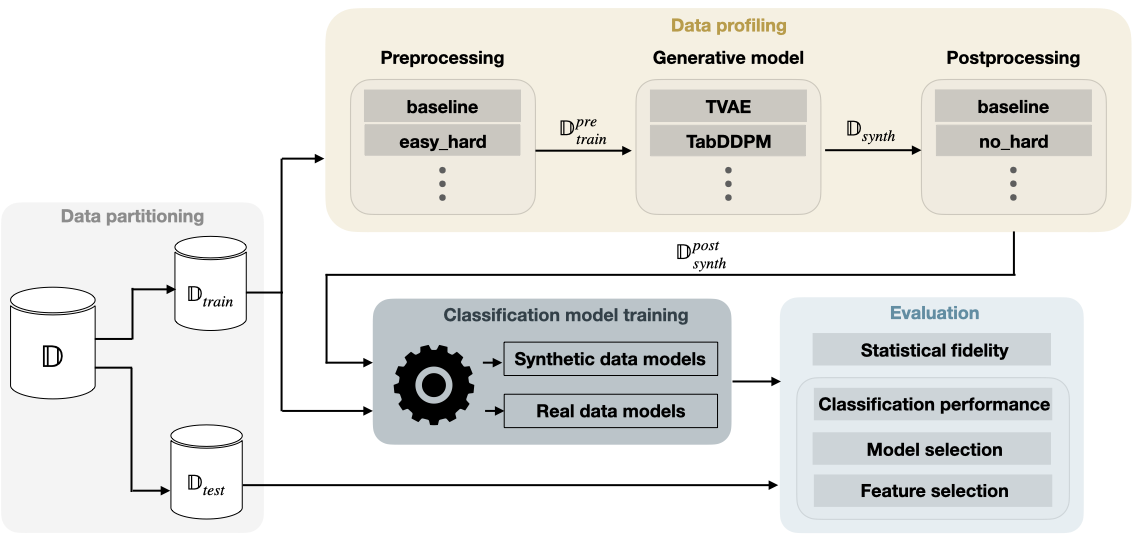
- Define data-centric profiling (easy/ambiguous/hard) using methods like Cleanlab, Data-IQ, and Data Maps.
- Preprocess the real training data to create profiles before training generative models.
- Train separate generative models on different data profiles and combine synthetic data proportionally.
- Apply postprocessing strategies (baseline vs. remove hard examples) to the synthetic data.
- Train classifiers on real vs. synthetic data and compare via downstream evaluation (AUROC, rankings).
- Evaluate statistical fidelity with divergence metrics (inverse KL, MMD, Wasserstein) and extend to data-utility tasks.
Experimental results
Research questions
- RQ1Does statistical fidelity alone predict downstream utility of synthetic tabular data?
- RQ2Can data-centric profiling improve the realism and utility of synthetic data for classification, model selection, and feature selection?
- RQ3How do different generative models perform across downstream tasks when guided by data profiles?
- RQ4What is the impact of label noise on the effectiveness of data-centric preprocessing/postprocessing?
Key findings
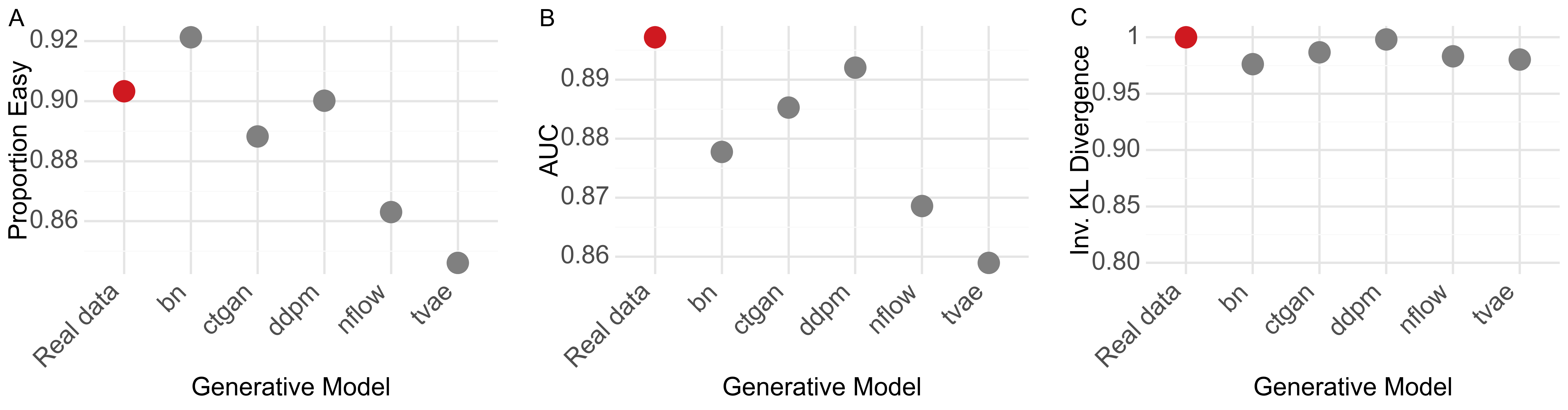
- Statistical fidelity alone is insufficient to gauge synthetic data usefulness for downstream tasks.
- Different generative models (CTGAN, TabDDPM, TVAE) excel at different tasks (model selection, feature selection, classification).
- Data-centric preprocessing and postprocessing generally improve classification, model selection, and feature selection across most models and datasets, often with some loss in statistical fidelity.
- The benefits of data-centric processing persist under varying label noise but diminish somewhat at high noise levels (e.g., >8%).
- No single generator dominates across all tasks; CTGAN and TVAE often offer favorable trade-offs between fidelity and downstream utility.
Read this paper
Open the full text in the Nubint reader and ask about any passage as you read.
Read this paper on NubintThis review was generated by AI from the original paper. Please check the paper before citing it.