
[Paper Review] Reinforcement Learning and Machine ethics:a systematic review
This systematic review synthesizes recent research on reinforcement learning (RL) for machine ethics, analyzing how ethical behavior is implemented in RL agents through ethical specifications, frameworks, and environments. It identifies key trends, highlights gaps in ethical theory grounding, and calls for standardized taxonomies and stronger integration with moral philosophy to avoid 'anecdotal ethics' and ensure responsible development.
Machine ethics is the field that studies how ethical behaviour can be accomplished by autonomous systems. While there exist some systematic reviews aiming to consolidate the state of the art in machine ethics prior to 2020, these tend to not include work that uses reinforcement learning agents as entities whose ethical behaviour is to be achieved. The reason for this is that only in the last years we have witnessed an increase in machine ethics studies within reinforcement learning. We present here a systematic review of reinforcement learning for machine ethics and machine ethics within reinforcement learning. Additionally, we highlight trends in terms of ethics specifications, components and frameworks of reinforcement learning, and environments used to result in ethical behaviour. Our systematic review aims to consolidate the work in machine ethics and reinforcement learning thus completing the gap in the state of the art machine ethics landscape
Motivation & Objective
- To consolidate the state of the art in reinforcement learning (RL) for machine ethics, a rapidly growing but under-surveyed domain.
- To identify and categorize ethical specifications, RL components, and frameworks used in recent RL-based machine ethics research.
- To analyze the types of environments and ethical theories (e.g., utilitarianism, deontology) underlying ethical behavior in RL agents.
- To highlight gaps in ethical theory grounding and the lack of consensus on whose ethics should be encoded in RL systems.
- To provide a foundation for future research by establishing a taxonomy and identifying key challenges such as bias propagation and lack of benchmarking.
Proposed method
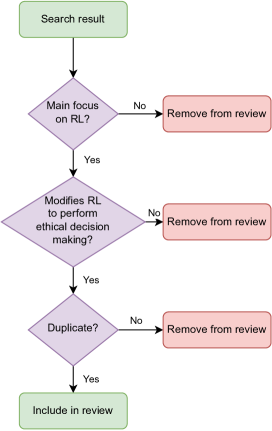
- Conducted a systematic literature review using keywords across AI research repositories, filtering 605 initial papers to 62 relevant, on-topic studies.
- Analyzed papers based on the RL paradigm used (e.g., Q-learning, deep RL, actor-critic, inverse RL, multi-objective RL), ethical theory alignment, and modifications to RL components (e.g., reward shaping, constraints, reward modeling).
- Categorized ethical specifications by source: developer, user, expert, co-operator, or unspecified human factor.
- Mapped ethical theories used, including utilitarianism, social contracts, virtue ethics, and deontology, and assessed their explicit or implicit implementation.
- Evaluated environments used to train ethical RL agents, such as game-like scenarios, recommendation systems, and multi-agent settings.
- Identified trends such as increasing use of constrained multi-objective RL and Safe RL for ethical alignment, and emphasized the need for formal ethical grounding.
Experimental results
Research questions
- RQ1How are ethical behaviors encoded in reinforcement learning agents, and which RL paradigms are most commonly used?
- RQ2Which ethical theories (e.g., utilitarianism, deontology) are most frequently implemented or referenced in RL-based machine ethics research?
- RQ3Who is the source of ethical values in RL agents—developers, users, experts, or teammates—and what are the implications of this choice?
- RQ4What are the dominant frameworks and components (e.g., reward shaping, constraints) used to achieve ethical behavior in RL agents?
- RQ5How can the field move beyond 'anecdotal ethics' and establish a more systematic, philosophically grounded approach to ethical RL?
Key findings
- The review identifies a growing trend in using constrained multi-objective RL and Safe RL to embed ethical behavior, suggesting these are promising pathways for ethical alignment.
- Most studies do not explicitly ground ethical behavior in a well-defined moral theory, leading to a risk of propagating unexamined developer or user biases.
- A significant number of papers rely on human demonstrators or expert feedback, but few ensure these experts are aware of competing ethical perspectives, risking narrow ethical encoding.
- User-specified ethics is a viable but usability-challenging approach, as excessive customization may hinder practical deployment.
- There is a lack of standardized benchmarks and systematic evaluation methods for assessing the ethical capabilities of RL agents, creating a major research gap.
- The field would benefit from a shared taxonomy and stronger integration with moral philosophy and psychology to avoid ad hoc or anthropocentric ethical assumptions.
Read this paper
Open the full text in the Nubint reader and ask about any passage as you read.
Read this paper on NubintThis review was generated by AI from the original paper. Please check the paper before citing it.