
[Paper Review] Reinforcement Learning-based Counter-Misinformation Response Generation: A Case Study of COVID-19 Vaccine Misinformation
The paper introduces MisinfoCorrect, an RL-based counter-misinformation response generator that uses two novel datasets (in-the-wild and crowdsourced) to produce polite, evidenced, and refuting responses to COVID-19 vaccine misinformation, and shows it outperforms baselines.
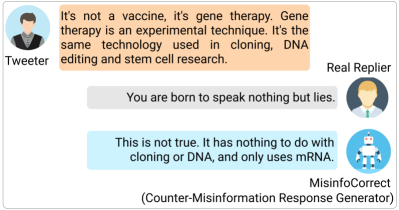
The spread of online misinformation threatens public health, democracy, and the broader society. While professional fact-checkers form the first line of defense by fact-checking popular false claims, they do not engage directly in conversations with misinformation spreaders. On the other hand, non-expert ordinary users act as eyes-on-the-ground who proactively counter misinformation -- recent research has shown that 96% counter-misinformation responses are made by ordinary users. However, research also found that 2/3 times, these responses are rude and lack evidence. This work seeks to create a counter-misinformation response generation model to empower users to effectively correct misinformation. This objective is challenging due to the absence of datasets containing ground-truth of ideal counter-misinformation responses, and the lack of models that can generate responses backed by communication theories. In this work, we create two novel datasets of misinformation and counter-misinformation response pairs from in-the-wild social media and crowdsourcing from college-educated students. We annotate the collected data to distinguish poor from ideal responses that are factual, polite, and refute misinformation. We propose MisinfoCorrect, a reinforcement learning-based framework that learns to generate counter-misinformation responses for an input misinformation post. The model rewards the generator to increase the politeness, factuality, and refutation attitude while retaining text fluency and relevancy. Quantitative and qualitative evaluation shows that our model outperforms several baselines by generating high-quality counter-responses. This work illustrates the promise of generative text models for social good -- here, to help create a safe and reliable information ecosystem. The code and data is accessible on https://github.com/claws-lab/MisinfoCorrect.
Motivation & Objective
- Motivate crowd-driven correction of misinformation by producing effective, evidence-based counter-responses.
- Create two annotated datasets of misinformation posts and counter-responses from social media and crowdsourcing.
- Develop a reinforcement learning framework that rewards politeness, refutation, and evidence while ensuring fluency and relevance.
Proposed method
- Construct two datasets: an in-the-wild Twitter-derived dataset with 754 misinfo-counterreply pairs and a 591-crowdsourced counter-response dataset.
- Annotate counter-responses for properties: refuting, evidence, and politeness; report distribution.
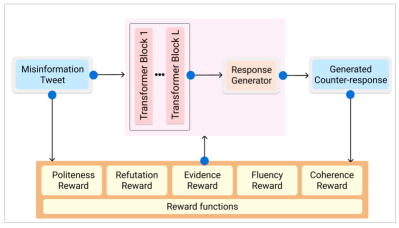
- Develop MisinfoCorrect, a GPT-2-based generator fine-tuned with DialoGPT weights and trained with RL using a composite reward.
- Define state as the misinformation post, action as the generated counter-response, and policy as a transformer-based generator.
- Design rewards for politeness, refutation, evidence, fluency (inverse perplexity), and coherence (semantic similarity to the post).
- Total reward r = α*r_politeness + β*r_refutation + γ*r_evidence + θ*r_fluency + λ*r_coherence; train with reward-augmented objective L(θ) = -r*log p(ĉ|m).
- Initialize with DialoGPT weights and apply a warm-start strategy using paired data; optimize with Adam.
Experimental results
Research questions
- RQ1RQ1: Can the proposed model generate high-quality counter-responses with the desirable properties?
- RQ2RQ2: What is the impact of using in-the-wild vs crowdsourced data on generation quality?
Key findings
- Two large datasets were created: 1,345 counter-misinformation responses in total (754 social-media pairs; 591 crowd-generated).
- MisinfoCorrect outperforms five representative baselines in generating high-quality counter-responses.
- Politeness, refutation, and evidence are explicitly optimized via tailored rewards within an RL setup.
- The approach demonstrates the feasibility of learning evidence-based, respectful counter-responses to COVID-19 vaccine misinformation.
Read this paper
Open the full text in the Nubint reader and ask about any passage as you read.
Read this paper on NubintThis review was generated by AI from the original paper. Please check the paper before citing it.