
[Paper Review] Reinforcement Learning from Delayed Observations via World Models
This paper proposes using world models to address observation delays in partially observable environments by transforming delayed POMDPs into delayed MDPs through latent state representation. By extending Dreamer-V3 with action-memory-aware policies and latent state imagination, the method achieves up to 30% performance gain over baseline model-based RL, particularly excelling in visual and high-delay settings without prior knowledge of delay distribution.
In standard reinforcement learning settings, agents typically assume immediate feedback about the effects of their actions after taking them. However, in practice, this assumption may not hold true due to physical constraints and can significantly impact the performance of learning algorithms. In this paper, we address observation delays in partially observable environments. We propose leveraging world models, which have shown success in integrating past observations and learning dynamics, to handle observation delays. By reducing delayed POMDPs to delayed MDPs with world models, our methods can effectively handle partial observability, where existing approaches achieve sub-optimal performance or degrade quickly as observability decreases. Experiments suggest that one of our methods can outperform a naive model-based approach by up to 250%. Moreover, we evaluate our methods on visual delayed environments, for the first time showcasing delay-aware reinforcement learning continuous control with visual observations.
Motivation & Objective
- To address the challenge of delayed observations in partially observable environments, where standard RL assumes immediate feedback.
- To improve sample efficiency and robustness in delayed POMDPs, where existing model-free and model-based methods degrade under partial observability.
- To enable effective reinforcement learning with visual inputs under observation delays—previously unexplored in delayed RL.
- To develop delay-agnostic and robust methods that do not require prior knowledge of delay distribution or domain-specific hyperparameter tuning.
Proposed method
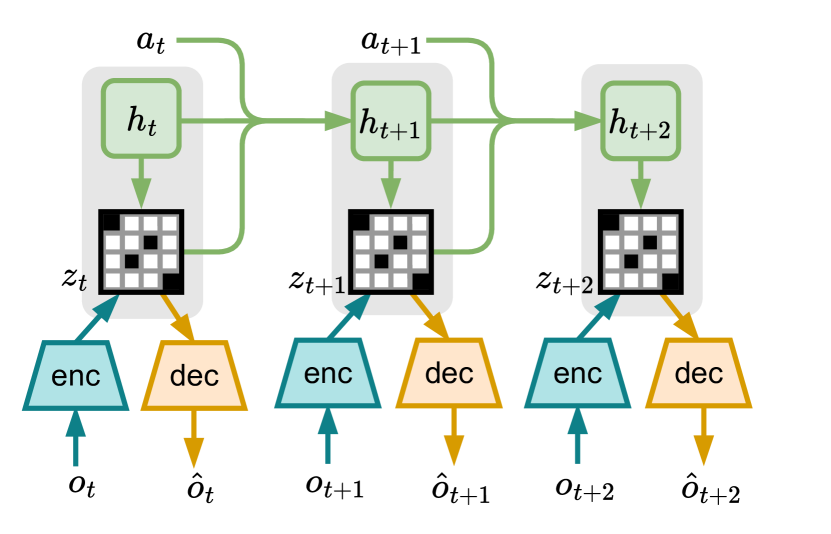
- Proposes three strategies: (1) delayed actor with action memory, (2) latent state imagination via model-based rollouts, and (3) delay-agnostic policy using undelayed world model.
- Adapts Dreamer-V3 by modifying the policy network to incorporate action history since the last observation, forming an extended latent state.
- Uses a learned world model to predict future latent states through imagination, reducing dependency on real-time observations.
- Employs a one-step transition model for rollouts, with error accumulation mitigated via the Extended method that includes action history.
- Introduces a delay-agnostic variant that trains on undelayed data but generalizes to delayed environments without retraining.
- Leverages the inherent temporal modeling capacity of world models to infer hidden states from delayed observations, effectively turning POMDPs into MDPs.
Experimental results
Research questions
- RQ1Can world models effectively mitigate performance degradation in partially observable environments with delayed observations?
- RQ2How does incorporating action history into the latent state improve policy learning under observation delays?
- RQ3Can model-based RL with world models generalize to visual input environments with delayed observations, where prior work is limited?
- RQ4Does a delay-agnostic method trained on undelayed data achieve robust performance across varying delay distributions?
- RQ5How does the performance of world model-based methods compare to memoryless and extended-state MDP baselines under increasing delay and partial observability?
Key findings
- The Extended method, which incorporates action history into the latent state, improves performance by up to 30% on average over the Agnostic baseline in DMC vision tasks.
- The Agnostic method generalizes well across environments without prior knowledge of delay distribution, though performance degrades with increasing delay due to distribution shift.
- The Latent method, relying on one-step prediction, suffers from error accumulation over long delays, leading to significant performance drop.
- The Extended method maintains strong performance under high partial observability, such as when 50% of velocity components are omitted, outperforming D-TRPO and DC-AC in such settings.
- Memoryless and Latent methods perform best under small delays but degrade quickly as delay increases, due to lack of action memory and error accumulation.
- This work is the first to evaluate delay-aware reinforcement learning on visual observation environments, demonstrating feasibility and effectiveness of world models in such settings.

Read this paper
Open the full text in the Nubint reader and ask about any passage as you read.
Read this paper on NubintThis review was generated by AI from the original paper. Please check the paper before citing it.