
[Paper Review] Reinforcement Learning Tutor Better Supported Lower Performers in a Math Task
This study applies deep reinforcement learning (RL) to develop an adaptive narrative-based AI tutor for elementary math, optimizing pedagogical support in real time. The RL agent significantly improved learning outcomes—especially for low-performing students—by providing personalized hints, with results generalizing across diverse student populations and validated through explainable AI methods.
Resource limitations make it hard to provide all students with one of the most effective educational interventions: personalized instruction. Reinforcement learning could be a key tool to reduce the development cost and improve the effectiveness of intelligent tutoring software that aims to provide the right support, at the right time, to a student. Here we illustrate that deep reinforcement learning can be used to provide adaptive pedagogical support to students learning about the concept of volume in a narrative storyline software. Using explainable artificial intelligence tools, we extracted interpretable insights about the pedagogical policy learned and demonstrated that the resulting policy had similar performance in a different student population. Most importantly, in both studies, the reinforcement-learning narrative system had the largest benefit for those students with the lowest initial pretest scores, suggesting the opportunity for AI to adapt and provide support for those most in need.
Motivation & Objective
- To investigate whether reinforcement learning can automatically optimize adaptive pedagogical support in a narrative-based math learning environment.
- To evaluate whether RL-trained tutors improve learning outcomes, particularly for students with low initial knowledge.
- To ensure the learned policy is interpretable using explainable AI (XAI) techniques.
- To test the generalization of the RL policy across different student populations with varying socioeconomic and geographic backgrounds.
- To assess whether the benefits of the RL tutor are due to increased time on task or actual pedagogical effectiveness.
Proposed method
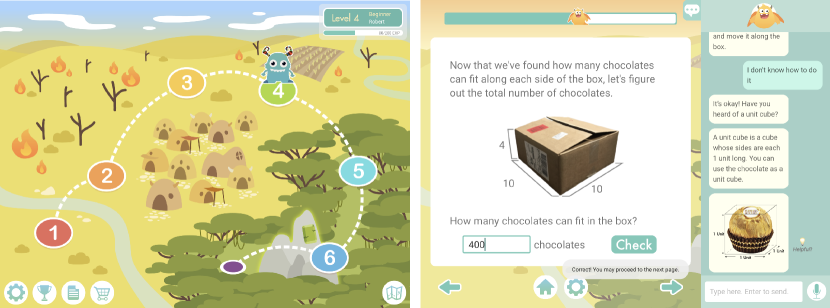
- A deep Q-network (DQN) was trained using offline interaction data from a prior study to learn a policy for selecting optimal hints in a narrative-based math tutoring system.
- The state space included student knowledge estimates, recent performance, and engagement metrics; the action space consisted of different types of hints and feedback.
- The policy was distilled into a lighter-weight model for deployment in a second study with a different student population.
- Explainable AI techniques, including attention maps and saliency analysis, were used to interpret the RL policy and validate its decision-making process.
- The system used real-time user interaction data, including quiz responses and chat logs, to update the agent’s policy via webhooks and a GraphQL-based backend.
- A/B testing compared the RL-powered narrative AI tutor against a control condition with no adaptive support across two independent studies with distinct student cohorts.
Experimental results
Research questions
- RQ1Can reinforcement learning effectively learn to provide adaptive, personalized pedagogical support in a narrative-based math tutoring environment?
- RQ2Does the RL-powered tutor improve learning outcomes, especially for students with low initial knowledge?
- RQ3Can the RL policy be successfully transferred and generalized to a different student population with diverse demographics and socioeconomic backgrounds?
- RQ4Is the observed improvement due to increased time on task or actual pedagogical effectiveness?
- RQ5Can explainable AI methods provide meaningful insights into how the RL agent makes pedagogical decisions?
Key findings
- Students with the lowest pretest scores (0–2) showed the largest improvement in post-test performance when using the RL-powered narrative AI tutor, with a 22.5% relative gain over the control condition.
- The RL tutor outperformed the control condition across all pretest performance groups, but the benefit was most pronounced for low-achieving students, indicating a potential for equity in AI-driven education.
- The distilled policy from Study 1 generalized effectively to Study 2, a more geographically and socioeconomically diverse population, with similar performance gains observed.
- Time-on-task did not significantly differ between conditions, suggesting that the improvement was due to pedagogical quality, not increased engagement time.
- Explainable AI methods revealed that the RL policy prioritized knowledge state and recent performance when selecting hints, demonstrating interpretable and pedagogically sound behavior.
- Engagement scores were higher in the RL condition across all pretest groups, but the most significant performance gains were observed in the lowest-performing group, reinforcing the system’s targeted impact.
Read this paper
Open the full text in the Nubint reader and ask about any passage as you read.
Read this paper on NubintThis review was generated by AI from the original paper. Please check the paper before citing it.