
[Paper Review] Reinforcement Learning with Simple Sequence Priors
This paper proposes a novel reinforcement learning algorithm that incorporates simple sequence priors—favoring action sequences compressible by autoregressive models or off-the-shelf compression algorithms like LZ4—to improve learning efficiency and robustness. By integrating these priors into the Soft Actor-Critic framework as an information-theoretic regularization, the method achieves faster convergence and higher returns than state-of-the-art model-free RL agents in continuous control tasks from the DeepMind Control Suite.
Everything else being equal, simpler models should be preferred over more complex ones. In reinforcement learning (RL), simplicity is typically quantified on an action-by-action basis -- but this timescale ignores temporal regularities, like repetitions, often present in sequential strategies. We therefore propose an RL algorithm that learns to solve tasks with sequences of actions that are compressible. We explore two possible sources of simple action sequences: Sequences that can be learned by autoregressive models, and sequences that are compressible with off-the-shelf data compression algorithms. Distilling these preferences into sequence priors, we derive a novel information-theoretic objective that incentivizes agents to learn policies that maximize rewards while conforming to these priors. We show that the resulting RL algorithm leads to faster learning, and attains higher returns than state-of-the-art model-free approaches in a series of continuous control tasks from the DeepMind Control Suite. These priors also produce a powerful information-regularized agent that is robust to noisy observations and can perform open-loop control.
Motivation & Objective
- To address the limitation of existing RL methods that prioritize simplicity at the action level while ignoring temporal regularities in action sequences.
- To investigate whether enforcing compressibility of action sequences—via autoregressive models or lossless compression algorithms—improves policy learning and generalization.
- To develop a sequence-level inductive bias that enhances sample efficiency, robustness to noise, and information efficiency in deep RL agents.
- To demonstrate that simple sequence priors lead to faster learning and higher returns compared to state-of-the-art model-free RL algorithms.
- To explore the utility of off-the-shelf compression algorithms like LZ4 as effective, zero-shot priors for policy regularization without requiring training.
Proposed method
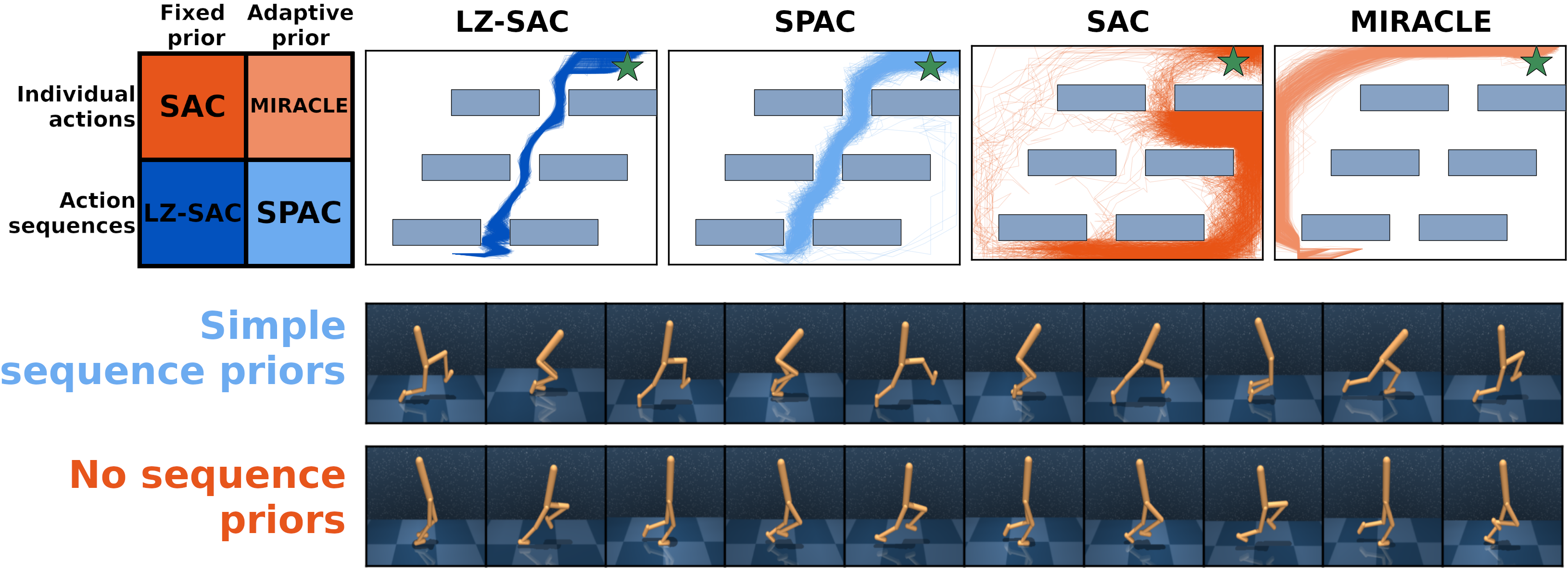
- Proposes Lempel-Ziv Soft Actor-Critic (LZ-SAC), which uses the LZ4 compression algorithm to compute a fixed, pre-programmed prior over action sequences.
- Introduces Soft Predictable Actor-Critic (SPAC), a learned sequence prior using a transformer-based autoregressive model to predict future actions from past actions.
- Derives an information-theoretic objective that regularizes the policy to minimize the description length of action sequences under the prior, encouraging compressible behavior.
- Integrates the sequence prior regularization into the Soft Actor-Critic (SAC) framework by modifying the policy objective to include a negative log-likelihood term based on the prior.
- Employs a differentiable approximation of the compression cost to enable end-to-end training, allowing the agent to learn policies that are both rewarding and compressible.
- Uses the prior to guide exploration and improve generalization, particularly in noisy or partially observed environments.
Experimental results
Research questions
- RQ1Can enforcing compressibility of action sequences lead to faster and more sample-efficient reinforcement learning in continuous control tasks?
- RQ2How does a fixed, off-the-shelf compression prior (e.g., LZ4) compare to a learned sequence prior (e.g., transformer-based model) in terms of policy performance and robustness?
- RQ3To what extent do simple sequence priors improve generalization and robustness under noisy or missing observations?
- RQ4Does information regularization via sequence compression lead to more efficient policies in terms of bits of information used per decision?
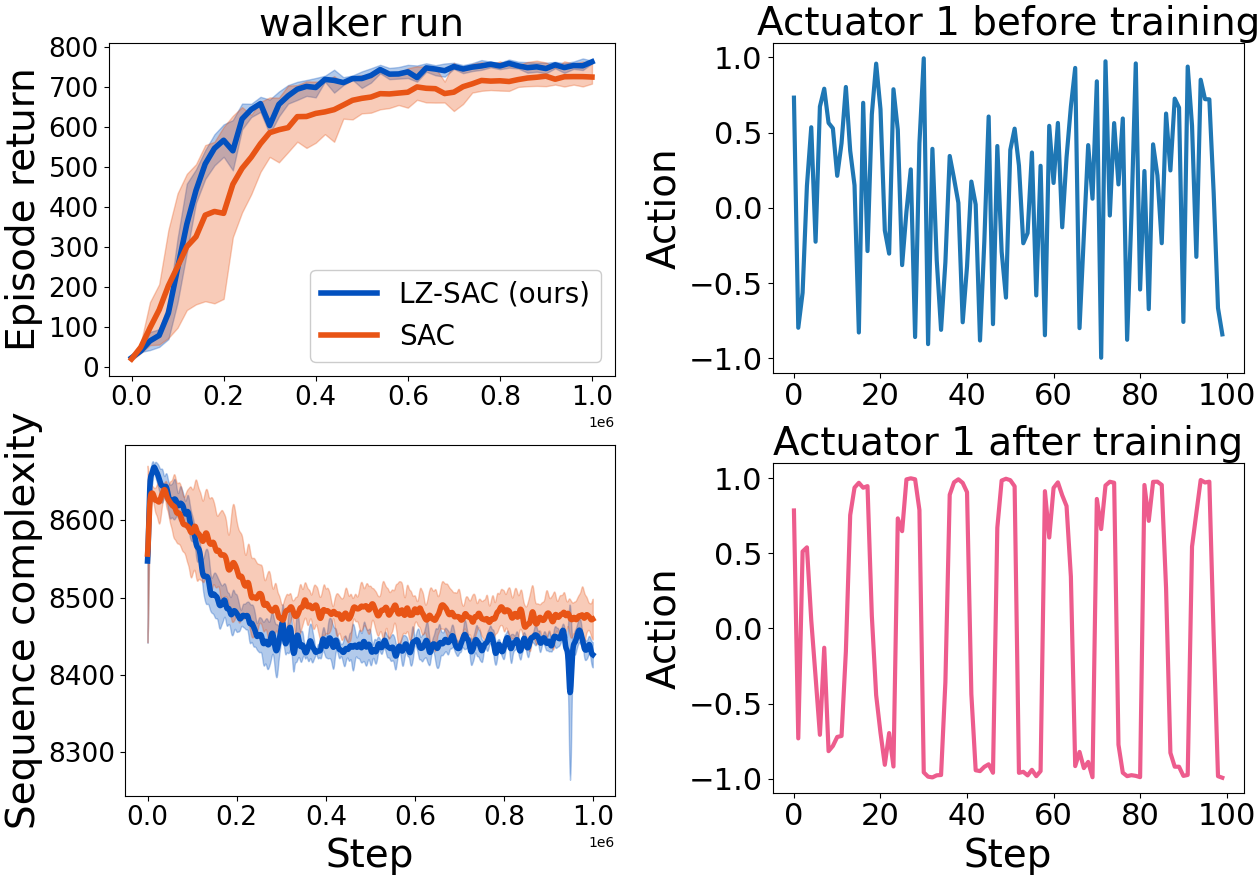
- RQ5Can sequence priors that favor periodic or repetitive action patterns naturally emerge in complex control tasks, such as walking or running?
Key findings
- LZ-SAC outperforms or matches state-of-the-art model-free RL agents like SAC and MIRACLE in terms of final return across multiple tasks in the DeepMind Control Suite.
- SPAC learns more compressible policies than MIRACLE, achieving higher returns while using fewer bits of information per decision, consistent with the information bottleneck principle.
- The LZ4-based prior, despite being fixed and pre-programmed, produces policies that outperform non-sequential priors and come close to the performance of learned priors in tasks like Cheetah Run and Walker Run.
- Agents trained with LZ-SAC show superior robustness to observation noise, maintaining high performance even when inputs are corrupted.
- Both LZ-SAC and SPAC generate predictable, repetitive action sequences (e.g., alternating leg movements in walking), indicating that the priors successfully induce structured, compressible behavior.
- The use of sequence priors leads to faster learning curves, with agents reaching higher returns earlier in training compared to baseline methods.
Read this paper
Open the full text in the Nubint reader and ask about any passage as you read.
Read this paper on NubintThis review was generated by AI from the original paper. Please check the paper before citing it.