
[Paper Review] Relational Multi-Task Learning: Modeling Relations between Data and Tasks
MetaLink builds a heterogeneous knowledge graph over data points and task heads to transfer labels from auxiliary tasks to target tasks, formulating relational multi-task learning as link-label prediction with a GNN.
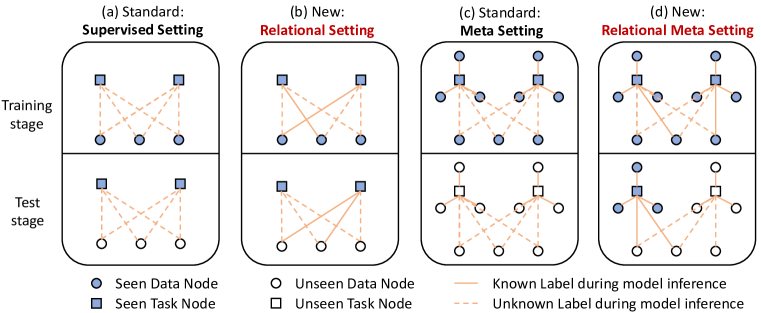
A key assumption in multi-task learning is that at the inference time the multi-task model only has access to a given data point but not to the data point's labels from other tasks. This presents an opportunity to extend multi-task learning to utilize data point's labels from other auxiliary tasks, and this way improves performance on the new task. Here we introduce a novel relational multi-task learning setting where we leverage data point labels from auxiliary tasks to make more accurate predictions on the new task. We develop MetaLink, where our key innovation is to build a knowledge graph that connects data points and tasks and thus allows us to leverage labels from auxiliary tasks. The knowledge graph consists of two types of nodes: (1) data nodes, where node features are data embeddings computed by the neural network, and (2) task nodes, with the last layer's weights for each task as node features. The edges in this knowledge graph capture data-task relationships, and the edge label captures the label of a data point on a particular task. Under MetaLink, we reformulate the new task as a link label prediction problem between a data node and a task node. The MetaLink framework provides flexibility to model knowledge transfer from auxiliary task labels to the task of interest. We evaluate MetaLink on 6 benchmark datasets in both biochemical and vision domains. Experiments demonstrate that MetaLink can successfully utilize the relations among different tasks, outperforming the state-of-the-art methods under the proposed relational multi-task learning setting, with up to 27% improvement in ROC AUC.
Motivation & Objective
- Motivate learning from multiple tasks where test-time data points may come with labels for auxiliary tasks.
- Propose a relational multi-task setting that leverages auxiliary task labels at inference.
- Introduce MetaLink to model data-task, data-data, and task-task relations via a knowledge graph.
- Reformulate predicting a data point on a new task as a link-label prediction problem on a graph.
- Demonstrate data-efficient improvements across biochemical and vision benchmarks.
Proposed method
- Construct a knowledge graph with data nodes (embeddings z^(i)) and task nodes (weights w_j) connected by edges labeled with y_j^(i).
- Reinterpret a task head as input alongside data embeddings, enabling f_phi(w_j, z^(i)) predictions.
- Use a heterogeneous Graph Neural Network (GNN) over the data-task graph to produce node embeddings h_v^(l) via GraphConv layers with type-aware messages and edge features.
- Incorporate edge labels y_v^(u) as trainable edge features in message passing to capture task-specific labels.
- Aggregate over multiple GNN layers to form a final prediction via EdgePred( h_i^(L), h_j^(L) ).
- Apply MetaLink to relational, meta, and relational meta settings, including a relabeling strategy for unseen tasks and inductive initialization for new task nodes.

Experimental results
Research questions
- RQ1Can auxiliary task labels available at inference time improve predictions on a target task in a multi-task setting?
- RQ2How can data points and tasks be modeled in a unified graph so that a GNN can exploit data-task relations for improved performance?
- RQ3Does a heterogeneous GNN with edge features and type-aware message passing effectively leverage cross-task information?
- RQ4How does MetaLink perform across biochemical and vision benchmarks under relational and meta-task settings, including unseen tasks?
- RQ5What is the impact of the ratio of auxiliary task labels on predictive gains?
Key findings
- MetaLink outperforms state-of-the-art baselines under relational multi-task settings on biochemical and vision benchmarks, with up to 27% ROC AUC improvement.
- Relational and relational meta settings yield substantial gains, while standard settings may show limited benefit when auxiliary labels are unavailable.
- Ablation shows larger improvements on tasks with higher inter-task correlations, confirming that MetaLink learns meaningful cross-task relations.
- Increasing the fraction of auxiliary task labels generally improves performance across datasets.
- In few-shot learning benchmarks (mini-ImageNet, tiered-ImageNet), MetaLink with KG layers outperforms baselines, with gains up to 2 KG layers providing the best performance.
- On MS-COCO, MetaLink shows consistent improvements in relational settings, especially when using multiple KG layers.
Read this paper
Open the full text in the Nubint reader and ask about any passage as you read.
Read this paper on NubintThis review was generated by AI from the original paper. Please check the paper before citing it.