
[Paper Review] Relaxation and Dephasing in a Two-electron 13C Nanotube Double Quantum Dot
This study measures relaxation (T₁) and dephasing (T₂*) in a two-electron 13C nanotube double quantum dot using charge-sensing Pauli blockade. It identifies spin-orbit coupling as the dominant relaxation mechanism, with T₁ showing a minimum at 1.4 T, while T₂* ≈ 3.2 ns is consistent with hyperfine coupling, indicating the need for isotopically purified nanotubes to extend coherence.
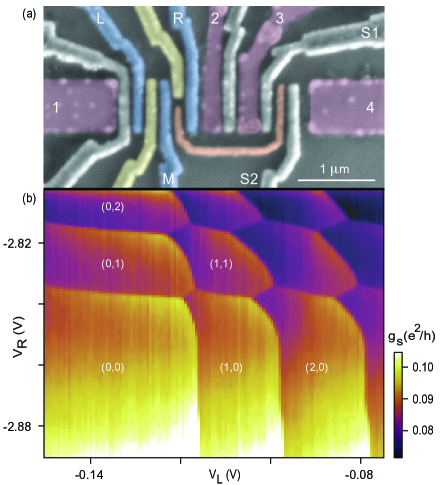
We use charge sensing of Pauli blockade (including spin and isospin) in a two-electron 13C nanotube double quantum dot to measure relaxation and dephasing times. The relaxation time, T1, first decreases with parallel magnetic field then goes through a minimum in a field of 1.4 T. We attribute both results to the spin-orbit-modified electronic spectrum of carbon nanotubes, which suppresses hyperfine mediated relaxation and enhances relaxation due to soft phonons. The inhomogeneous dephasing time, T2*, is consistent with previous data on hyperfine coupling strength in 13C nanotubes.
Motivation & Objective
- To measure relaxation and dephasing times in a two-electron 13C nanotube double quantum dot for spin qubit applications.
- To investigate the role of spin-orbit coupling and hyperfine interactions in relaxation and dephasing mechanisms.
- To determine whether isotopically enriched 13C nanotubes reduce decoherence compared to natural abundance materials.
- To assess the impact of nuclear spin fluctuations on qubit coherence using inhomogeneous dephasing time T₂*.
- To validate theoretical models of spin-orbit coupling and hyperfine coupling in carbon nanotube quantum dots.
Proposed method
- Charge sensing via a capacitively coupled quantum dot to detect tunneling blockade in the (1,1) and (0,2) charge states.
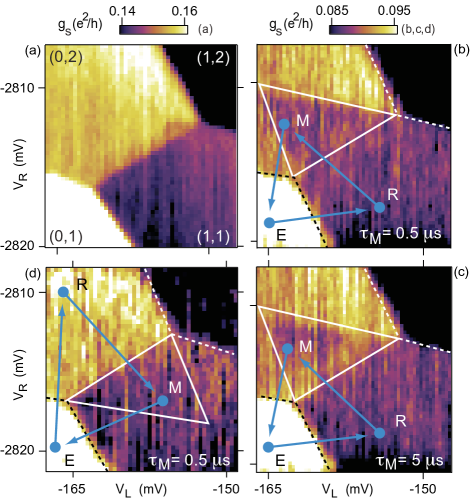
- Application of fast gate pulses to cycle through (1,1) → (0,2) states to measure relaxation time T₁ using return probability.
- Use of a pulse sequence to prepare (0,2) states, separate electrons into (1,1), and measure return probability to infer T₂*.
- Fitting the magnetic field dependence of T₁ to a model incorporating spin-orbit splitting ΔSO and field misalignment angle θ.
- Calibration of sensor conductance gₛ to extract return probability and extract T₂* from Gaussian decay fits.
- Measurement of interdot capacitive coupling and lever-arm ratios from nonlinear transport to extract energy scales.
Experimental results
Research questions
- RQ1How does the relaxation time T₁ of two-electron states in a 13C nanotube double quantum dot depend on applied magnetic field?
- RQ2What is the origin of the observed minimum in T₁ at 1.4 T, and how does it relate to spin-orbit coupling?
- RQ3To what extent does hyperfine coupling contribute to relaxation and dephasing in this system?
- RQ4How does the inhomogeneous dephasing time T₂* compare to theoretical predictions based on nuclear spin fluctuations?
- RQ5Can the observed T₁ and T₂* values be explained by spin-orbit coupling and hyperfine interactions alone, or are additional mechanisms required?
Key findings
- The relaxation time T₁ decreases with increasing parallel magnetic field and exhibits a minimum at 1.4 T, indicating a non-monotonic field dependence.
- The T₁ minimum is attributed to spin-orbit coupling, which suppresses hyperfine-mediated relaxation at low fields and enhances soft-phonon-mediated relaxation at higher fields.
- The measured T₁ is well-fit by a model incorporating spin-orbit splitting ΔSO and field misalignment angle θ, with a scale factor C = 65 ns/√μeV.
- The inhomogeneous dephasing time T₂* is measured to be 3.2 ns, consistent with recent hyperfine coupling measurements in 13C nanotubes.
- The inferred nuclear field fluctuation strength δB||^|| = 1.8 mT is about half the estimated single-dot nuclear field, suggesting possible anisotropy or suppression of dipolar coupling.
- The saturation return probability of 0.17 is lower than the expected 1/3 for singlet-triplet systems in GaAs, likely due to additional isospin degrees of freedom in carbon nanotubes.
Read this paper
Open the full text in the Nubint reader and ask about any passage as you read.
Read this paper on NubintThis review was generated by AI from the original paper. Please check the paper before citing it.