
[Paper Review] Relaxed Transformer Decoders for Direct Action Proposal Generation
This paper proposes RTD-Net, a relaxed Transformer decoder framework for direct temporal action proposal generation that replaces anchor-based and heuristic matching methods with a boundary-attentive encoder, a relaxed matching scheme, and a three-branch detection head. The method achieves state-of-the-art performance on THUMOS14 and ActivityNet-1.3 with faster inference and no need for non-maximum suppression.
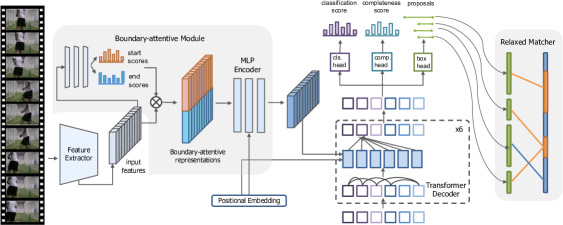
Temporal action proposal generation is an important and challenging task in video understanding, which aims at detecting all temporal segments containing action instances of interest. The existing proposal generation approaches are generally based on pre-defined anchor windows or heuristic bottom-up boundary matching strategies. This paper presents a simple and efficient framework (RTD-Net) for direct action proposal generation, by re-purposing a Transformer-alike architecture. To tackle the essential visual difference between time and space, we make three important improvements over the original transformer detection framework (DETR). First, to deal with slowness prior in videos, we replace the original Transformer encoder with a boundary attentive module to better capture long-range temporal information. Second, due to the ambiguous temporal boundary and relatively sparse annotations, we present a relaxed matching scheme to relieve the strict criteria of single assignment to each groundtruth. Finally, we devise a three-branch head to further improve the proposal confidence estimation by explicitly predicting its completeness. Extensive experiments on THUMOS14 and ActivityNet-1.3 benchmarks demonstrate the effectiveness of RTD-Net, on both tasks of temporal action proposal generation and temporal action detection. Moreover, due to its simplicity in design, our framework is more efficient than previous proposal generation methods, without non-maximum suppression post-processing. The code and models are made available at https://github.com/MCG-NJU/RTD-Action.
Motivation & Objective
- To address the limitations of anchor-based and boundary-matching methods in temporal action proposal generation, which rely on hand-crafted designs and are sensitive to noise.
- To adapt the Transformer architecture for video action proposal generation, overcoming challenges such as feature slowness and ambiguous temporal boundaries.
- To eliminate the need for non-maximum suppression (NMS) by learning consistent proposal scoring through a three-branch head.
- To improve proposal quality by explicitly modeling completeness via a tIoU estimation head.
- To streamline the proposal generation pipeline using a set-prediction paradigm with end-to-end training and inference.
Proposed method
- Replace the standard Transformer encoder with a boundary-attentive module to better capture long-range temporal dependencies and reduce over-smoothing from slow feature changes.
- Introduce a relaxed matching scheme that allows multiple predictions to be assigned to a single ground-truth, reducing the negative impact of ambiguous or noisy annotations.
- Design a three-branch detection head that jointly predicts bounding box coordinates, classification scores, and a completeness score (tIoU) to improve proposal confidence estimation.
- Use a tIoU loss on the completeness head to regularize training and guide the model toward more accurate and complete proposals.
- Train the model end-to-end using a set criterion with relaxed matching, enabling direct prediction of action proposals without anchor generation or post-processing.
- Leverage self-attention in the decoder to model inter-proposal relationships globally, improving localization accuracy through contextual reasoning.
Experimental results
Research questions
- RQ1Can a Transformer-based architecture be effectively adapted for direct temporal action proposal generation in videos, bypassing anchor and heuristic matching mechanisms?
- RQ2How can the inherent slowness of video features and ambiguous temporal boundaries be addressed in a Transformer-based framework?
- RQ3Does a relaxed matching strategy improve training stability and generalization compared to strict one-to-one assignment in proposal generation?
- RQ4Can explicit completeness estimation via tIoU loss improve proposal quality and eliminate the need for NMS?
- RQ5How does the proposed framework compare in efficiency and accuracy to anchor-based and bottom-up boundary-based methods on standard benchmarks?
Key findings
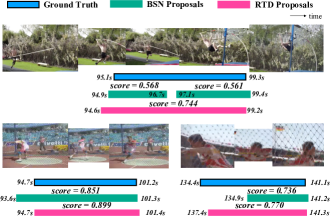
- RTD-Net achieves 61.11% AR@100 on ActivityNet-1.3 and 16.34% AR@1 on HACS Segments with only 100 queries, outperforming BSN in AR@1 despite fewer proposals.
- The model achieves a 53.41% AUC on HACS Segments, matching BSN’s AUC while being free of NMS, indicating higher efficiency at low proposal counts.
- Using early-fusion RGB and optical flow features improves AR@50 to 41.52% on THUMOS14, outperforming RGB-only (37.28%) and flow-only (38.75%) features.
- The completeness head significantly improves proposal quality, with scores consistently ranking proposals by quality and enabling NMS-free inference.
- The relaxed matcher improves convergence and generalization, especially on datasets with noisy or ambiguous annotations.
- The boundary-attentive encoder effectively mitigates over-smoothing from slow feature changes, enhancing boundary localization accuracy.
Read this paper
Open the full text in the Nubint reader and ask about any passage as you read.
Read this paper on NubintThis review was generated by AI from the original paper. Please check the paper before citing it.