
[Paper Review] Reliable LLM-based User Simulator for Task-Oriented Dialogue Systems
The paper introduces DAUS, a domain-aware, fine-tuned LLM-based user simulator for TOD systems that reduces hallucinations and improves goal fulfillment, evaluated on AutomotiveData and MultiWOZ with ConvLab2.
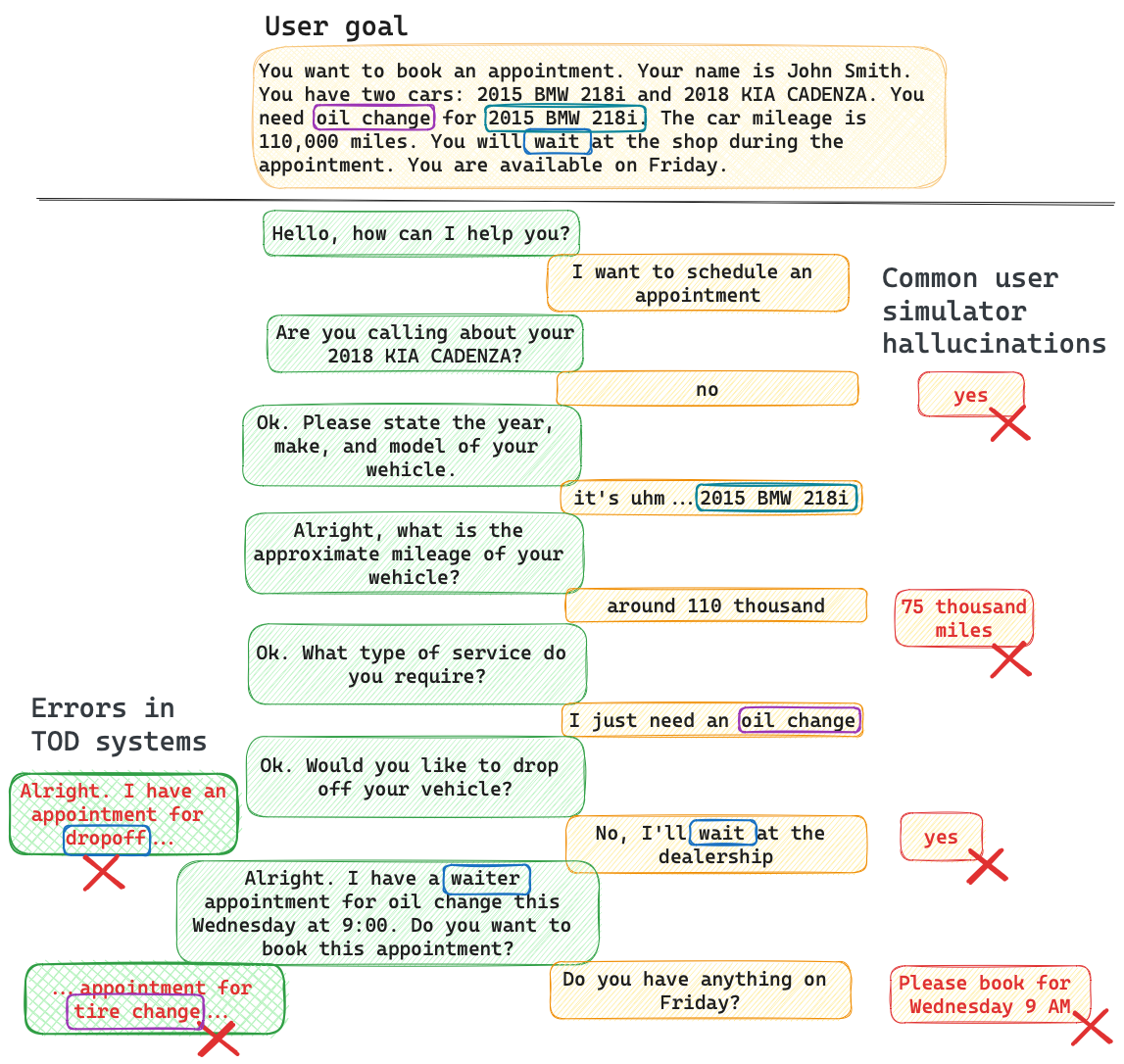
In the realm of dialogue systems, user simulation techniques have emerged as a game-changer, redefining the evaluation and enhancement of task-oriented dialogue (TOD) systems. These methods are crucial for replicating real user interactions, enabling applications like synthetic data augmentation, error detection, and robust evaluation. However, existing approaches often rely on rigid rule-based methods or on annotated data. This paper introduces DAUS, a Domain-Aware User Simulator. Leveraging large language models, we fine-tune DAUS on real examples of task-oriented dialogues. Results on two relevant benchmarks showcase significant improvements in terms of user goal fulfillment. Notably, we have observed that fine-tuning enhances the simulator's coherence with user goals, effectively mitigating hallucinations -- a major source of inconsistencies in simulator responses.
Motivation & Objective
- Motivate the need for realistic user simulation to evaluate and enhance TOD systems.
- Propose a domain-aware, fine-tuned LLM-based user simulator (DAUS) trained on in-domain dialogues with user goals.
- Show that domain-specific fine-tuning reduces hallucinations and improves coherence with user goals.
- Demonstrate data efficiency and system-agnostic interaction by not requiring internals of the TOD system.
Proposed method
- Fine-tune a pre-trained LLM (Llama-2) with LoRA on in-domain dialog data annotated with user goals.
- Construct prompts by concatenating the user goal and dialogue history, and generate the next user utterance autoregressively.
- Post-process generated utterances to pass clean messages to TOD systems.
- Evaluate with internal TOD and ConvLab2-based TODs, comparing against zero-/few-shot baselines and an agenda-based simulator (ABUS).
- Use domain-specific evaluation metrics (goal fulfillment, entity accuracy, transport type) and lexical diversity metrics (MTLD, Unig, UttLen).
Experimental results
Research questions
- RQ1Can domain-specific fine-tuning of an LLM reduce hallucinations and improve coherence in a TOD user simulator?
- RQ2Does DAUS improve goal fulfillment and domain-specific entity accuracy compared to in-context learning baselines across multiple TOD benchmarks?
- RQ3How does fine-tuning affect lexical diversity of generated utterances in domain-specific data?
- RQ4To what extent can DAUS generalize to unseen subtasks or user goals within TOD domains?
Key findings
- DAUS outperforms all baselines on goal-fulfillment metrics across internal TOD and MultiWOZ/ConvLab2 setups.
- Fine-tuning on domain data yields higher precision/recall for relevant entities and transport-type accuracy, indicating better domain knowledge integration.
- Lexical diversity is maintained for MultiWOZ and can decrease with highly domain-specific automotive data due to limited vocabulary in real user data.
- DAUS demonstrates domain adaptation benefits with a relatively small training dataset and lower computational demands via LoRA-based fine-tuning.
- Human qualitative analysis shows reduced hallucinations and fewer incomplete goals with DAUS compared to a Flan-T5-based baseline, though TOD system limitations can still cause premature dialogue termination in some cases.
- DAUS exhibits domain-specific vocabulary acquisition (e.g., transport type terms) that improves task-specific performance.
Read this paper
Open the full text in the Nubint reader and ask about any passage as you read.
Read this paper on NubintThis review was generated by AI from the original paper. Please check the paper before citing it.