
[Paper Review] Relightable 3D Gaussians: Realistic Point Cloud Relighting with BRDF Decomposition and Ray Tracing
This paper proposes Relightable 3D Gaussians, a differentiable point-based rendering framework that extends 3D Gaussian Splatting with per-point BRDF parameters, normal vectors, and incident lighting for real-time relighting and ray-traced rendering. By decomposing lighting into global and local components and introducing a BVH-accelerated point-based ray tracer, the method enables physically based rendering with accurate shadows, achieving real-time performance (>120 FPS) and improved material estimation over SOTA.
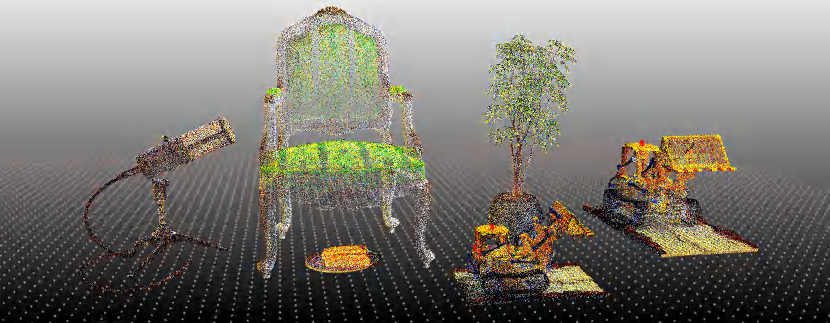
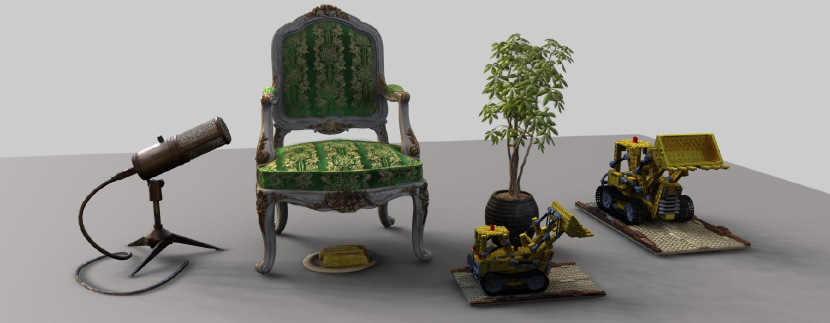
In this paper, we present a novel differentiable point-based rendering framework to achieve photo-realistic relighting. To make the reconstructed scene relightable, we enhance vanilla 3D Gaussians by associating extra properties, including normal vectors, BRDF parameters, and incident lighting from various directions. From a collection of multi-view images, the 3D scene is optimized through 3D Gaussian Splatting while BRDF and lighting are decomposed by physically based differentiable rendering. To produce plausible shadow effects in photo-realistic relighting, we introduce an innovative point-based ray tracing with the bounding volume hierarchies for efficient visibility pre-computation. Extensive experiments demonstrate our improved BRDF estimation, novel view synthesis and relighting results compared to state-of-the-art approaches. The proposed framework showcases the potential to revolutionize the mesh-based graphics pipeline with a point-based pipeline enabling editing, tracing, and relighting.
Motivation & Objective
- To enable real-time, physically based relighting of 3D point clouds without relying on mesh-based representations.
- To address the lack of material and lighting control in existing 3D Gaussian Splatting methods, which are limited to novel view synthesis.
- To develop an efficient, differentiable ray-tracing pipeline for point-based scenes to support realistic rendering with shadows.
- To improve material estimation accuracy through BRDF decomposition and regularization techniques.
- To demonstrate a fully point-based graphics pipeline that supports editing, relighting, and ray tracing in real time.
Proposed method
- Each 3D Gaussian point is augmented with a normal vector, BRDF parameters (base color, roughness, metallic), and incident lighting from multiple directions.
- Lighting is decomposed into global (environment map) and local (incident light field) components to improve robustness and decomposition accuracy.
- A differentiable rendering pipeline based on physically based rendering (PBR) is used to optimize BRDF and lighting parameters via inverse rendering.
- A novel BVH-based ray-tracing method is introduced to efficiently compute visibility and bake shadow effects for each 3D Gaussian point.
- Regularization terms are applied, including base color regularization, BRDF smoothness, and lighting regularization, to mitigate optimization ambiguities.
- The framework integrates off-the-shelf MVS reconstruction to improve geometric fidelity in real-world data, especially for challenging scenes.
Experimental results
Research questions
- RQ1Can 3D Gaussian points be extended with per-point BRDF and lighting attributes to enable realistic relighting?
- RQ2How can efficient visibility computation be achieved for point-based scenes to support real-time ray-traced rendering with shadows?
- RQ3Can lighting and material decomposition be improved by separating global and local incident light components?
- RQ4To what extent does regularization improve the stability and accuracy of BRDF and lighting estimation in point-based rendering?
- RQ5Can a fully point-based graphics pipeline support editing, relighting, and real-time rendering without mesh reconstruction?
Key findings
- The method achieves real-time rendering at over 120 FPS, demonstrating practical feasibility for interactive applications.
- On the NeRF synthetic dataset, the method achieves PSNR of 31.78, SSIM of 0.961, and LPIPS of 0.042 with 48 ray samples, showing strong novel view synthesis performance.
- The ablation study confirms that splitting incident lighting into global and local components improves light estimation accuracy.
- Base color and lighting regularizations significantly enhance material decomposition quality, especially on real-world DTU data.
- The BVH-based ray tracer enables accurate shadow effects in point-based scenes, enabling realistic rendering not supported by standard 3DGS.
- Despite using MVS for geometry enhancement, the method still struggles with unbounded scenes and background interference, indicating a need for improved geometric priors.
Read this paper
Open the full text in the Nubint reader and ask about any passage as you read.
Read this paper on NubintThis review was generated by AI from the original paper. Please check the paper before citing it.