
[Paper Review] ReLU Strikes Back: Exploiting Activation Sparsity in Large Language Models
This paper advocates for reinstating ReLU activation in large language models (LLMs) to exploit inherent activation sparsity, achieving up to 3x reduction in inference FLOPS with minimal performance drop. By leveraging structured sparsity from ReLU and introducing ReLU layers after normalization, the method enables efficient speculative decoding and model compression, demonstrating that ReLU-based LLMs can outperform smaller dense models in both efficiency and accuracy under constrained compute budgets.
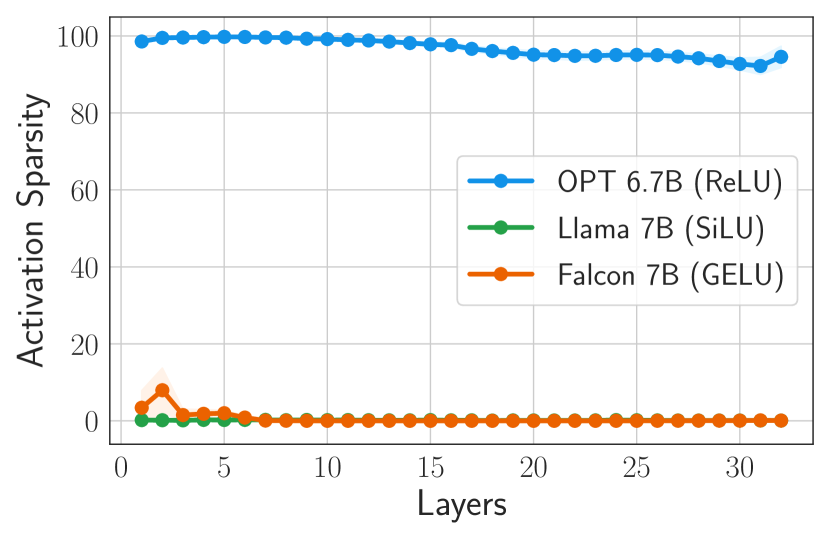
Large Language Models (LLMs) with billions of parameters have drastically transformed AI applications. However, their demanding computation during inference has raised significant challenges for deployment on resource-constrained devices. Despite recent trends favoring alternative activation functions such as GELU or SiLU, known for increased computation, this study strongly advocates for reinstating ReLU activation in LLMs. We demonstrate that using the ReLU activation function has a negligible impact on convergence and performance while significantly reducing computation and weight transfer. This reduction is particularly valuable during the memory-bound inference step, where efficiency is paramount. Exploring sparsity patterns in ReLU-based LLMs, we unveil the reutilization of activated neurons for generating new tokens and leveraging these insights, we propose practical strategies to substantially reduce LLM inference computation up to three times, using ReLU activations with minimal performance trade-offs.
Motivation & Objective
- To re-evaluate ReLU activation in LLMs despite the trend toward smoother, more complex alternatives like GELU and SiLU.
- To investigate whether ReLU-based LLMs can achieve significant inference efficiency gains through structured activation sparsity.
- To explore practical methods for reducing FLOPS in existing non-ReLU LLMs (e.g., Llama, Falcon) via fine-tuning with ReLU and architectural modifications.
- To demonstrate that ReLU-based models can surpass smaller dense models in accuracy when constrained by inference FLOPS.
- To uncover novel applications of activation sparsity, such as aggregated sparsity for speculative decoding and pre-activation analysis for alternative activation design.
Proposed method
- Fine-tuning existing non-ReLU LLMs (e.g., Llama, Falcon) with ReLU activations to restore original performance while gaining inference efficiency.
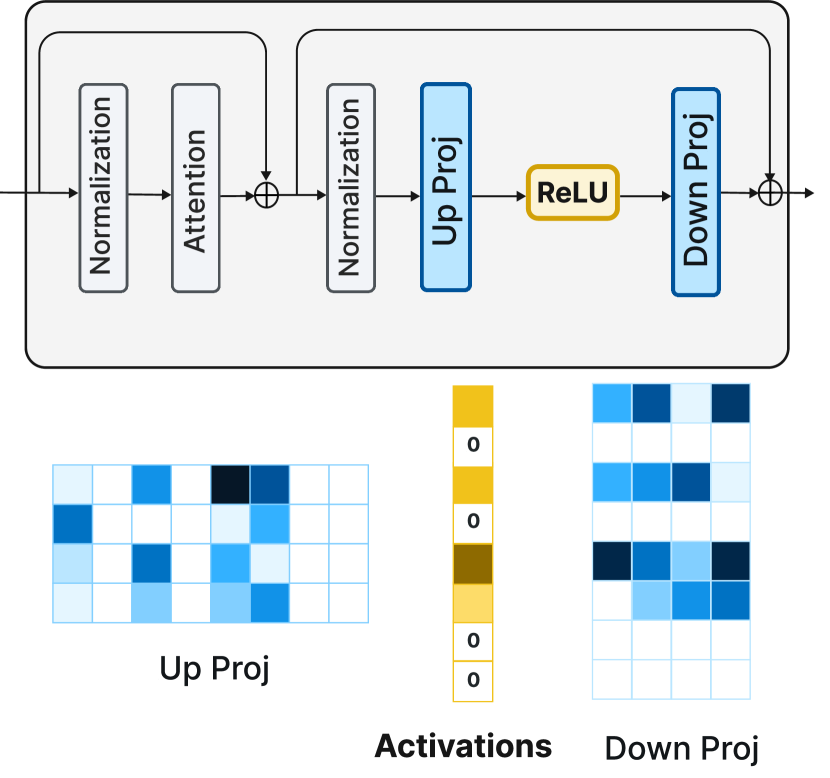
- Inserting additional ReLU layers after normalization layers to further amplify activation sparsity and reduce FLOPS.
- Proposing a sparse speculative decoding framework that exploits aggregated sparsity to accelerate autoregressive generation.
- Using pre-activation distributions from ReLU-trained models to guide the design of alternative sparse activation functions (e.g., shifted ReLU).
- Measuring and leveraging 'aggregated sparsity'—the reuse of already activated neurons across token generation steps—to reduce redundant computation.
- Applying structured sparsity patterns (e.g., zeroing entire rows in weight matrices) to accelerate inference on modern hardware, especially in memory-bound scenarios.
Experimental results
Research questions
- RQ1Does using ReLU in LLMs lead to significant inference efficiency gains without sacrificing model performance?
- RQ2Can non-ReLU LLMs (e.g., Llama, Falcon) be effectively fine-tuned with ReLU activations to recover original performance while reducing FLOPS?
- RQ3To what extent can activation sparsity be exploited to accelerate speculative decoding in autoregressive generation?
- RQ4Can pre-activation distributions be used to design alternative sparse activation functions that maintain performance while maximizing sparsity?
- RQ5Do ReLU-ified large models outperform smaller dense models in accuracy when constrained by the same inference FLOPS budget?
Key findings
- ReLU-based LLMs achieve up to 32% reduction in inference FLOPS (from 6.6G to 4.5G FLOPS per token) on the OPT model due to high activation sparsity (>90%).
- Fine-tuning non-ReLU LLMs with ReLU activations restores original performance on reasoning and reading comprehension tasks with minimal accuracy drop.
- The proposed method reduces inference FLOPS by up to threefold by inserting ReLU layers after normalization and exploiting aggregated sparsity.
- Sparse speculative decoding using ReLU-based models achieves higher speedup than standard speculative decoding, especially at higher generation speeds (γ), due to sustained sparsity.
- Reluified large models (e.g., OPT 6.7B) outperform smaller dense models with equivalent FLOPS, lying above the original model scaling curve and achieving up to 2% higher zero-shot accuracy.
- Pre-activation analysis reveals that ReLU-like distributions emerge naturally in training, enabling the design of shifted ReLU functions achieving up to 90% sparsity with performance comparable to standard ReLU.
Read this paper
Open the full text in the Nubint reader and ask about any passage as you read.
Read this paper on NubintThis review was generated by AI from the original paper. Please check the paper before citing it.