
[Paper Review] Representer Point Selection for Explaining Regularized High-dimensional Models
This paper introduces high-dimensional representers—sample-based explanations that quantify each training sample's contribution to a model's prediction in regularized high-dimensional models. By extending the representer theorem to $μat$-norm and nuclear norm regularizations, it enables efficient, interpretable influence analysis even in sparse or low-rank settings, outperforming baselines in identifying harmful negative samples for collaborative filtering.
We introduce a novel class of sample-based explanations we term high-dimensional representers, that can be used to explain the predictions of a regularized high-dimensional model in terms of importance weights for each of the training samples. Our workhorse is a novel representer theorem for general regularized high-dimensional models, which decomposes the model prediction in terms of contributions from each of the training samples: with positive (negative) values corresponding to positive (negative) impact training samples to the model's prediction. We derive consequences for the canonical instances of $\ell_1$ regularized sparse models, and nuclear norm regularized low-rank models. As a case study, we further investigate the application of low-rank models in the context of collaborative filtering, where we instantiate high-dimensional representers for specific popular classes of models. Finally, we study the empirical performance of our proposed methods on three real-world binary classification datasets and two recommender system datasets. We also showcase the utility of high-dimensional representers in explaining model recommendations.
Motivation & Objective
- To address the lack of scalable, interpretable sample-based explanations for high-dimensional models regularized with $μat$-norm or nuclear norm, which do not satisfy classical representer theorem conditions.
- To develop a general representer theorem for high-dimensional regularized models by leveraging structured subspaces and subdifferentials from Negahban et al.'s framework.
- To enable efficient, meaningful similarity-based importance scoring between test samples and training data via projection onto low-dimensional structured subspaces.
- To demonstrate the utility of high-dimensional representers in real-world applications, particularly in collaborative filtering and negative sampling improvement.
- To empirically validate the method on binary classification and recommender system datasets, showing superior performance in identifying influential training samples.
Proposed method
- Derive a generalized representer theorem for regularized high-dimensional models by analyzing the subdifferential structure of $μat$-norm and nuclear norm regularizations.
- Project test and training samples onto low-dimensional structured subspaces (e.g., sparse or low-rank subspaces) to compute local similarity scores for influence estimation.
- Define global importance scores per training sample as the weighted contribution to the model prediction, derived from the representer decomposition.
- Apply the method to collaborative filtering by treating the final interaction layer as a bilinear matrix factorization, with fixed encoders and regularized final layer.
- Use aggregated importance scores to identify and remove harmful negative samples in implicit recommendation systems.
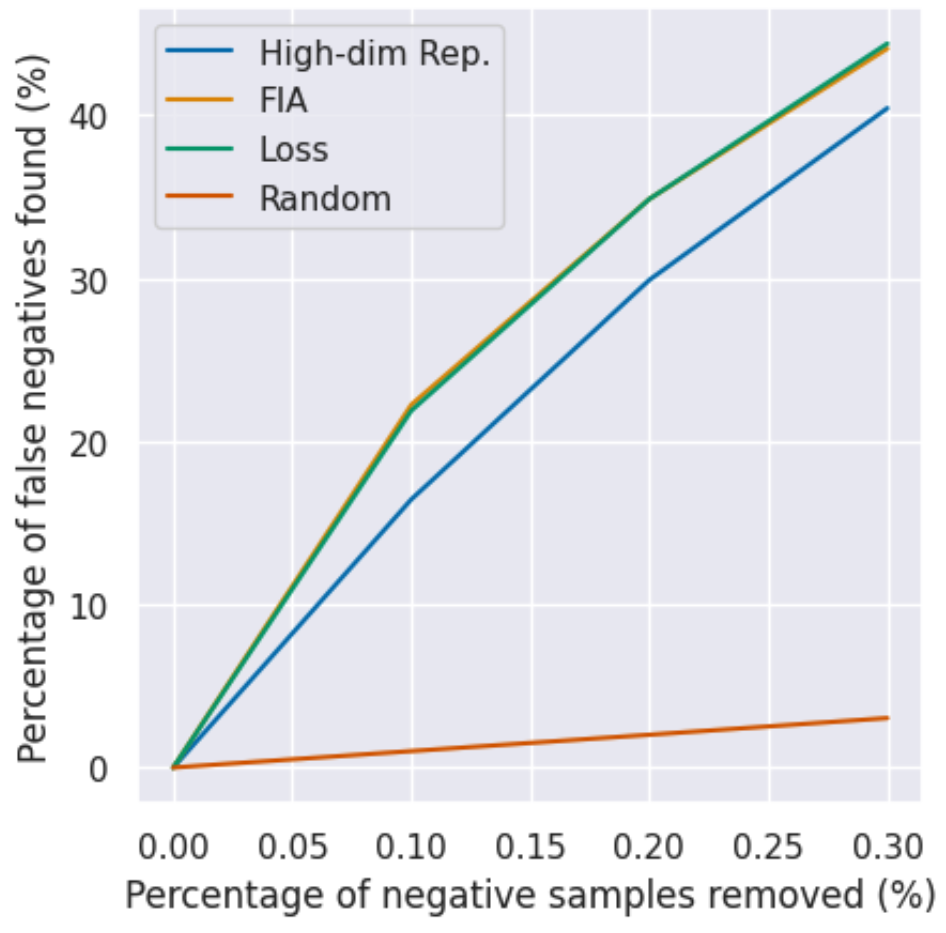
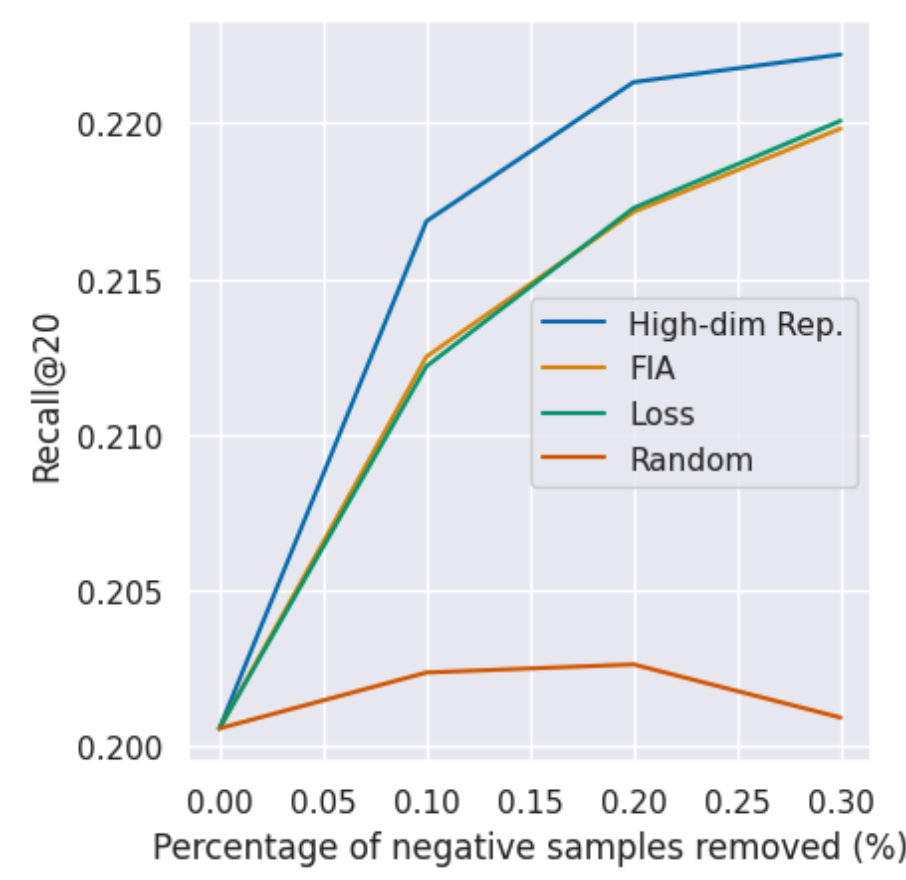
- Evaluate performance using recall@20 and false negative identification rates, comparing against FIA, loss-based filtering, and random sampling.
Experimental results
Research questions
- RQ1Can a generalized representer theorem be derived for high-dimensional models regularized with $μat$-norm or nuclear norm, which do not conform to RKHS norms?
- RQ2How can influence scores for training samples be computed efficiently and meaningfully in high-dimensional, sparse, or low-rank models?
- RQ3To what extent can high-dimensional representers improve negative sampling strategies in collaborative filtering by identifying harmful negative samples?
- RQ4How do high-dimensional representers compare to existing influence estimation methods (e.g., FIA, loss-based filtering) in identifying influential training samples?
- RQ5Can the method be extended to deep neural network variants of collaborative filtering models, such as two-tower architectures?
Key findings
- The high-dimensional representer method outperforms random selection, FIA, and loss-based filtering in identifying influential negative samples that improve model performance after removal.
- While identifying slightly fewer false negatives than loss-based or FIA methods, the high-dimensional representer selects more impactful false negatives, leading to greater performance gains in recall@20.
- The method achieves significant performance improvement in collaborative filtering by retraining after removing the top $p\%$ of negative samples ranked by aggregated importance scores.
- The representer-based approach enables scalable and interpretable influence analysis in high-dimensional models where classical $μat$-regularized or $μat$-regularized representer theorems do not apply.
- Empirical results on MovieLens-100k and three binary classification datasets confirm the method’s effectiveness and generalizability across model types and data modalities.
- The method is applicable to deep learning models such as two-tower networks by treating the final interaction layer as a bilinear factorization with fixed encoders.
Read this paper
Open the full text in the Nubint reader and ask about any passage as you read.
Read this paper on NubintThis review was generated by AI from the original paper. Please check the paper before citing it.