
[Paper Review] Reproducibility in Machine Learning-based Research: Overview, Barriers and Drivers
A critical survey that identifies barriers to ML reproducibility (description, code, data, experiment) and discusses technology, procedural, and awareness-driven drivers, plus a Drivers-Barriers-Matrix to guide improvements.
Many research fields are currently reckoning with issues of poor levels of reproducibility. Some label it a "crisis", and research employing or building Machine Learning (ML) models is no exception. Issues including lack of transparency, data or code, poor adherence to standards, and the sensitivity of ML training conditions mean that many papers are not even reproducible in principle. Where they are, though, reproducibility experiments have found worryingly low degrees of similarity with original results. Despite previous appeals from ML researchers on this topic and various initiatives from conference reproducibility tracks to the ACM's new Emerging Interest Group on Reproducibility and Replicability, we contend that the general community continues to take this issue too lightly. Poor reproducibility threatens trust in and integrity of research results. Therefore, in this article, we lay out a new perspective on the key barriers and drivers (both procedural and technical) to increased reproducibility at various levels (methods, code, data, and experiments). We then map the drivers to the barriers to give concrete advice for strategies for researchers to mitigate reproducibility issues in their own work, to lay out key areas where further research is needed in specific areas, and to further ignite discussion on the threat presented by these urgent issues.
Motivation & Objective
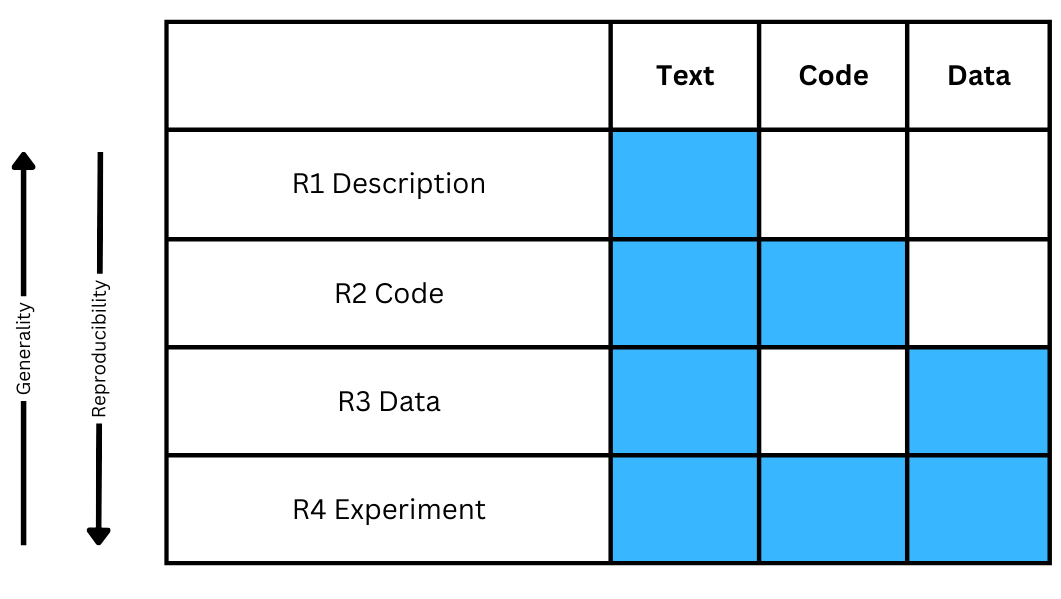
- Clarify and unify definitions of reproducibility in ML research across description, code, data, and experiment types.
- Identify and categorize barriers to ML reproducibility in both Computer Science and Biomedical contexts.
- Identify and classify drivers that can enhance ML reproducibility and map them to the barriers.
- Propose a visual Drivers-Barriers-Matrix to support decision-making for adopting reproducibility solutions.
Proposed method
- Review and synthesize literature on ML reproducibility and existing barriers/drivers.
- Categorize barriers into four reproducibility types (R1 Description, R2 Code, R3 Data, R4 Experiment).
- Classify drivers into technology-based, procedural, and awareness/education categories.
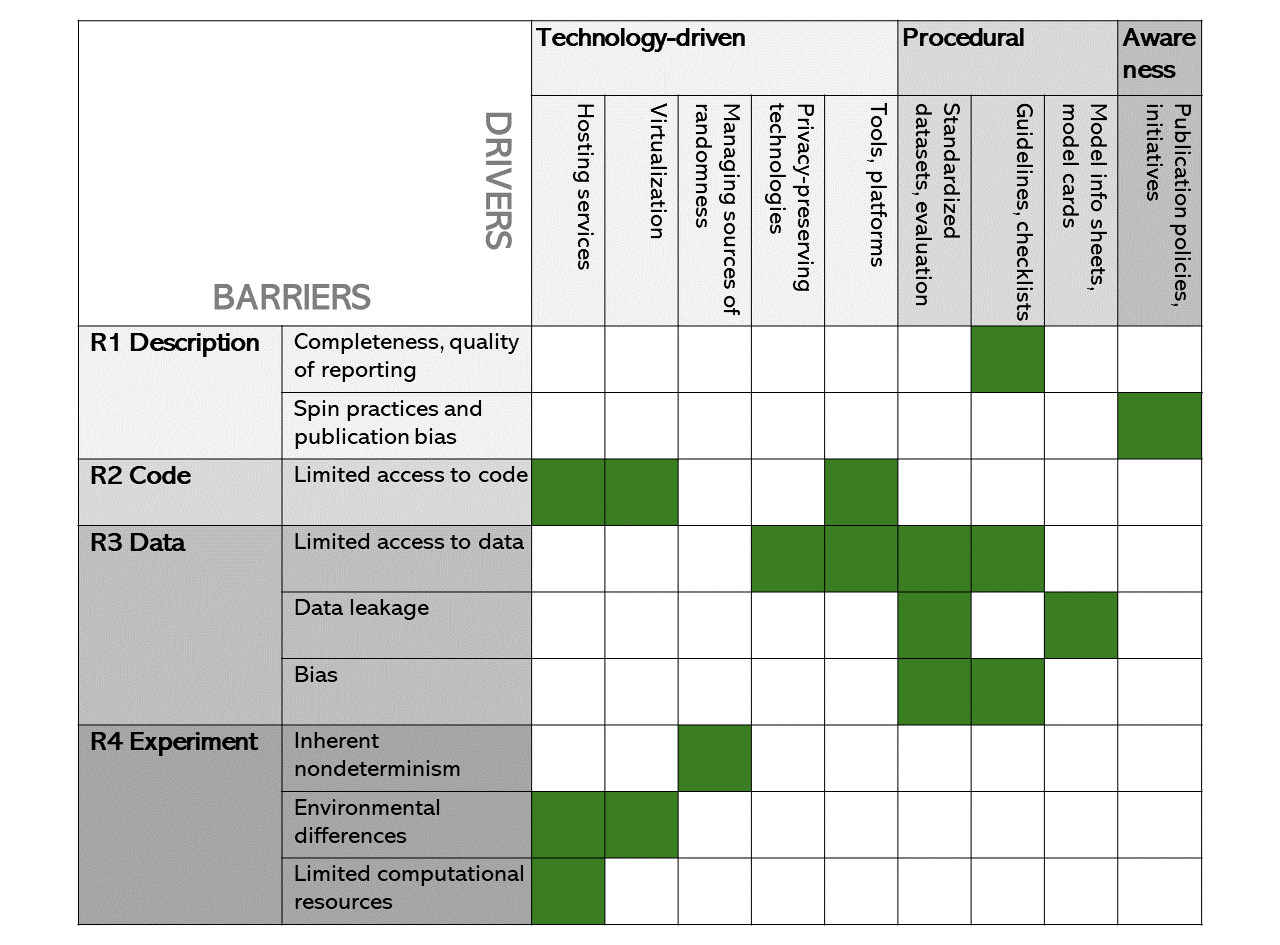
- Map drivers to barriers to assess feasibility of improvements.
- Introduce a Drivers-Barriers-Matrix to visualize and communicate the relationships.
Experimental results
Research questions
- RQ1What are the main barriers to reproducibility in ML-driven research across description, code, data, and experiment?
- RQ2What drivers exist to support ML reproducibility, and how do they map to the identified barriers?
- RQ3How can a Drivers-Barriers-Matrix help researchers and institutions decide on reproducibility interventions?
- RQ4How do ML-specific challenges (e.g., nondeterminism, data leakage, AutoML) interact with general reproducibility concerns?
- RQ5What guidelines, tools, and practices show promise for improving ML reproducibility in CS and Biomedical fields?
Key findings
- Nine identified barriers to ML reproducibility distributed across four reproducibility types: description, code, data, and experiment.
- Limited access to code and data, plus documentation gaps, are major impediments to repro- ducibility.
- Inherent nondeterminism, environmental differences, and resource constraints significantly affect experiment reproducibility.
- Privacy-preserving tech, hosting services, virtualization, and tooling/platforms can act as reproducibility enablers but have trade-offs.
- Standardized datasets, evaluation methods, and guidelines/checklists (e.g., model cards, data cards) support reproducibility.
- Awareness, education, and practical workflows are essential for sustained improvements in ML reproducibility.
Read this paper
Open the full text in the Nubint reader and ask about any passage as you read.
Read this paper on NubintThis review was generated by AI from the original paper. Please check the paper before citing it.