
[Paper Review] Reproducibility in Machine Learning-Driven Research
This mini-survey investigates reproducibility challenges in machine learning (ML)-driven research, identifying key barriers such as unpublished code, data leakage, and sensitivity to training conditions. It evaluates drivers like code sharing, model info sheets, checklists, awareness campaigns, and journal policies—finding that LLMs (e.g., GPT-4) can verify checklists with 86.6% accuracy, and that structured practices significantly improve reproducibility viability.
Research is facing a reproducibility crisis, in which the results and findings of many studies are difficult or even impossible to reproduce. This is also the case in machine learning (ML) and artificial intelligence (AI) research. Often, this is the case due to unpublished data and/or source-code, and due to sensitivity to ML training conditions. Although different solutions to address this issue are discussed in the research community such as using ML platforms, the level of reproducibility in ML-driven research is not increasing substantially. Therefore, in this mini survey, we review the literature on reproducibility in ML-driven research with three main aims: (i) reflect on the current situation of ML reproducibility in various research fields, (ii) identify reproducibility issues and barriers that exist in these research fields applying ML, and (iii) identify potential drivers such as tools, practices, and interventions that support ML reproducibility. With this, we hope to contribute to decisions on the viability of different solutions for supporting ML reproducibility.
Motivation & Objective
- To assess the current state of reproducibility in machine learning across diverse research fields.
- To identify systemic barriers—such as unpublished code, data leakage, and hyperparameter sensitivity—that hinder reproducibility in ML research.
- To evaluate existing drivers, including checklists, model info sheets, awareness initiatives, and journal policies, that support reproducibility.
- To examine the role of emerging tools like LLMs in verifying reproducibility checklists with high accuracy.
- To provide a foundation for evaluating the viability of different reproducibility solutions in ML research.
Proposed method
- Conducted a systematic literature review focusing on reproducibility in ML-driven research, analyzing barriers and drivers.
- Classified reproducibility into three degrees: R1 (exact experiment reproducibility), R2 (data reproducibility), and R3 (method reproducibility).
- Evaluated tools such as checklists, model info sheets, and awareness initiatives (e.g., ReproducedPapers.org, reproducibility challenges).
- Assessed the use of Large Language Models (LLMs), particularly GPT-4, to verify checklist compliance with high accuracy (86.6%).
- Analyzed journal-level interventions, including code/data availability mandates and preregistration, to improve research credibility.
- Examined case studies like the ACM TORS journal, which supports reproducibility through reproducibility paper publications and preregistration.
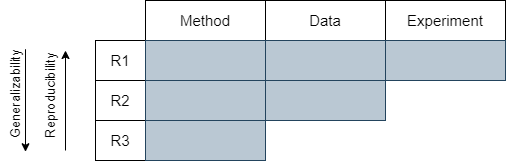
Experimental results
Research questions
- RQ1What are the current levels and degrees of reproducibility in machine learning research across different scientific fields?
- RQ2What are the primary barriers—such as code and data unavailability or implementation sensitivity—that impede reproducibility in ML?
- RQ3How effective are proposed drivers like checklists, model info sheets, and awareness campaigns in improving ML reproducibility?
- RQ4To what extent can LLMs like GPT-4 assist in verifying compliance with reproducibility checklists?
- RQ5How can journals and conferences implement policies (e.g., preregistration, mandatory code/data sharing) to enhance reproducibility in ML research?
Key findings
- The reproducibility crisis in ML is pervasive, with unpublished code and sensitivity to training conditions being major barriers to result replication.
- R1 (experiment reproducibility) ensures exact output consistency under identical conditions, while R3 (method reproducibility) allows for generalization across different implementations and data.
- Model info sheets significantly reduce data leakage risks by requiring authors to document data splits and preprocessing, especially helpful for non-expert ML practitioners.
- LLMs such as GPT-4 demonstrated 86.6% accuracy in verifying checklist compliance, offering a scalable solution for automated reproducibility validation.
- Awareness initiatives like reproducibility challenges and repositories like ReproducedPapers.org are effective in promoting transparency and teaching reproducibility.
- Journals such as ACM TORS are advancing reproducibility by enabling preregistration and publishing dedicated reproducibility studies, thus improving research credibility.
Read this paper
Open the full text in the Nubint reader and ask about any passage as you read.
Read this paper on NubintThis review was generated by AI from the original paper. Please check the paper before citing it.