
[Paper Review] RES-SE-NET: Boosting Performance of Resnets by Enhancing Bridge-connections
This paper proposes Res-SE-Net, an enhanced residual network that improves performance by applying Squeeze-and-Excitation (SE) blocks to bridge-connections—skip connections that reshape feature maps between residual blocks. By adaptively weighting feature maps in these connections, Res-SE-Net achieves state-of-the-art accuracy on CIFAR-10 and CIFAR-100, outperforming both standard ResNet and SE-ResNet by up to 1.94% on CIFAR-100 and 0.87% on CIFAR-10.
One of the ways to train deep neural networks effectively is to use residual connections. Residual connections can be classified as being either identity connections or bridge-connections with a reshaping convolution. Empirical observations on CIFAR-10 and CIFAR-100 datasets using a baseline Resnet model, with bridge-connections removed, have shown a significant reduction in accuracy. This reduction is due to lack of contribution, in the form of feature maps, by the bridge-connections. Hence bridge-connections are vital for Resnet. However, all feature maps in the bridge-connections are considered to be equally important. In this work, an upgraded architecture "Res-SE-Net" is proposed to further strengthen the contribution from the bridge-connections by quantifying the importance of each feature map and weighting them accordingly using Squeeze-and-Excitation (SE) block. It is demonstrated that Res-SE-Net generalizes much better than Resnet and SE-Resnet on the benchmark CIFAR-10 and CIFAR-100 datasets.
Motivation & Objective
- To investigate the role of bridge-connections in ResNet, which are critical for performance but often treated as uniform feature map pass-throughs.
- To address the limitation that all feature maps in bridge-connections are currently weighted equally, despite varying importance.
- To improve model generalization and accuracy by dynamically recalibrating feature map importance in bridge-connections.
- To demonstrate that enhancing bridge-connections via SE blocks leads to consistent performance gains over baseline ResNet and SE-ResNet.
- To validate that the SE block integration does not disrupt gradient flow or training stability in deep networks.
Proposed method
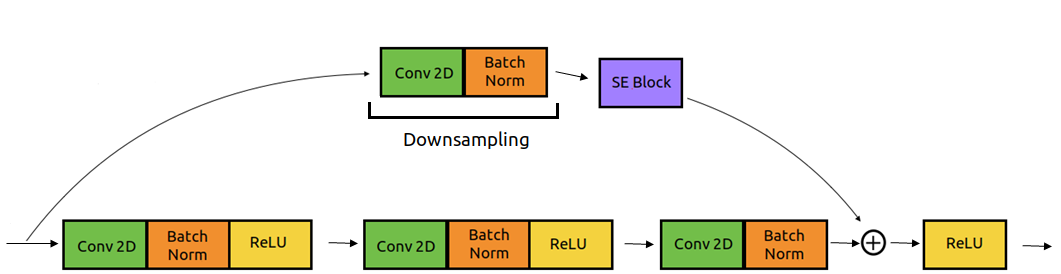
- Introduces Res-SE-Net, a modified ResNet architecture where Squeeze-and-Excitation (SE) blocks are inserted into every bridge-connection path.
- The SE block computes channel-wise attention weights by global average pooling, followed by fully connected layers with ReLU and sigmoid activation to produce learnable scaling factors.
- These learned weights are applied to the feature maps in the bridge-connection before they are added to the residual path via element-wise multiplication.
- The architecture maintains residual learning by preserving the skip-connection structure, ensuring stable gradient flow during backpropagation.
- The method is evaluated on CIFAR-10 and CIFAR-100 using standard ResNet depth configurations (20, 32, 44, 56, 110 layers).
- Training is conducted with standard data augmentation and optimization protocols, with performance compared against baseline ResNet and SE-ResNet.
Experimental results
Research questions
- RQ1How critical are bridge-connections to the performance of ResNet, especially when removed?
- RQ2Does treating all feature maps in bridge-connections equally limit model capacity, and can dynamic weighting improve performance?
- RQ3Can the integration of Squeeze-and-Excitation blocks into bridge-connections enhance feature map representation without disrupting training?
- RQ4Does Res-SE-Net generalize better than SE-ResNet and baseline ResNet on benchmark image classification datasets?
- RQ5What is the impact of SE block placement in bridge-connections versus identity skip-connections on model accuracy and training stability?
Key findings
- Res-SE-Net achieves an average accuracy improvement of 0.566% over baseline ResNet on CIFAR-10 and 0.704% on CIFAR-100 across all depth configurations.
- The Res-SE-Net-110 variant achieves the highest improvement, with a 0.87% gain on CIFAR-10 and 1.6% on CIFAR-100 compared to ResNet-110.
- Res-SE-Net outperforms SE-ResNet by an average of 0.124% on CIFAR-10 and 1.392% on CIFAR-100, with Res-SE-Net-110 achieving a 0.74% and 1.94% improvement respectively.
- Training losses for all Res-SE-Net models remain smooth and stable across depths (20 to 110 layers), indicating no disruption to gradient flow.
- Empirical results show that adding SE blocks to identity skip-connections degrades performance, especially in deeper networks, highlighting the importance of selective placement.
- The proposed architecture generalizes better than both baseline ResNet and SE-ResNet, demonstrating that enhancing bridge-connections yields significant performance gains.
Read this paper
Open the full text in the Nubint reader and ask about any passage as you read.
Read this paper on NubintThis review was generated by AI from the original paper. Please check the paper before citing it.