
[Paper Review] Resource Allocation and Workload Scheduling for Large-Scale Distributed Deep Learning: A Survey
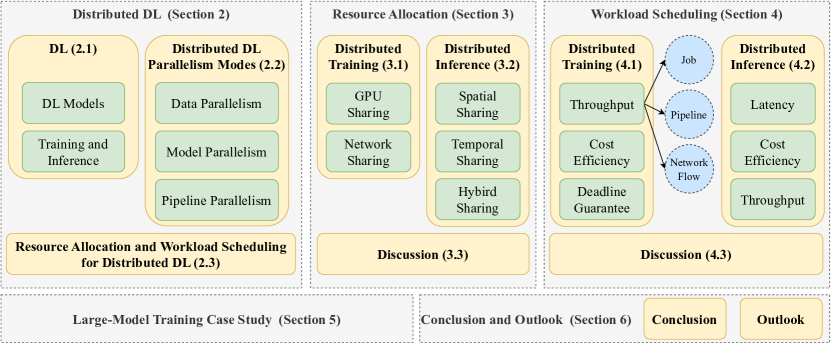
This paper surveys resource allocation and workload scheduling strategies for large-scale distributed deep learning from 2019–2024, including a case study on large-model training.
With rapidly increasing distributed deep learning workloads in large-scale data centers, efficient distributed deep learning framework strategies for resource allocation and workload scheduling have become the key to high-performance deep learning. The large-scale environment with large volumes of datasets, models, and computational and communication resources raises various unique challenges for resource allocation and workload scheduling in distributed deep learning, such as scheduling complexity, resource and workload heterogeneity, and fault tolerance. To uncover these challenges and corresponding solutions, this survey reviews the literature, mainly from 2019 to 2024, on efficient resource allocation and workload scheduling strategies for large-scale distributed DL. We explore these strategies by focusing on various resource types, scheduling granularity levels, and performance goals during distributed training and inference processes. We highlight critical challenges for each topic and discuss key insights of existing technologies. To illustrate practical large-scale resource allocation and workload scheduling in real distributed deep learning scenarios, we use a case study of training large language models. This survey aims to encourage computer science, artificial intelligence, and communications researchers to understand recent advances and explore future research directions for efficient framework strategies for large-scale distributed deep learning.
Motivation & Objective
- Systematically review resource allocation and workload scheduling frameworks for large-scale distributed DL.
- Analyze challenges across resource types (GPU, network) and scheduling granularities (job, pipeline, network flow).
- Compare existing technologies and provide insights to guide practical deployment in data centers.
- Illustrate applications with a case study on large-model distributed training.
- Suggest future research directions to improve efficiency and scalability.
Proposed method
- Conduct a systematic literature review of 2019–2024 on distributed DL resource-management and scheduling.
- Classify strategies by resource types (GPU sharing, network sharing) and by scheduling granularity (job, pipeline, coflow).
- Organize analysis around training and inference workflows and multiple performance goals.
- Provide a case study on large-model distributed training to demonstrate practical application.
- Offer a synthesis of challenges and key insights to guide future research.
Experimental results
Research questions
- RQ1What are the main challenges in resource allocation and workload scheduling for large-scale distributed DL?
- RQ2What strategies exist for GPU sharing and network bandwidth sharing, and how do they differ by scheduling granularity?
- RQ3How can these framework strategies be applied in practice to improve training and inference performance in data centers?
- RQ4What insights and future directions emerge from surveying literature from 2019 to 2024?
Key findings
- The survey comprehensively maps resource allocation and workload scheduling frameworks for large-scale distributed DL across training and inference.
- It highlights critical challenges for GPU sharing, network bandwidth sharing, and scheduling at job, pipeline, and network-flow levels.
- It compares related surveys and fills gaps by emphasizing joint computation–communication optimization.
- It provides a case study on large-model distributed training to illustrate practical applications in data centers.
- It identifies gaps and proposes future research directions for efficient framework strategies.
Read this paper
Open the full text in the Nubint reader and ask about any passage as you read.
Read this paper on NubintThis review was generated by AI from the original paper. Please check the paper before citing it.