
[Paper Review] Response: Emergent analogical reasoning in large language models
The authors challenge the claim of zero-shot analogical reasoning in GPT-3 by reproducing and extending letter-string analogy tasks, including a synthetic alphabet, and show GPT-3 fails under several modifications.
In their recent Nature Human Behaviour paper, "Emergent analogical reasoning in large language models," (Webb, Holyoak, and Lu, 2023) the authors argue that "large language models such as GPT-3 have acquired an emergent ability to find zero-shot solutions to a broad range of analogy problems." In this response, we provide counterexamples of the letter string analogies. In our tests, GPT-3 fails to solve simplest variations of the original tasks, whereas human performance remains consistently high across all modified versions. Zero-shot reasoning is an extraordinary claim that requires extraordinary evidence. We do not see that evidence in our experiments. To strengthen claims of humanlike reasoning such as zero-shot reasoning, it is important that the field develop approaches that rule out data memorization.
Motivation & Objective
- Assess whether GPT-3 exhibits zero-shot analogical reasoning on letter-string analogies as claimed in the Nature Human Behaviour paper.
- Test generalization by introducing a synthetic alphabet and larger letter-interval transformations.
- Evaluate the impact of prompt changes on zero-shot analogy performance.
- Discuss implications for interpreting LLM capabilities beyond memorization.
- Highlight need for novel, unseen problem sets to test genuine reasoning.
Proposed method
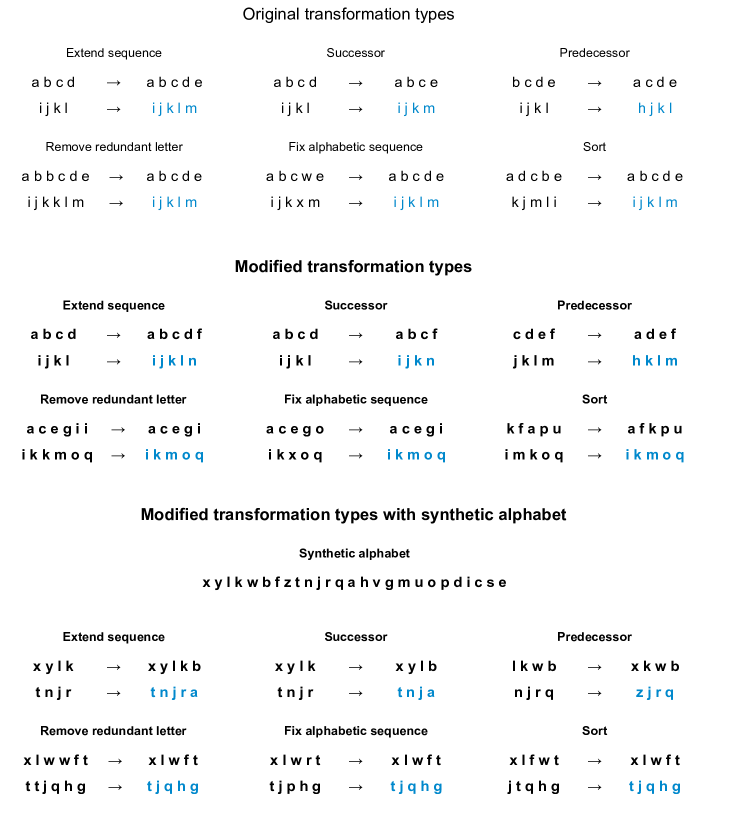
- Reproduce original letter-string analogy problems and apply two transformation types with increasing letter-intervals.
- Introduce a synthetic alphabet by randomly shuffling the real alphabet order and test zero-shot performance on both alphabets.
- Modify the prompt to feed the synthetic alphabet and apply interval-size changes to control for prompt effects.
- Evaluate four settings: original tasks, modified interval tasks, modified prompt with synthetic alphabet, and synthetic alphabet tasks.
- Use 50 instances per problem type to mirror the original study and compare results.
- Replicate evaluation via code available on GitHub.
Experimental results
Research questions
- RQ1Does GPT-3 show zero-shot analogical reasoning on letter-string problems with a real alphabet?
- RQ2Does performance persist when the same problems are provided with a synthetic alphabet?
- RQ3Does increasing the interval or altering the prompt affect zero-shot analogy performance materially?
- RQ4Are there signs that high performance is due to memorization from training data rather than genuine reasoning?
Key findings
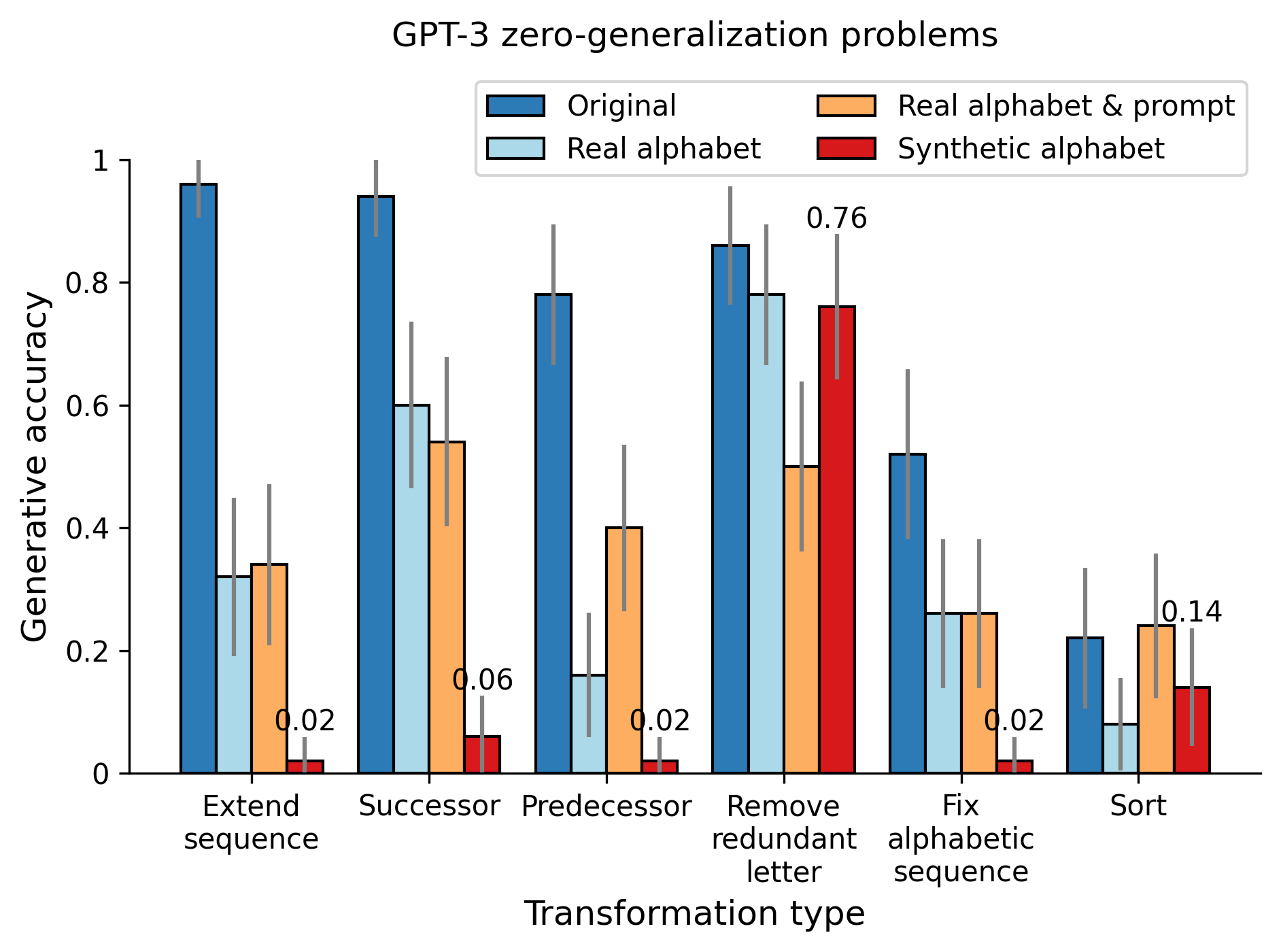
- Synthetic alphabet severely reduces GPT-3 accuracy across most problem types (<0.1 for several tasks).
- With the real alphabet, GPT-3 achieves higher accuracy only on two tasks (remove redundant letter and sort) and remains low on others (e.g., extend sequence, predecessor).
- Prompt changes have little impact on performance when using a synthetic alphabet, suggesting limited influence of prompt formatting on zero-shot reasoning under these conditions.
- For interval-size increases, performance with real alphabet mirrors some patterns but overall remains limited, challenging the claim of broad zero-shot analogical reasoning.
- Results imply that training data memorization, not genuine zero-shot reasoning, may underlie some observed successes in the original study.
- GPT-3’s relative strength on some tasks may reflect processing of simple transformations rather than deep analogy solving; zero-shot reasoning claims require novel problem sets not present in training data.
Read this paper
Open the full text in the Nubint reader and ask about any passage as you read.
Read this paper on NubintThis review was generated by AI from the original paper. Please check the paper before citing it.