
[Paper Review] Restart Sampling for Improving Generative Processes
The paper introduces Restart sampling, which interleaves large-noise forward forwards with backward ODEs to combine contraction from stochasticity with low discretization error, yielding faster and higher-quality generative sampling than prior ODE or SDE samplers.
Generative processes that involve solving differential equations, such as diffusion models, frequently necessitate balancing speed and quality. ODE-based samplers are fast but plateau in performance while SDE-based samplers deliver higher sample quality at the cost of increased sampling time. We attribute this difference to sampling errors: ODE-samplers involve smaller discretization errors while stochasticity in SDE contracts accumulated errors. Based on these findings, we propose a novel sampling algorithm called Restart in order to better balance discretization errors and contraction. The sampling method alternates between adding substantial noise in additional forward steps and strictly following a backward ODE. Empirically, Restart sampler surpasses previous SDE and ODE samplers in both speed and accuracy. Restart not only outperforms the previous best SDE results, but also accelerates the sampling speed by 10-fold / 2-fold on CIFAR-10 / ImageNet $64 imes 64$. In addition, it attains significantly better sample quality than ODE samplers within comparable sampling times. Moreover, Restart better balances text-image alignment/visual quality versus diversity than previous samplers in the large-scale text-to-image Stable Diffusion model pre-trained on LAION $512 imes 512$. Code is available at https://github.com/Newbeeer/diffusion_restart_sampling
Motivation & Objective
- Motivate the speed-quality trade-off in differential-equation-based generative models (ODE vs SDE sampling).
- Theoretically analyze how discretization error and contraction interact in ODE and SDE samplers.
- Propose a Restart sampling algorithm that blends stochasticity with deterministic ODE steps to improve performance.
- Provide theoretical bounds and empirical evidence showing Restart surpasses prior solvers in speed and quality.
Proposed method
- Characterize ODE and SDE samplers and derive an upper bound on Wasserstein-1 distance to the data distribution.
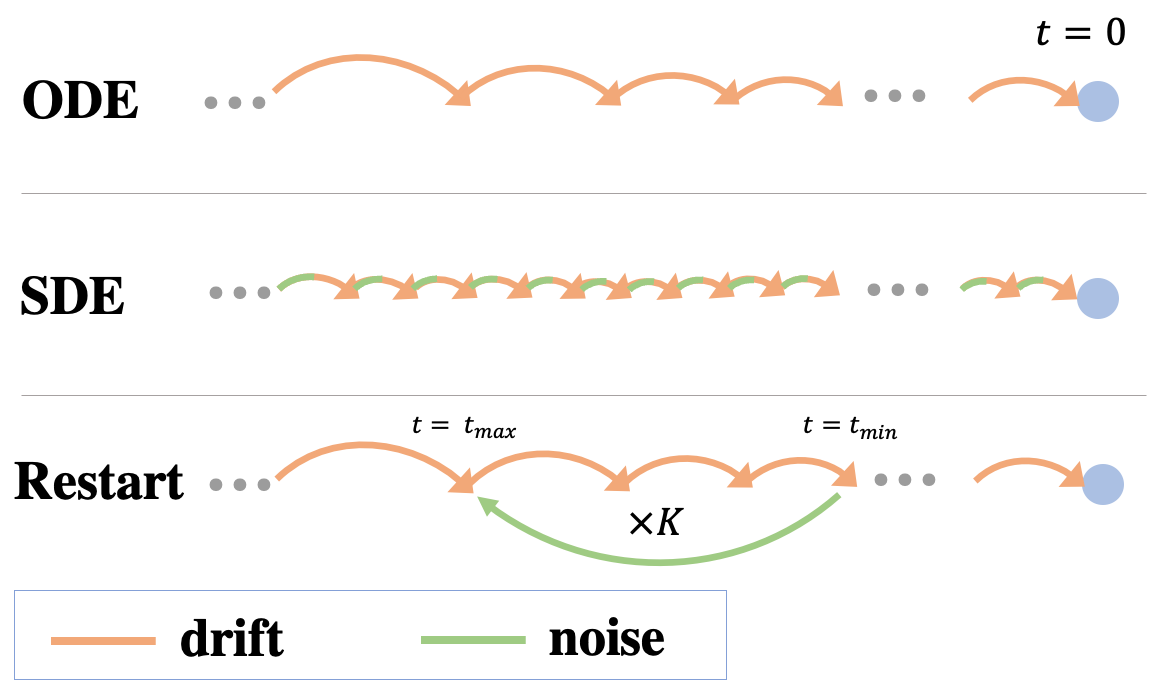
- Introduce Restart sampling that repeats forward-noise and backward-ODE cycles within a time interval to amplify contraction of initial errors.
- Separate stochasticity from the drift by performing large-noise forward steps and a deterministic backward ODE in each Restart iteration.
- Provide guidance on selecting the Restart interval and number of Restart iterations (K) to balance contraction with added sampling error.
- Show that Restart allows smaller discretization error while benefiting from stochastic contraction, enabling fast sampling.
Experimental results
Research questions
- RQ1How do discretization errors and stochastic contraction influence sampling quality across ODE and SDE samplers?
- RQ2Can a Restart strategy leverage large forward noise with deterministic backward dynamics to outperform both ODE and SDE samplers?
- RQ3What theoretical guarantees (Wasserstein bounds) support the efficacy of Restart over existing methods?
- RQ4What are practical guidelines for choosing Restart interval and K for different models and datasets?
- RQ5Does Restart improve speed and quality on standard benchmarks and large-scale text-to-image models?
Key findings
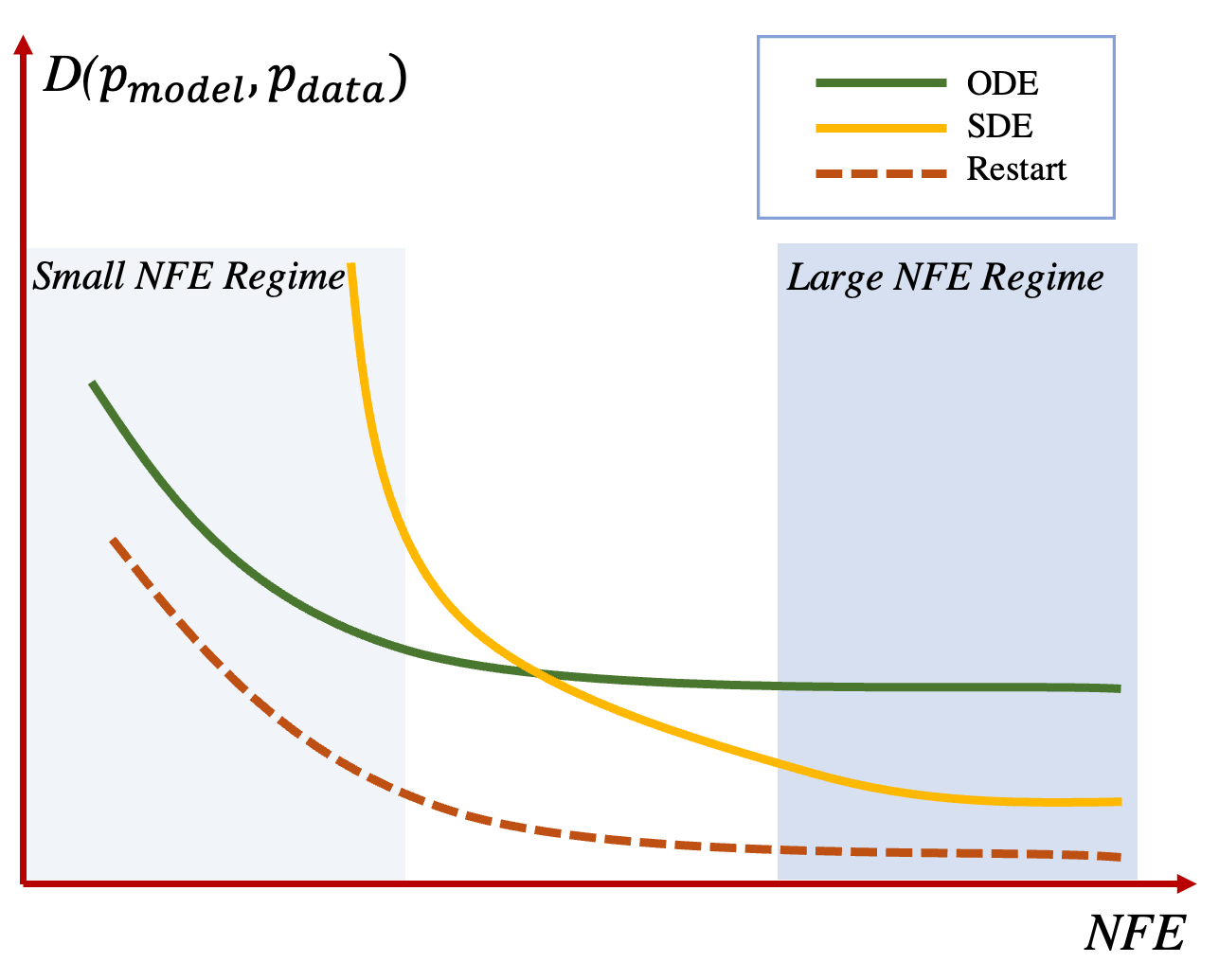
- Restart consistently surpasses previous ODE and SDE samplers in both sample quality and speed across NFEs, datasets, and pretrained models.
- On CIFAR-10 with VP, Restart achieves 10x faster or 2x faster sampling compared to the previous best SDE results at similar FID, and outperforms fast ODE solvers.
- Restart attains new state-of-the-art FID scores for UNet architectures without extra training (e.g., 1.36 on class-conditional ImageNet 64×64 with EDM, 1.88 on unconditional CIFAR-10 with PFGM++).
- Restart improves text-to-image trade-offs in Stable Diffusion on LAION-5B by balancing text-image alignment/visual quality and diversity better than prior samplers.
- Theoretical analysis shows Restart yields a smaller Wasserstein upper bound than both SDE and ODE due to stronger contraction and ODE-like discretization error, with contraction increasing exponentially with the number of Restart iterations K (up to a regime depending on other factors).
- Empirical results include Pareto-frontier analyses showing Restart achieves lower contracted error for a given additional sampling error and demonstrates advantages in both low-NFE and high-NFE regimes.
Read this paper
Open the full text in the Nubint reader and ask about any passage as you read.
Read this paper on NubintThis review was generated by AI from the original paper. Please check the paper before citing it.