
[Paper Review] Rethinking Depth Estimation for Multi-View Stereo: A Unified Representation
This paper proposes UniMVSNet, a novel unified depth representation that combines the sub-pixel accuracy of regression with the robust cost volume supervision of classification, using a new Unified Focal Loss (UFL) to address sample imbalance. The method achieves state-of-the-art performance on both DTU and Tanks and Temples benchmarks, ranking first in both datasets with superior generalization and robustness.
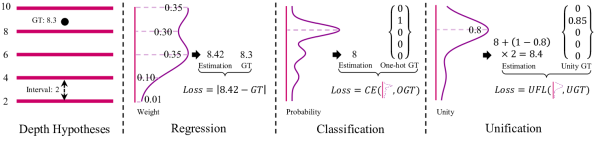
Depth estimation is solved as a regression or classification problem in existing learning-based multi-view stereo methods. Although these two representations have recently demonstrated their excellent performance, they still have apparent shortcomings, e.g., regression methods tend to overfit due to the indirect learning cost volume, and classification methods cannot directly infer the exact depth due to its discrete prediction. In this paper, we propose a novel representation, termed Unification, to unify the advantages of regression and classification. It can directly constrain the cost volume like classification methods, but also realize the sub-pixel depth prediction like regression methods. To excavate the potential of unification, we design a new loss function named Unified Focal Loss, which is more uniform and reasonable to combat the challenge of sample imbalance. Combining these two unburdened modules, we present a coarse-to-fine framework, that we call UniMVSNet. The results of ranking first on both DTU and Tanks and Temples benchmarks verify that our model not only performs the best but also has the best generalization ability.
Motivation & Objective
- To address the limitations of regression and classification in learning-based multi-view stereo (MVS) by unifying their advantages.
- To overcome the indirect supervision in regression and the discrete nature of classification in depth estimation.
- To design a unified representation that enables direct cost volume supervision and sub-pixel depth prediction.
- To develop a more effective loss function, Unified Focal Loss (UFL), that better handles sample imbalance in continuous labels.
- To demonstrate the effectiveness and generalization of the proposed modules through a plug-and-play framework, UniMVSNet.
Proposed method
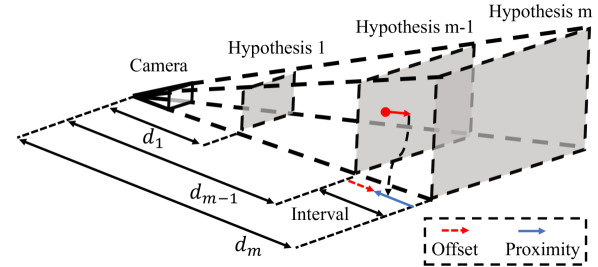
- Proposes a unified depth representation called 'Unification' that uses a continuous, proximity-based label (unity) to represent both the optimal depth hypothesis and its offset to ground truth.
- Defines the unity label as a single non-zero value in a continuous interval, where proximity (1 - offset) encodes the confidence and location of the ground-truth depth.
- Introduces Unified Focal Loss (UFL), a generalization of Focal Loss and GFL, that better distinguishes hard and easy samples by incorporating ground-truth magnitude.
- Applies UFL directly to the unified representation to enable robust, end-to-end training with improved sample balancing.
- Designs a coarse-to-fine framework, UniMVSNet, integrating Unification and UFL into a standard MVS pipeline with no additional computational or memory cost.
- Employs adaptive aggregation and finer ground-truth supervision for fair comparison, while ablation studies confirm the method's standalone superiority.
Experimental results
Research questions
- RQ1Can a unified depth representation effectively combine the sub-pixel precision of regression with the robustness of classification-based supervision?
- RQ2How can a loss function be designed to better handle class imbalance in continuous depth labels, especially when ground-truth magnitude varies?
- RQ3Does the proposed unified representation maintain robustness when the depth hypothesis range does not cover the ground truth?
- RQ4To what extent does the Unified Focal Loss improve accuracy and completeness compared to existing focal loss variants in MVS?
- RQ5Can the proposed modules be effectively integrated into existing MVS frameworks without increasing computational cost?
Key findings
- UniMVSNet achieves state-of-the-art performance on the DTU benchmark, ranking first with a 0.324 mm overall error (compared to 0.333 mm for the baseline).
- On the Tanks and Temples benchmark, UniMVSNet improves by 2.68 points on the intermediate set and 3.24 points on the advanced set over the previous best model.
- The unified representation maintains correct supervision even when the hypothesis range misses the ground truth, as all-unity labels become zero, avoiding model corruption.
- Unified Focal Loss (UFL) significantly improves both accuracy and completeness over GFL and standard Focal Loss, especially in handling hard samples.
- Ablation shows that even with only 50% of the training data, the unified representation outperforms the baseline with full data, demonstrating strong generalization.
- The proposed modules are plug-and-play, adding no computational or memory overhead, and can be seamlessly integrated into existing MVS frameworks.
Read this paper
Open the full text in the Nubint reader and ask about any passage as you read.
Read this paper on NubintThis review was generated by AI from the original paper. Please check the paper before citing it.