
[Paper Review] Rethinking Intersection Over Union for Small Object Detection in Few-Shot Regime
The paper introduces SIoU, a scale-adaptive IoU variant designed to improve small object detection in few-shot object detection, and demonstrates its advantages as both a loss function and an evaluation metric across aerial and natural datasets.
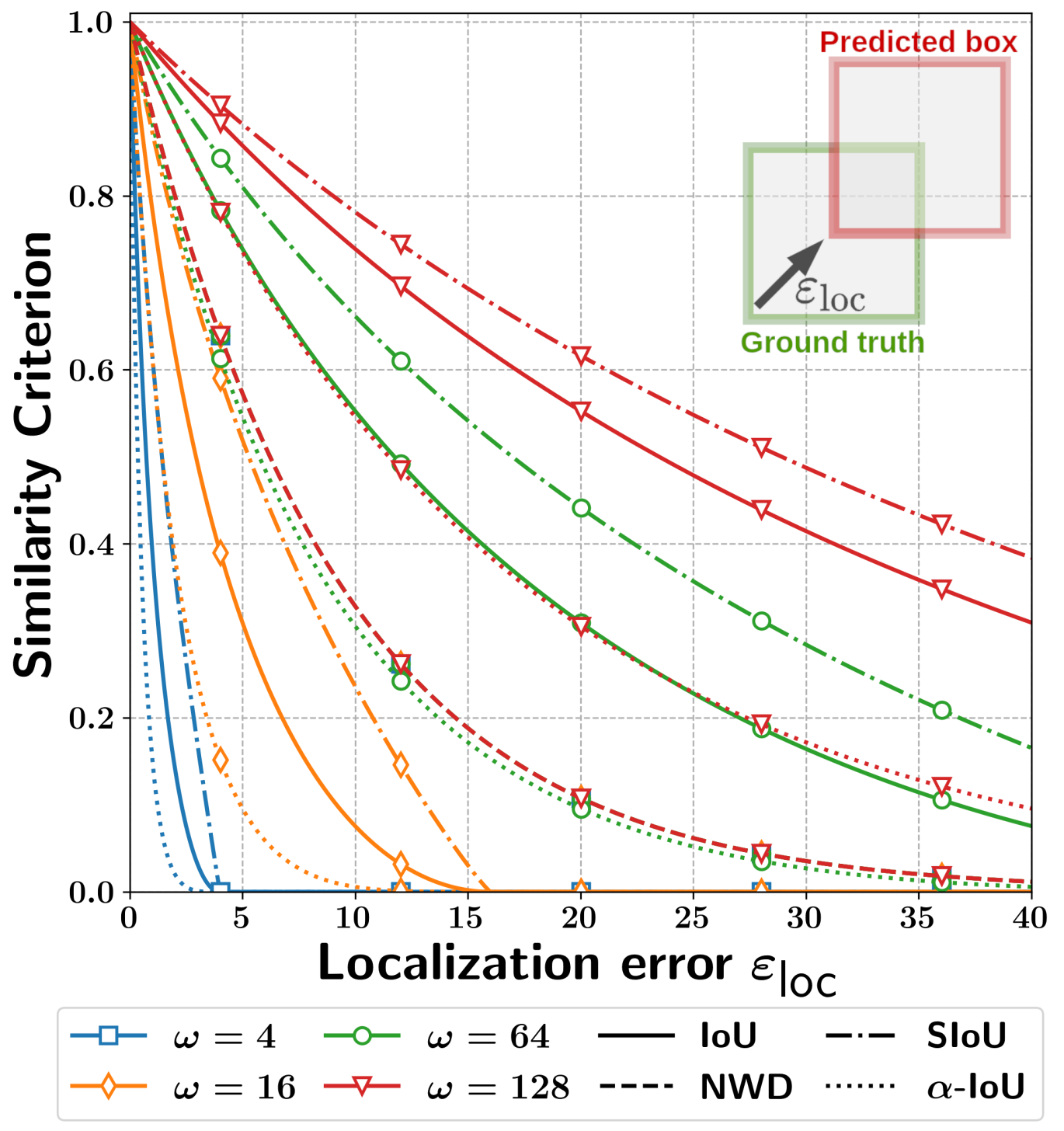
In Few-Shot Object Detection (FSOD), detecting small objects is extremely difficult. The limited supervision cripples the localization capabilities of the models and a few pixels shift can dramatically reduce the Intersection over Union (IoU) between the ground truth and predicted boxes for small objects. To this end, we propose Scale-adaptive Intersection over Union (SIoU), a novel box similarity measure. SIoU changes with the objects' size, it is more lenient with small object shifts. We conducted a user study and SIoU better aligns than IoU with human judgment. Employing SIoU as an evaluation criterion helps to build more user-oriented models. SIoU can also be used as a loss function to prioritize small objects during training, outperforming existing loss functions. SIoU improves small object detection in the non-few-shot regime, but this setting is unrealistic in the industry as annotated detection datasets are often too expensive to acquire. Hence, our experiments mainly focus on the few-shot regime to demonstrate the superiority and versatility of SIoU loss. SIoU improves significantly FSOD performance on small objects in both natural (Pascal VOC and COCO datasets) and aerial images (DOTA and DIOR). In aerial imagery, small objects are critical and SIoU loss achieves new state-of-the-art FSOD on DOTA and DIOR.
Motivation & Objective
- Motivate the limitations of IoU for small objects in few-shot object detection.
- Propose a scale-adaptive similarity measure (SIoU) to improve localization for small objects.
- Analyze SIoU theoretically and empirically against existing criteria.
- Demonstrate SIoU’s effectiveness as both a training loss and an evaluation metric.
- Show improvements on aerial (DOTA/DIOR) and natural (Pascal VOC/COCO) datasets.
Proposed method
- Define SIoU as IoU raised to a size-dependent power p that scales with object sizes, controlled by parameters gamma and kappa (p = 1 - gamma * exp(- sqrt(w1*h1 + w2*h2) / (sqrt(2)*kappa))).
- Extend SIoU to a GIoU-like variant (GSIoU) by applying the same power to GIoU for non-overlapping cases.
- Analyze SIoU via loss/gradient reweighting, distributional properties, and alignment with human perception through a user study.
- Compare SIoU and generalized criteria (NWD, DIoU/α-IoU, GIoU) across FSOD setups and datasets.
- Evaluate SIoU as a regression loss and as an evaluation metric, focusing on small objects and few-shot regimes.
Experimental results
Research questions
- RQ1Does IoU adequately handle small object localization in few-shot regimes, and can a scale-aware metric improve both training and evaluation?
- RQ2Can SIoU better align with human perception of localization quality for small objects than IoU?
- RQ3Do SIoU-based losses improve FSOD performance on small objects across aerial and natural datasets?
- RQ4How does SIoU compare to existing criteria (NWD, α-IoU, GIoU, GSIoU) in FSOD settings?
- RQ5What are the practical parameter choices (gamma, kappa) to balance small vs. large objects during training?
Key findings
- SIoU (and its GSIoU extension) outperforms IoU and several alternatives in FSOD, especially for small objects across DOTA, DIOR, Pascal VOC, and COCO.
- SIoU’s scale-dependent power p makes localization errors on small objects less punitive, improving detection performance on novel classes in aerial datasets.
- A user study shows SIoU aligns better with human perception than IoU, particularly for small objects, justifying its use for evaluation.
- SIoU loss reweights gradients by size, allowing targeted emphasis on small objects during training and achieving new state-of-the-art FSOD results on DOTA/DIOR.
- Parameter choices (e.g., gamma, kappa) can be tuned to emphasize smaller objects, with empirical guidance provided for different datasets.

Read this paper
Open the full text in the Nubint reader and ask about any passage as you read.
Read this paper on NubintThis review was generated by AI from the original paper. Please check the paper before citing it.