
[Paper Review] Rethinking Multi-User Semantic Communications with Deep Generative Models
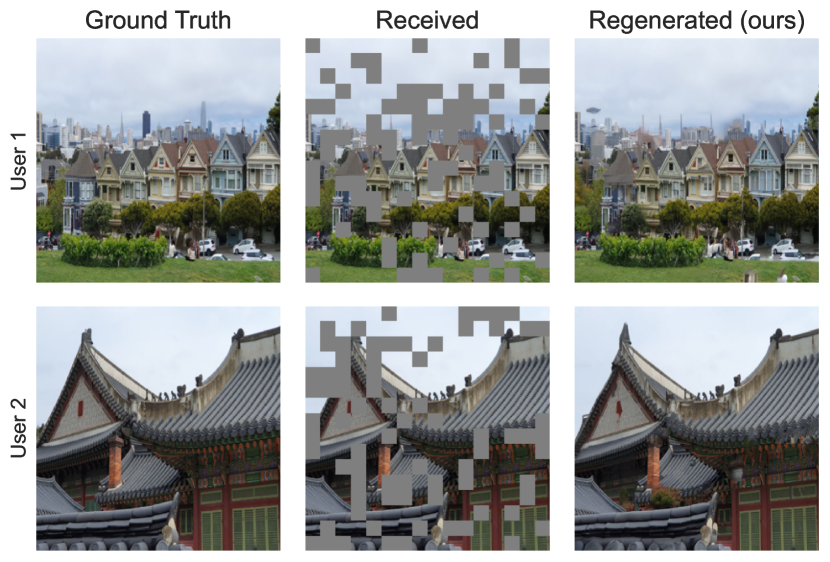
This paper proposes a novel generative semantic communication framework for multi-user scenarios using null-space diffusion models to reconstruct missing or corrupted data at the receiver. By transmitting only essential semantic bits and leveraging diffusion models to fill gaps and denoise, the system achieves high perceptual quality even at low subcarrier ratios (down to N/M = 0.1) and low SNR, outperforming traditional methods like DeepJSCC and LDPC.
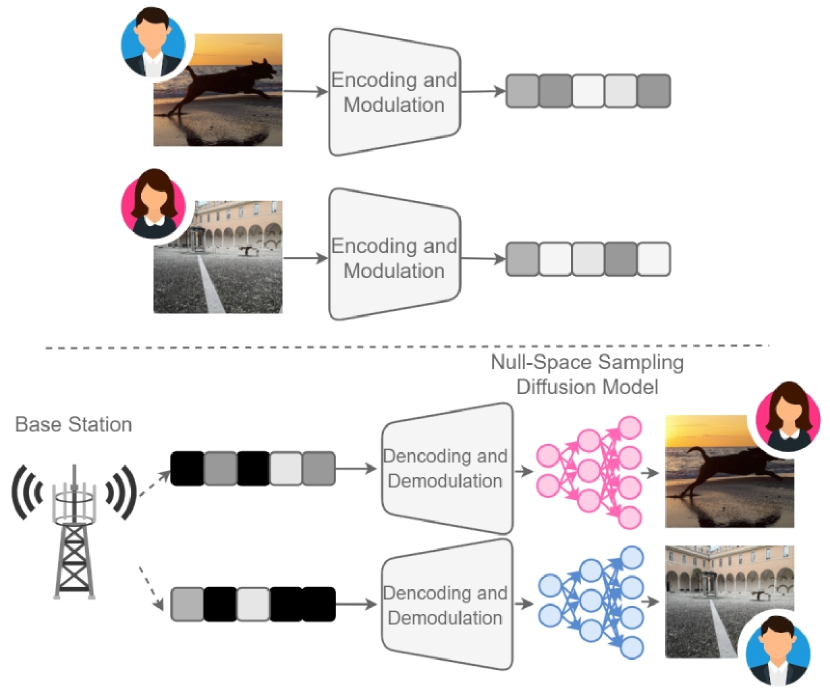
In recent years, novel communication strategies have emerged to face the challenges that the increased number of connected devices and the higher quality of transmitted information are posing. Among them, semantic communication obtained promising results especially when combined with state-of-the-art deep generative models, such as large language or diffusion models, able to regenerate content from extremely compressed semantic information. However, most of these approaches focus on single-user scenarios processing the received content at the receiver on top of conventional communication systems. In this paper, we propose to go beyond these methods by developing a novel generative semantic communication framework tailored for multi-user scenarios. This system assigns the channel to users knowing that the lost information can be filled in with a diffusion model at the receivers. Under this innovative perspective, OFDMA systems should not aim to transmit the largest part of information, but solely the bits necessary to the generative model to semantically regenerate the missing ones. The thorough experimental evaluation shows the capabilities of the novel diffusion model and the effectiveness of the proposed framework, leading towards a GenAI-based next generation of communications.
Motivation & Objective
- To address the challenge of efficient multi-user communication under spectral congestion by shifting focus from maximizing data transmission to minimizing essential semantic bits.
- To enable robust signal reconstruction in multi-user scenarios where subcarriers are limited and channel noise is high.
- To integrate deep generative models—specifically diffusion models—into the semantic communication pipeline to regenerate content from minimal transmitted information.
- To formalize the multi-user communication problem as an inverse problem solvable via null-space decomposition in diffusion model sampling.
- To demonstrate the effectiveness of the proposed framework across extreme conditions, including low SNR and low N/M ratios.
Proposed method
- The framework formulates multi-user semantic communication as an inverse problem, where the receiver reconstructs the full signal from partial, noisy, or missing data.
- A null-space diffusion model is designed to sample from the null space of the channel matrix, enabling the model to generate missing or corrupted signal components.
- The diffusion sampling process is adapted using null-space decomposition to align with the communication constraints, ensuring that only necessary bits are transmitted.
- The method leverages pre-trained diffusion models capable of generating high-fidelity images and audio from compressed semantic representations.
- The system is evaluated under OFDMA-like resource allocation, where only a subset of subcarriers (N < M) are used, and the receiver fills in the gaps via generative modeling.
- The approach is validated using CelebA-HQ images under varying N/M ratios (0.1 to 0.7) and SNR levels (−10 to 10), with metrics including SSIM, PSNR, FID, and LPIPS.
Experimental results
Research questions
- RQ1Can a diffusion model effectively reconstruct missing or corrupted signal components in a multi-user communication system with limited subcarrier allocation?
- RQ2How well does the proposed null-space sampling strategy perform under extreme channel conditions, such as low SNR and low N/M ratios?
- RQ3To what extent can the generative model maintain perceptual quality when only a small fraction of the original signal is transmitted?
- RQ4How does the proposed framework compare to conventional semantic communication methods like DeepJSCC and LDPC in terms of robustness and performance under noise and bandwidth constraints?
- RQ5Can the generative model simultaneously denoise and inpaint signal gaps in a single, unified framework?
Key findings
- The proposed method achieves an SSIM of 0.8 at an N/M ratio of 0.4 (102 out of 256 subcarriers), indicating high-quality reconstruction even with significant data loss.
- At an N/M ratio of 0.2 (51 subcarriers), the method maintains an SSIM of 0.66 with recognizable and visually plausible image regeneration.
- Performance degrades significantly only at the extreme N/M ratio of 0.1 (26 subcarriers), demonstrating robustness across a wide range of subcarrier limitations.
- The method consistently outperforms baseline approaches (DeepJSCC, LDPC) across all SNR levels, including −10 dB, where other methods fail to recover meaningful content.
- The null-space diffusion model effectively denoises corrupted signals, preserving perceptual quality even under high AWGN noise, as confirmed by visual and quantitative results.
- The framework demonstrates strong resilience to both missing data and channel noise, achieving superior results in SSIM, PSNR, FID, and LPIPS across all tested scenarios.
Read this paper
Open the full text in the Nubint reader and ask about any passage as you read.
Read this paper on NubintThis review was generated by AI from the original paper. Please check the paper before citing it.