
[Paper Review] Rethinking Semi-Supervised Medical Image Segmentation: A Variance-Reduction Perspective
ARCO introduces variance-reduction based stratified group sampling for semi-supervised medical image segmentation, improving robustness and label efficiency across multiple datasets by reducing gradient estimation variance.
For medical image segmentation, contrastive learning is the dominant practice to improve the quality of visual representations by contrasting semantically similar and dissimilar pairs of samples. This is enabled by the observation that without accessing ground truth labels, negative examples with truly dissimilar anatomical features, if sampled, can significantly improve the performance. In reality, however, these samples may come from similar anatomical regions and the models may struggle to distinguish the minority tail-class samples, making the tail classes more prone to misclassification, both of which typically lead to model collapse. In this paper, we propose ARCO, a semi-supervised contrastive learning (CL) framework with stratified group theory for medical image segmentation. In particular, we first propose building ARCO through the concept of variance-reduced estimation and show that certain variance-reduction techniques are particularly beneficial in pixel/voxel-level segmentation tasks with extremely limited labels. Furthermore, we theoretically prove these sampling techniques are universal in variance reduction. Finally, we experimentally validate our approaches on eight benchmarks, <i>i.e</i>., five 2D/3D medical and three semantic segmentation datasets, with different label settings, and our methods consistently outperform state-of-the-art semi-supervised methods. Additionally, we augment the CL frameworks with these sampling techniques and demonstrate significant gains over previous methods. We believe our work is an important step towards semi-supervised medical image segmentation by quantifying the limitation of current self-supervision objectives for accomplishing such challenging safety-critical tasks.
Motivation & Objective
- Motivate robustness and label efficiency in semi-supervised medical image segmentation with extremely limited labels.
- Develop a variance-reduction sampling framework to guide pixel/voxel selection for contrastive learning.
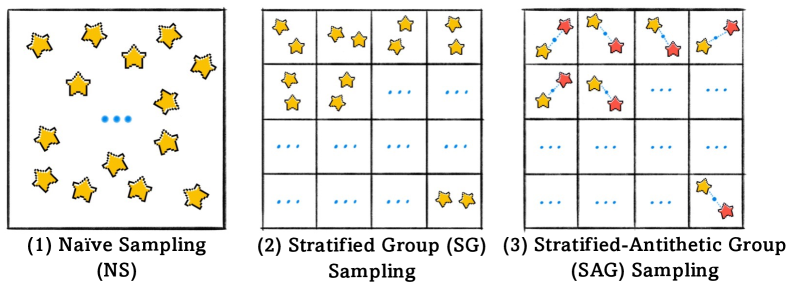
- Propose Stratified Group (SG) and Stratified-Antithetic Group (SAG) sampling to improve gradient variance and convergence.
- Demonstrate cross-dataset and cross-architecture robustness and competitive performance on 2D/3D medical and semantic segmentation benchmarks.
Proposed method
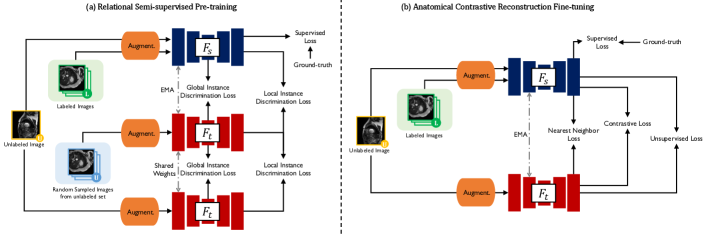
- Formulate ARCO as a semi-supervised contrastive learning framework built on variance-reduced estimation.
- Introduce Stratified Group (SG) sampling by partitioning images into class-based grids and sampling within each grid.
- Extend SG with Stratified-Antithetic Group (SAG) to further reduce variance via symmetry constraints.
- Provide theoretical guarantees: unbiasedness and variance reduction (SG/SAG) compared to naive sampling.
- Integrate ARCO with MONA-like relational pre-training and anatomical contrastive fine-tuning to learn robust, tail-aware representations.
Experimental results
Research questions
- RQ1Can variance-reduction sampling improve robustness and convergence in semi-supervised medical image segmentation under extreme label scarcity?
- RQ2Do SG and SAG provide unbiased, lower-variance gradient estimates for pixel/voxel-level contrastive learning?
- RQ3How does ARCO perform across diverse 2D/3D medical and semantic segmentation benchmarks with varying label ratios?
- RQ4Does embedding ARCO into existing SSL frameworks yield consistent gains in segmentation accuracy and boundary delineation?
Key findings
- ARCO methods achieve superior segmentation performance across eight benchmarks and multiple label ratios, outperforming state-of-the-art SSL methods.
- ARCO-SG and ARCO-SAG show notable Dice score gains over MONA in 1%, 5%, and 10% label settings (e.g., improvements around 0.3%–4.1% relative Dice in reported cases).
- Theoretically, SG is unbiased and has variance no larger than Naive Sampling, with SAG's variance within a factor of 2 of SG, demonstrating universal variance reduction benefits.
- Empirical results demonstrate faster convergence and more stable learning due to reduced gradient variance, and improved boundary accuracy in anatomical structures.
- A key claimed result is up to 11.08% absolute improvement in Dice on segmentation robustness benchmarks.
Read this paper
Open the full text in the Nubint reader and ask about any passage as you read.
Read this paper on NubintThis review was generated by AI from the original paper. Please check the paper before citing it.