
[Paper Review] Rethinking the Heatmap Regression for Bottom-up Human Pose Estimation
This paper proposes Scale-Adaptive Heatmap Regression (SAHR) and Weight-Adaptive Heatmap Regression (WAHR) to improve bottom-up human pose estimation by dynamically adjusting Gaussian kernel standard deviations for keypoint supervision based on scale and uncertainty. SAHR learns per-keypoint standard deviations via a scale map head, while WAHR mitigates foreground-background class imbalance by reweighting loss. The method achieves 72.0 AP on COCO test-dev2017, outperforming state-of-the-art by +1.5 AP.
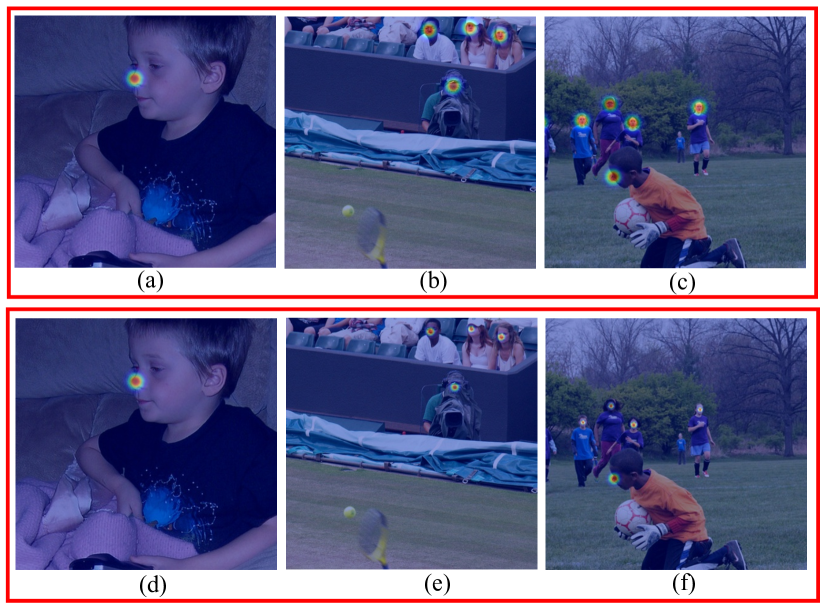
Heatmap regression has become the most prevalent choice for nowadays human pose estimation methods. The ground-truth heatmaps are usually constructed via covering all skeletal keypoints by 2D gaussian kernels. The standard deviations of these kernels are fixed. However, for bottom-up methods, which need to handle a large variance of human scales and labeling ambiguities, the current practice seems unreasonable. To better cope with these problems, we propose the scale-adaptive heatmap regression (SAHR) method, which can adaptively adjust the standard deviation for each keypoint. In this way, SAHR is more tolerant of various human scales and labeling ambiguities. However, SAHR may aggravate the imbalance between fore-background samples, which potentially hurts the improvement of SAHR. Thus, we further introduce the weight-adaptive heatmap regression (WAHR) to help balance the fore-background samples. Extensive experiments show that SAHR together with WAHR largely improves the accuracy of bottom-up human pose estimation. As a result, we finally outperform the state-of-the-art model by +1.5AP and achieve 72.0AP on COCO test-dev2017, which is com-arable with the performances of most top-down methods. Source codes are available at https://github.com/greatlog/SWAHR-HumanPose.
Motivation & Objective
- To address the limitations of fixed-standard-deviation heatmap regression in bottom-up human pose estimation, especially regarding scale variance and labeling ambiguities.
- To propose a method that adaptively adjusts Gaussian kernel standard deviations per keypoint based on human scale and uncertainty, improving robustness.
- To mitigate foreground-background sample imbalance introduced by adaptive regression, which can hinder model convergence and performance.
- To achieve state-of-the-art performance in bottom-up pose estimation without relying on human detection or multi-scale testing.
Proposed method
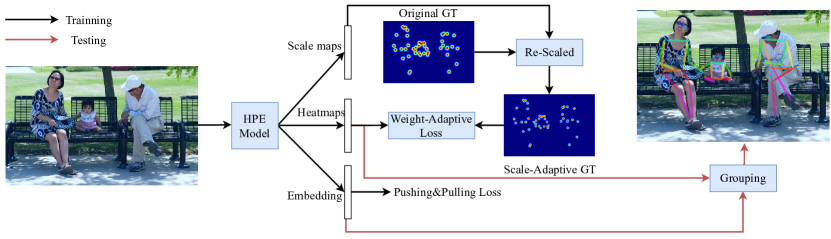
- Introduces a scale map head that predicts per-keypoint standard deviation multipliers, allowing adaptive adjustment of Gaussian kernel spread in heatmap supervision.
- Modifies ground-truth heatmap construction by scaling base standard deviation σ₀ with predicted scale maps s, resulting in σ = σ₀ · s for each keypoint.
- Applies a learnable, spatially varying standard deviation per keypoint, enabling better modeling of semantic discriminative regions and labeling uncertainty.
- Introduces a weight-adaptive loss mechanism inspired by focal loss, which down-weights easy (background) samples and focuses training on hard (foreground) samples.
- Combines SAHR and WAHR into a unified training objective, improving generalization and accuracy in multi-person, scale-varied scenarios.
- Employs a standard backbone (e.g., HrHRNet-W48) with added scale map and weight map heads, trained end-to-end with L2 loss on adapted heatmaps.
Experimental results
Research questions
- RQ1Can adaptive standard deviation in heatmap regression improve performance on bottom-up human pose estimation under large scale variations?
- RQ2How does modeling keypoint uncertainty through variable Gaussian kernel spread affect localization accuracy and robustness?
- RQ3Does the introduction of adaptive standard deviation exacerbate foreground-background class imbalance in heatmap supervision?
- RQ4Can a learnable, adaptive weighting scheme mitigate the imbalance issue and further improve model performance?
- RQ5To what extent can SAHR and WAHR together achieve state-of-the-art performance in bottom-up pose estimation, especially in crowded scenes?
Key findings
- The proposed SAHR method achieves a +1.5 AP improvement over the baseline HrHRNet-W48 on COCO test-dev2017, reaching 72.0 AP.
- On the more challenging CrowdPose dataset, the method achieves 71.6 AP without multi-scale testing and 73.8 AP with multi-scale testing, outperforming top-down methods in crowded scenes.
- The ablation study confirms that adaptive standard deviation significantly improves performance on large-scale persons, with AP increasing from 66.6 to 75.1 on large instances.
- The weight-adaptive loss (WAHR) effectively reduces the impact of easy background samples, improving performance on hard samples, especially in crowded scenarios.
- The method demonstrates superior generalization in crowded scenes, where top-down methods fail due to occlusion and detection errors, while bottom-up methods like HrHRNet-W48 + SWAHR achieve state-of-the-art results.
Read this paper
Open the full text in the Nubint reader and ask about any passage as you read.
Read this paper on NubintThis review was generated by AI from the original paper. Please check the paper before citing it.