
[Paper Review] Retrieving Multimodal Information for Augmented Generation: A Survey
This survey proposes a unified framework for retrieval-augmented generation (RAG) using multimodal knowledge—such as images, code, structured data, audio, and video—to enhance factuality, reasoning, and interpretability in large language models (LLMs). It systematically reviews 146 papers across modalities, categorizing methods by application and modality, and identifies key challenges and future research directions in multimodal RAG.
As Large Language Models (LLMs) become popular, there emerged an important trend of using multimodality to augment the LLMs' generation ability, which enables LLMs to better interact with the world. However, there lacks a unified perception of at which stage and how to incorporate different modalities. In this survey, we review methods that assist and augment generative models by retrieving multimodal knowledge, whose formats range from images, codes, tables, graphs, to audio. Such methods offer a promising solution to important concerns such as factuality, reasoning, interpretability, and robustness. By providing an in-depth review, this survey is expected to provide scholars with a deeper understanding of the methods' applications and encourage them to adapt existing techniques to the fast-growing field of LLMs.
Motivation & Objective
- To establish multimodal retrieval-augmented generation (RAG) as a distinct and growing research area in LLMs.
- To address the lack of a unified understanding of how and when to incorporate diverse modalities into generative models.
- To improve LLMs' factuality, reasoning, interpretability, and robustness by retrieving external multimodal knowledge.
- To provide a comprehensive, modality-specific review of existing techniques and their applications.
- To identify open challenges and guide future research in multimodal RAG.
Proposed method
- Systematically surveyed 146 papers from ACL Anthology and Google Scholar using keyword-based filtering with modality-specific terms.
- Grouped methods by modality (image, code, structured knowledge, audio, video) and further categorized by application within each modality.
- Conducted manual filtering of search results to ensure relevance to multimodal RAG, focusing on retrieval and generation integration.
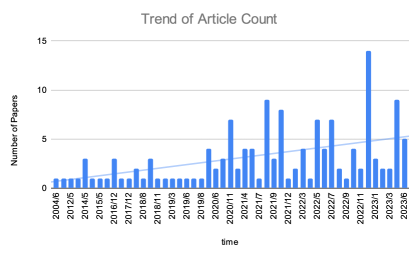
- Analyzed trends in publication growth, showing a sharp rise in multimodal RAG papers from late 2022 onward.
- Contextualized methodological connections and shared challenges across different modalities to highlight cross-cutting insights.
- Provided a structured analysis of techniques, including retrieval mechanisms, grounding strategies, and generation refinement.
Experimental results
Research questions
- RQ1How can multimodal knowledge retrieval enhance the factual consistency and reasoning ability of large language models?
- RQ2What are the key methodological differences and shared challenges across retrieval-augmented generation in different modalities (e.g., image, code, audio)?
- RQ3How has the adoption of multimodal RAG evolved over time, and what trends are emerging in this field?
- RQ4What are the most effective retrieval and generation strategies for integrating non-textual modalities into LLMs?
- RQ5What future research directions can address current limitations in multimodal RAG, such as robustness and interpretability?
Key findings
- The field of multimodal retrieval-augmented generation has grown rapidly, with a notable surge in publications from late 2022, aligning with the rise of general-purpose LLMs.
- Retrieval of non-textual modalities—such as images, code, and structured knowledge—significantly improves factual grounding and reasoning in LLMs.
- Methods that retrieve and ground knowledge from diverse formats (e.g., tables, graphs, audio) show measurable improvements in interpretability and robustness.
- A unified framework for multimodal RAG is needed to standardize retrieval strategies and integration patterns across modalities.
- Future work should focus on scalable, cross-modal retrieval mechanisms and better alignment between retrieved content and generation tasks.
- The survey identifies a clear research gap in methodological unification and cross-modality transferability, urging more systematic benchmarking and evaluation.
Read this paper
Open the full text in the Nubint reader and ask about any passage as you read.
Read this paper on NubintThis review was generated by AI from the original paper. Please check the paper before citing it.